

























































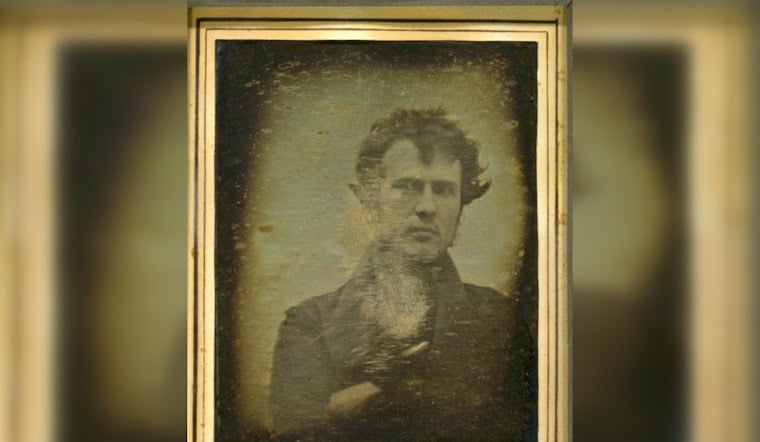
Long before front-facing cameras and Instagram filters, a 30-year-old Philadelphian stepped into his family's lamp shop yard and made history. Robert Cornelius is believed to have captured the first self-portrait photograph in America in 1839, and on Saturday the city honored that moment with a selfie party at Franklin Square, complete with giveaways, photo lessons, storytelling and a chance to snap a picture with the Phillie Phanatic.
The Philadelphia Historic District 250th Committee organized the celebration, which centered on the history of Cornelius's original self-portrait, according to 6abc Philadelphia. Cornelius made his image in the yard behind his family's lamp shop at 710 Chestnut Street using a makeshift camera fashioned from a tin box and an opera glass lens, according to historical context reported by the Northeast Times. He made the attempt just months after Louis Daguerre had publicly announced his photographic process in Paris in August 1839.
Cornelius later handwrote a note on the back of the physical daguerreotype mount that read, “The first light Picture ever taken. 1839,” per the Public Domain Review. That original image is now preserved in the collections of the Library of Congress.
The Chemistry That Made It Possible
Getting a still human face onto a plate in 1839 was no small feat. Daguerre's original process relied only on iodine vapor, which meant subjects had to hold motionless in bright sunlight for more than ten minutes, according to Snopes. Cornelius partnered with University of Pennsylvania chemist Paul Beck Goddard, who introduced bromine vapor to sensitize silver plates, cutting sitting times down to under a minute.
Cornelius reportedly got the idea for his experiment after helping U.S. Mint employee Joseph Saxton, who had sought him out for his expertise in silver-plating copper sheets, according to local context from Billy Penn. Saxton went on to produce an 1839 image of Central High School that is recognized as the oldest surviving photograph taken in America, underscoring Philadelphia's early role at the center of the emerging medium.
Riding that momentum, Cornelius opened Philadelphia's first commercial portrait studio, and the second in the United States, on Lodge Alley in May 1840, according to Hidden City Philadelphia. He ran it until 1842, later renamed Ranstead Street, before stepping away from photography to return to the family lighting business full time.
An Industrialist Who Left Photography Behind
Cornelius's time behind the camera turned out to be brief. He went on to become an industrialist, patenting the “solar lamp” in 1843, a design that let lamps burn cheaper lard instead of costly whale oil, according to background compiled on Wikipedia. His lamp business expanded rapidly and eventually took precedence over the photo studio he had helped pioneer.
Today only around 54 known daguerreotypes produced by Cornelius are known to survive, making them rare artifacts that photo conservators continue working to identify and preserve, per Hidden City Philadelphia. The scarcity has only heightened interest in the handful of images that remain from his short-lived studio career.
A #1 Sculpture Bridges Two Eras of Selfies
The Franklin Square celebration featured a “#1” milestone sculpture created by Mural Arts Philadelphia artist Alana Bograd that placed Cornelius's 1839 portrait alongside modern smartphone selfies, according to the Northeast Times. The piece was commissioned specifically to bridge 19th-century photographic technology with today's selfie culture.
Saturday's selfie party was part of “52 Weeks of Firsts,” a weekly “Firstival” series organized by the Philadelphia Historic District 250th Committee to spotlight local innovations ahead of America's 250th anniversary in 2026, according to Historic Philadelphia, Inc. The weekly Saturday events have highlighted other Philly-born milestones, including the Slinky and the city's early public institutions.
Interest in Cornelius's image has surged well beyond historians in recent years. Global recognition of the 1839 self-portrait grew significantly after Oxford Dictionaries named “selfie” its Word of the Year in 2013, according to the Public Domain Review, which noted Oxford's definition of a selfie as a self-taken photograph typically shared on social media. That modern spotlight helped turn a 19th-century chemistry experiment into a recognizable ancestor of a habit now practiced by billions of smartphone users, and gave Franklin Square's Saturday crowd, giveaways, photo lessons and Phillie Phanatic selfie station included, plenty of reason to celebrate.





