

























































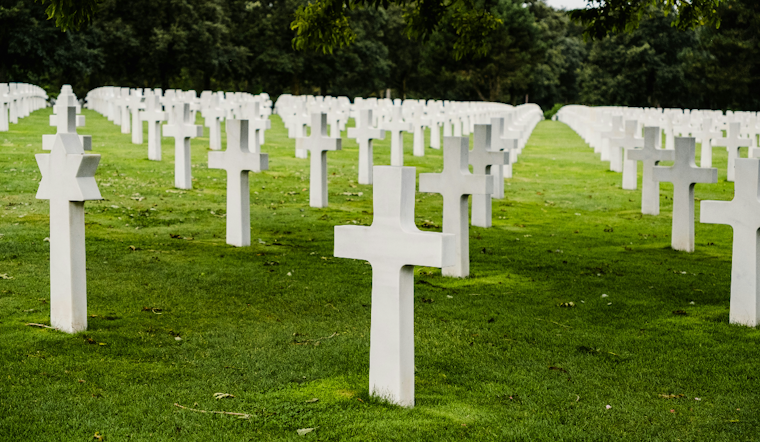
David and Wendy Hefter of Pikesville spent two days in France this summer saying Kaddish for 18 German Jewish soldiers who died fighting for Germany in World War I, only to discover that one of them was David's own long-lost great-uncle. The soldier, Isidor Katzenstein, had been buried under a Latin cross for more than a century before his headstone was replaced with a Star of David on July 3, 2026, at the Saint-Quentin German Military Cemetery.
The Hefters' journey to France came through Operation Benjamin, a nonprofit that identifies Jewish soldiers buried under Latin crosses and replaces their headstones with Stars of David, as reported by the Baltimore Jewish Times. David Hefter called the mission “108 years in the making,” according to the outlet's report. Operation Benjamin, founded in 2014, has historically focused on American Jewish soldiers killed in World War I and World War II, unveiling its first corrected headstone in 2018 for Private Benjamin Garadetsky at the Normandy American Cemetery and Memorial, where he too had been buried beneath a Latin cross.
An Unexpected Family Discovery
Isidor Katzenstein was born on December 10, 1899, in Wehrda, Germany, the son of Jakob Katzenstein and Betti Wallach. He served as a musketeer and died on October 24, 1918, in a French hospital at just 18 years old, weeks before the war's end. David Hefter has five first cousins and 10 first cousins once removed, and per the Baltimore Jewish Times, he said family has been very important to his family for generations — a sentiment that made learning of Katzenstein's existence, and his fate, especially resonant.
The broader Katzenstein family story reflects the era's devastation. Julius Katzenstein, born November 5, 1895, in Wehrda, married Bertha Stern in the same town before the couple emigrated to the United States in 1938, fleeing Nazi Germany just before the worst of the Holocaust. Others in the family were not so fortunate: Meta Katzenstein was murdered in Auschwitz, and Sara Katzenstein died during the Holocaust as well, though her son later relocated to Israel. Regina Katzenstein, another relative, died in Queens, New York, in 1997, according to the Baltimore Jewish Times account.
Operation Levi and the Search for Missing Stars of David
The Saint-Quentin ceremony was made possible through Operation Levi, a joint initiative created to identify German Jewish soldiers killed in World War I and replace their headstones with Stars of David. Shalom Lamm, co-founder and chief historian of Operation Benjamin, said the number of misidentified German Jewish soldiers stood at roughly 1,300, and when asked whether there were fewer Stars of David marking Jewish graves than there should be, Lamm said the answer was yes. The initiative grew out of a broader collaboration between Operation Benjamin and the German War Graves Commission, known as the Volksbund, which researchers say compiled an initial list of more than 1,300 German Jewish World War I soldiers mistakenly buried beneath Latin crosses, according to JNS.org.
Operation Levi's first headstone replacement ceremony took place on May 21, 2025, in Warmeriville, France, honoring Landsturmmann Meier Levi, a German Jewish soldier who died in 1917 at age 25 and had been buried under a cross. Dirk Backen, secretary general of the Volksbund, participated in that inaugural ceremony on behalf of the German government, according to a speech posted by the Volksbund Deutsche Kriegsgräberfürsorge. The Volksbund is a humanitarian organization commissioned by the German federal government that maintains nearly 840 war cemeteries across 45 countries containing approximately 2.8 million war casualties.
Two Days of Ceremony in Saint-Quentin
The Hefters' trip unfolded over two days of unveilings, the first occurring on July 2, 2026, with Isidor Katzenstein's ceremony following the next day. German soldiers participated in the commemoration alongside Operation Benjamin representatives, and David, Wendy, and their son Jesse Hefter all spoke during Katzenstein's ceremony. Wendy Hefter said each of the 18 unveilings for the German Jewish soldiers was meaningful, per the Baltimore Jewish Times report.
Approximately 100,000 German Jewish soldiers served in the Imperial German Army during World War I, and roughly 12,000 were killed in action, according to the Volksbund. Despite that scale of sacrifice, surviving Jewish veterans and their families faced persecution and murder during the Holocaust barely two decades later — a history that gives the headstone corrections in Saint-Quentin their particular weight.
A Rigorous Process Behind Each Headstone
Changing a military headstone is not simple. To approve such a change at overseas American military cemeteries, the American Battle Monuments Commission enforces a strict evidentiary standard requiring primary genealogical documentation, such as Census records, bar mitzvah photos, or Yiddish documents, along with formal consent from a soldier's closest living relatives, according to the Washington Examiner. Operation Benjamin has said it works with professional genealogists for months before contacting families, in part to avoid raising false hope.
That careful process has already yielded more than 1,000 identified U.S. soldiers buried under Latin crosses, per Lamm. Just weeks before the Saint-Quentin ceremonies, Operation Benjamin and Operation Levi partnered with the American Battle Monuments Commission and the Volksbund for a four-day joint mission in Verdun, France, in June 2026, rededicating the graves of 17 Jewish soldiers across the Meuse-Argonne American Cemetery and the Consenvoye German Military Cemetery, according to Yeshiva University. That delegation included U.S. Ambassador to France Charles Kushner and military cadets from both nations.
For the Hefters, who live in a Pikesville community that is part of a Baltimore-area Jewish population of roughly 95,400 residents across 46,700 households, per a 2020 study from Brandeis University, the trip to France closed a gap in family history that had stood since 1918. David Hefter's description of the mission as “108 years in the making” speaks not only to the century since Katzenstein's death, but to the long, painstaking work of research, documentation, and international cooperation that finally allowed his family to mark that history correctly.




