

























































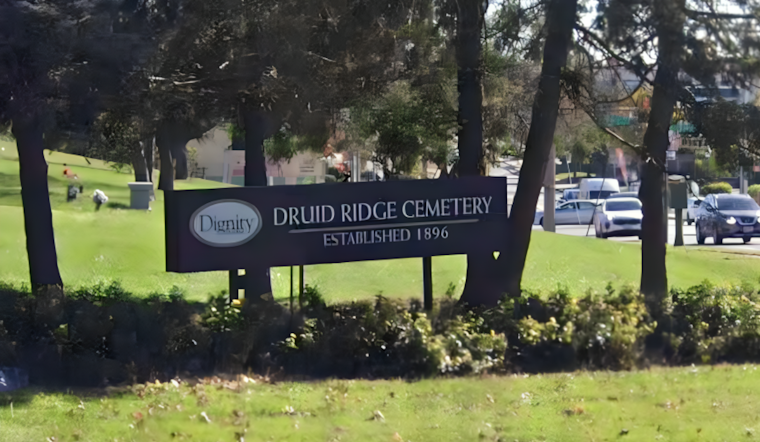
The empty granite pedestal still sits at Druid Ridge Cemetery in Pikesville, a faint outline in the stone marking where a bronze statue known as Black Aggie once loomed over the grave of General Felix Agnus for nearly 40 years. Now a coalition of local groups wants to bring her back.
The Pikesville Improvement Corporation, along with historical groups in the area, is in the initial stages of working to return Black Aggie and her history to Pikesville, according to WBAL-TV. The statue currently sits in a private federal office building and is cared for by the U.S. General Services Administration, per the same report. Community leaders have also begun exploring avenues to persuade federal officials to return the piece, as reported by The Baltimore Banner.
Black Aggie is a freehand copy of Augustus Saint-Gaudens' famous 1891 Adams Memorial, created by sculptor Edward Ludwig Albert Pausch between 1906 and 1907, according to background compiled by Wikipedia. The original memorial, installed at Washington's Rock Creek Cemetery, was commissioned by author Henry Adams following the 1885 death of his wife, Marian “Clover” Adams, who instructed Saint-Gaudens to evoke Buddhist concepts of nirvana and release from suffering, the Washington Post reported in August 2012.
A Statue Born From a Supplier's Deception
Civil War veteran and newspaper publisher General Felix Agnus commissioned the Pikesville statue after a Connecticut granite supplier misled him into believing he was purchasing an authorized casting made directly from Saint-Gaudens' original molds, per Wikipedia. Agnus, a brevet brigadier general in the Union Army before he went on to publish the Baltimore American, ultimately placed the statue over his family plot at Druid Ridge Cemetery in Pikesville.
The deception did not go unnoticed. Saint-Gaudens' widow sued the granite supplier for copyright infringement, and prominent sculptors publicly condemned Pausch's unauthorized copy, inflicting lasting damage on his professional reputation, according to Wikipedia. Saint-Gaudens himself had never registered a copyright on the original work, having viewed it as a private, sentimental tribute rather than a commercial piece.
From Local Legend to Federal Custody
By the mid-1900s, stories about Black Aggie had spread throughout Pikesville, according to WBAL-TV. Local legends claimed that people who slept in the statue's lap would be visited by the ghosts of those buried around her, that she came to life at night, that grass would not grow in her shadow, and that the spirits of everyone buried in the cemetery would gather at her feet once a year.
The folklore drew persistent trespassing, midnight dares, and fraternity hazing rituals to the cemetery for decades, and the vandalism eventually became untenable. Disturbed by the ongoing disturbances, the Agnus family removed Black Aggie from Druid Ridge Cemetery and donated her to the Smithsonian Institution in 1967, per Wikipedia. The statue then sat in storage there for roughly two decades.
A Courtyard Behind Lafayette Square
The Smithsonian transferred the statue to the General Services Administration in 1987, and federal officials that year initially considered placing it in the garden courtyard of Blair House on Lafayette Square, according to a historical account shared on Facebook. The Blair House Garden Committee rejected that proposal due to space constraints, so the statue was instead placed in a courtyard behind the Dolley Madison House and the National Courts Building near Lafayette Square, the Washington Post reported. That landscaped courtyard remains inaccessible to the general public outside business hours.
Despite the statue's absence from Pikesville for nearly six decades, representatives for Druid Ridge Cemetery have said in interviews that they still receive weekly phone calls and visits from people searching for Black Aggie, according to American Hauntings. The original pedestal remains at the cemetery, still bearing a bronze relief portrait of General Agnus on its reverse side, per an account published by OTIS.
Any formal return would have to clear significant bureaucratic hurdles, since the statue remains federal property and was originally removed specifically because of the vandalism and safety concerns it attracted. For now, the Pikesville Improvement Corporation and its partners are still in the early stages of pursuing talks with the statue's federal custodians, according to WBAL-TV 11 News producer Reid Campbell, who authored the station's report.




