

























































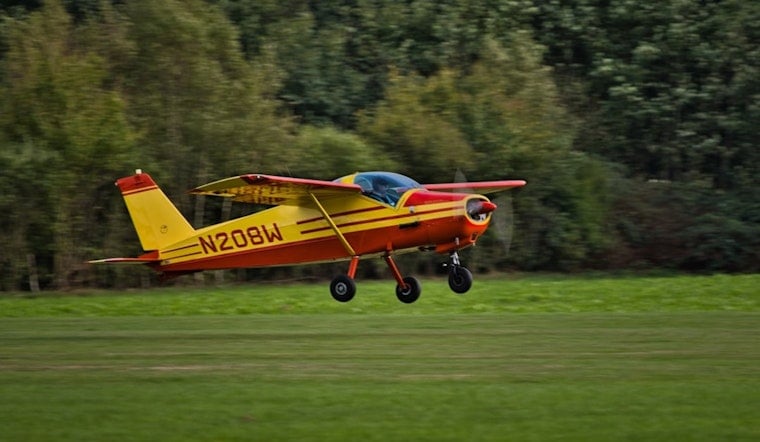
A small, fixed-wing, single-engine airplane crashed nose down in a field east of Big Bear Airport Thursday evening, leaving the pilot hospitalized. The pilot was the only person aboard, and was flown out by helicopter after the crash was first reported around 6:20 p.m. near the 100 block of Mountain View Boulevard.
The San Bernardino County Sheriff's Department dispatch center received numerous calls reporting the crash, according to the Victorville Daily Press. Deputies arriving at the scene found the aircraft crashed nose down in a field east of the airport, according to Jenny Smith, as reported by the Daily Press. The pilot's condition was unavailable as of the initial report, and no additional property beyond the aircraft was damaged.
Investigation Still in Early Stages
The crash remains under active investigation, per the same account. As is standard for general aviation accidents, federal regulations under 49 CFR Part 830 require that wreckage and flight documents be preserved by operators and first responders until the National Transportation Safety Board takes custody of the scene, according to the National Transportation Safety Board. Wreckage may be disturbed to remove persons injured or trapped, protect the wreckage from further damage, or protect the public from injury. The NTSB typically posts a preliminary factual report within 10 to 14 days of a general aviation crash, though full final cause determinations can take 12 to 24 months to complete.
It remains unknown whether Thursday's flight was attempting a takeoff or an approach when it went down, and the pilot's experience with mountain flying has not been disclosed. Whether mechanical failure or another factor contributed to the crash is also an open question at this stage of the investigation.
A High-Altitude Airport With a History of Close Calls
Big Bear City Airport sits at 6,752 feet above sea level in the San Bernardino Mountains, making it the highest-elevation public airport in Southern California, according to the Big Bear Airport District. The 117-acre airfield features a single asphalt runway, Runway 08/26, measuring 5,850 feet long and 75 feet wide, and handles roughly 30,000 aircraft operations a year, per the Federal Aviation Administration. Weather conditions on the day of the crash were not specified in the available reports. The FAA's Airport Improvement Program grant data is available.
That combination of high elevation and warm temperatures matters because thinner mountain air reduces engine performance and climb rates, a phenomenon aviation experts call density altitude. According to the Federal Aviation Administration, high density altitude reduces aircraft performance, increases runway-length requirements for takeoff and landing, and decreases rate of climb. Gleim Aviation has noted that an NTSB investigation into a fatal July 2017 takeoff crash at Big Bear Airport concluded the cause was an aerodynamic stall tied to high density altitude conditions. The standard air temperature used for calculations at Big Bear's elevation is just 36°F, meaning summer heat can dramatically elevate the effective altitude pilots must account for.
Field East of Airport Has Seen Fatal Crashes Before
The field east of Big Bear Airport has been the site of prior general aviation tragedy. On May 1, 2023, a single-engine Beechcraft A36 crashed at Big Bear Airport, killing all three people aboard, according to CBS Los Angeles. That flight had originated in French Valley with a stop in Corona before crashing near its intended destination in Big Bear.
Other incidents have unfolded closer to the runway itself. On May 9, 2024, a single-engine Cessna crashed upon takeoff at the northwest corner of the airport, though both occupants self-evacuated with only minor injuries, according to the Big Bear Fire Department. In June 2023, a Cessna 305C was involved in an accident at Big Bear Airport. The National Transportation Safety Board reported that a Cessna 305C, N62TX, was substantially damaged in an accident at Big Bear Airport on June 17, 2023. The National Transportation Safety Board has also reported an aircraft accident at Big Bear City Airport.
Safety Guidance for Mountain Flying
The Aircraft Owners and Pilots Association discusses calculating weight and balance generally. A Big Bear Airport District page citing Gary Buscombe says that a 200-pound reduction in gross weight can shorten takeoff roll by roughly 500 feet. Separate guidance recommends departing during cooler summer mornings, when denser air provides better climb performance, a precaution that carries added weight given the pattern of crashes at this same high-altitude airfield.





