

























































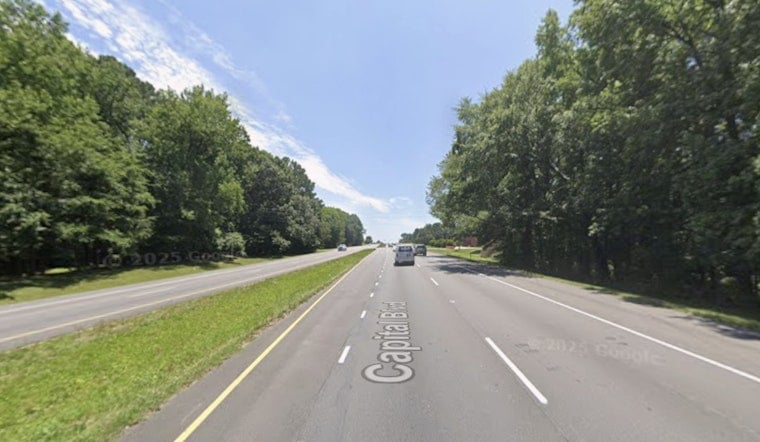
A 25-year-old woman died after being struck by a driver while walking near the shoulder of Capital Boulevard in Raleigh, and the man accused of hitting her and speeding off was later stopped and arrested by a Wake Forest police officer. Anas'jah Sharnae Leak was walking with another person at the time of the crash, and she died from her injuries.
According to ABC11 News, Raleigh police say the driver struck Leak and left the scene before officers identified a Dodge Challenger as the suspected hit-and-run vehicle. Wake Forest police pulled the car over on Dr. Calvin Jones Highway after noticing damage to the vehicle and an expired registration, and Raleigh officers responded to that traffic stop location to confirm the car matched the one they were searching for.
The driver, 35-year-old Tyron Jamaal Jackson, was arrested and charged with felony hit-and-run and misdemeanor death by motor vehicle. Under North Carolina General Statutes § 20-166(a), a driver involved in a crash resulting in serious injury or death who fails to stop and remain at the scene faces a Class F felony, carrying a potential sentence of 41 to 59 months in prison and mandatory license revocation, according to Browning & Long, PLLC. North Carolina law obligates drivers to stop and render aid regardless of who was at fault in a collision.
A Second Charge Tied to the Fatal Outcome
The misdemeanor death by motor vehicle charge Jackson also faces is North Carolina's highest misdemeanor classification, a Class A1 offense punishable by up to 150 days in jail and fines, per Garrett, Walker, Aycoth & Olson, Attorneys at Law. That charge applies to non-impaired traffic violations that proximately cause a fatal crash, meaning it is not necessarily an allegation that Jackson was under the influence. Whether prosecutors might pursue an upgraded felony death charge if alcohol or drug impairment is later determined remains an open question.
Dr. Calvin Jones Highway, also known as the NC 98 Bypass, is where the traffic stop unfolded in Wake Forest. The road intersects Capital Boulevard and carries between 20,000 and 30,000 vehicles per day, serving as a major east-west arterial connecting Wake Forest to the corridor where Leak was struck, according to Blip Billboards. The stop itself illustrates the kind of cross-jurisdiction cooperation between Wake Forest and Raleigh police that this case required.
Capital Boulevard's Long History as a Danger Zone
This was not an isolated tragedy along the corridor. Earlier the same day, Raleigh police separately responded to another fatal hit-and-run pedestrian crash along Capital Boulevard at Durant Road, where a different pedestrian died at the scene, Hoodline previously reported on a Durant Road death. The cluster of deadly incidents on the same date underscores how difficult it can be for law enforcement to apprehend fleeing drivers along this stretch of road.
Capital Boulevard has drawn scrutiny for years as one of the state's most hazardous corridors for people on foot or bike. City of Raleigh Vision Zero crash-risk rankings identify the intersection of Capital Boulevard and Calvary Drive as the number-one location in North Carolina for pedestrian and cyclist crash risk, according to Press Advantage. Traffic volume on Capital Boulevard between Interstate 440 and Interstate 540 reaches up to 65,000 vehicles per day, with city projections from the Capital North Corridor Plan estimating that figure will climb to 75,000 vehicles daily by 2040, per Axios.
Statewide Numbers and a Planned Freeway Overhaul
North Carolina recorded 864 bicycle crashes and 41 cyclist fatalities statewide in 2023, the highest cyclist death total in recent years and nearly double the 2022 count, with Wake County accounting for one of the largest county shares, Press Advantage reports. Wake County has also consistently ranked near the top of North Carolina's 100 counties in total annual traffic collisions, injuries, and fatal crashes, according to Carolina Law, as rapid population growth has pushed traffic volume beyond what many arterial roads were designed to handle.
In July, North Carolina transportation officials allocated funding in the State Transportation Improvement Plan for a $1.3 billion project known as U-5307, which would convert Capital Boulevard into a controlled-access freeway between I-540 and the Franklin County line, according to Wake Forest Economic Development. Construction on that multi-segment overhaul, meant to eliminate at-grade crossings, is not slated to begin until 2031. In the meantime, the City of Raleigh's Vision Zero initiative has set a goal of cutting fatal and serious-injury traffic crashes by 50% by 2040 through street redesigns, traffic calming, and crosswalk upgrades on high-risk corridors, and police periodically run targeted enforcement patrols along Capital Boulevard to curb speeding.





