

























































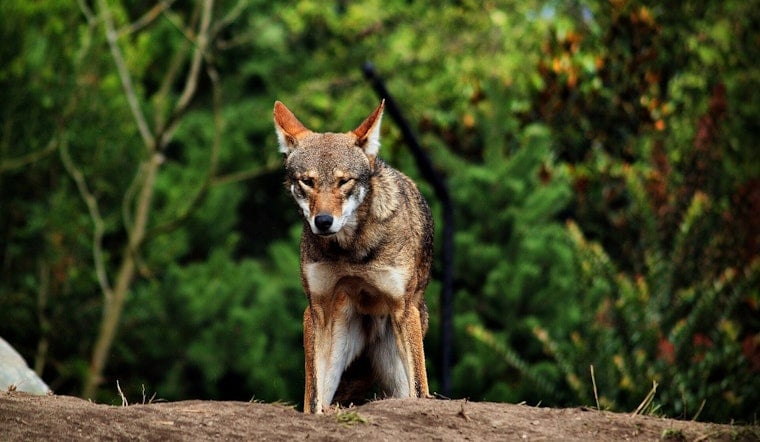
Three American red wolf pups born at the Saint Louis Zoo have been moved into the wild, placed into a den on North Carolina's Alligator River National Wildlife Refuge with a wild red wolf family that had just birthed a large litter of its own. Trail cameras later captured the zoo-born pups thriving alongside their new wild siblings, according to zoo officials.
The pups were flown to North Carolina in a cross-fostering operation described by FOX 2, which reported that the litter was the only one born in professional care eligible to support this year's effort. Saint Louis Zoo keeper Nicole Becker traveled to North Carolina along with the pups and zoo staffer Mossotti to help carry out the transfer, and Becker said the foster brought her joy. In exchange, some wild-born pups were fostered back to the Saint Louis Zoo's Sears Lehmann, Jr. Wildlife Reserve in Franklin County, Missouri.
According to the U.S. Fish and Wildlife Service, the 2026 exchange involved the Milltail pack, where wild parents identified as 2503F and 2191M produced a litter of six pups in early April. Biologists swapped three Saint Louis Zoo pups into that den while four wild-born pups were transferred back to Missouri, per the agency's account. Fish and Wildlife biologists monitored the den afterward to ensure the mother returned to care for all the pups.
Why the Timing Has to Be Nearly Perfect
Cross-fostering only works within a narrow biological window. Wildlife biologists must move captive-born pups that are under two weeks old into a wild den holding a similarly aged litter so the wild mother accepts and nurses them as her own, according to the Center for Biological Diversity. The Saint Louis Zoo's three pups underwent a comprehensive health exam in April before making the trip, and the pups reportedly began exploring outside the den once settled into their new wild home.
Saint Louis Zoo says fostering introduces critical genetic diversity into a wild population on the brink of extinction, and that genetic exchange between wild wolves and wolves in professional care is a rare and important opportunity for species recovery. Zoo officials add that genetic diversity helps populations stay healthy and resilient by increasing disease resistance, reducing inbreeding effects, and supporting long-term species growth. Emily Weller said the Saint Louis Zoo fostering partnership benefits red wolf recovery in the wild, while Becker said the groundbreaking conservation work supports red wolf care and protection for future generations.
A Species Still Clinging to Survival
American red wolves number less than 40 in the wild, according to the Saint Louis Zoo. The U.S. Fish and Wildlife Service puts the eastern North Carolina population at 22 to 23 adults and subadults plus 14 to 15 pups as of August, with another 295 red wolves held across the nationwide SAFE captive breeding network — a stark reminder of how thin the wild population remains after wild numbers dropped below 10 individuals in 2021. The entire species descends from just 14 founder wolves captured in the late 1970s, after red wolves were declared extinct in the wild in 1980 under the Endangered Species Act, according to the North Carolina Zoo.
The Albemarle Peninsula, a stretch of five rural counties in eastern North Carolina that includes the refuge, holds the world's only wild population of American red wolves, per Animalia. The species once ranged from Pennsylvania to Texas but has lost more than 99% of its historic range. The Saint Louis Zoo raises its own red wolves at the secluded 355-acre Sears Lehmann, Jr. Wildlife Reserve, which opened its 20-acre wolf habitat in 2022 and stays closed to the public specifically to keep the animals from becoming accustomed to humans.
Highways and Coyotes Remain the Bigger Threats
Even with new genetic reinforcements, wild red wolves face daily dangers that no foster program can solve alone. Vehicle strikes are the leading cause of death for wild red wolves, killing roughly 20% of the population in a single year between 2023 and 2024, according to the Sierra Club. U.S. Highway 64, a route heavily traveled by Outer Banks tourists, cuts directly through prime refuge habitat.
In response, the Federal Highway Administration awarded a $25 million grant to the North Carolina Department of Transportation to build 11 wildlife underpasses with funneled fencing along that highway inside the refuge, with private conservation groups raising more than $4 million in matching funds to help secure it, the Sierra Club reports. Biologists also run a coyote sterilization program in eastern North Carolina, keeping dozens of radio-collared, sterilized coyotes on the landscape as territorial placeholders to keep red wolves from interbreeding and producing hybrid litters, according to Reflection Riding.
Saint Louis Zoo partners with the SAFE American Red Wolf Program, and its Sears Lehmann, Jr. Wildlife Reserve marked its first breeding season in spring 2024, producing four pups named Otter, Molly, Finn, and Obi before expanding its capacity to support this year's wild cross-fostering exchange. Cross-fostering, the highway crossings, and the coyote sterilization effort together represent the layered strategy biologists are counting on to keep the species from vanishing from the wild a second time.





