

























































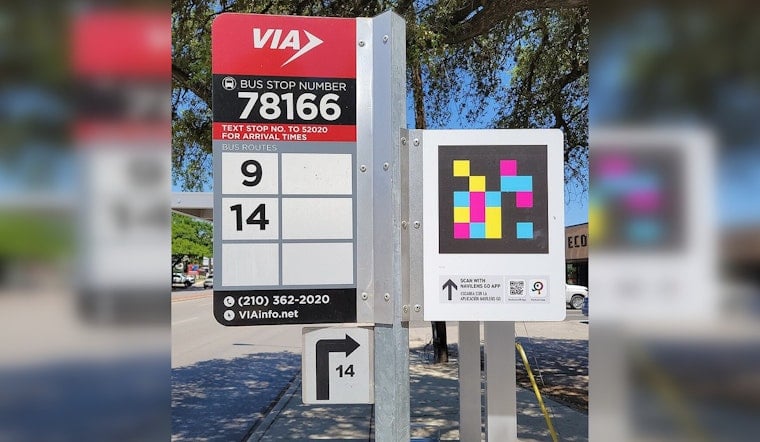
Standing at a San Antonio bus stop this summer has meant standing in direct sun more often than not. VIA Metropolitan Transit operates 6,100 active bus stops across the city, and less than 38 percent of them have any kind of shelter, leaving roughly 3,800 stops with no shade at all as the region has baked through more than a week and a half of triple-digit temperatures.
VIA's board of trustees still needs to approve the agency's proposed Fiscal Year 2027 budget, which includes funding for 150 new shelters, according to KSAT. VIA has identified 345 locations across its network that meet the criteria for a shelter, but the agency has not yet picked exactly which 150 will get one first. Razi Hosseini, VIA's vice president of engineering, said additional funding could allow the agency to build more shelters than currently planned.
VIA prioritizes shelter locations based on how much activity a stop sees, how many routes pass through it, and whether it sits near schools, medical facilities, community centers, or grocery stores, per the same KSAT report. But the agency's philosophy on rider comfort has historically leaned less on shelter construction and more on frequency. Hosseini said VIA aims to improve how often buses arrive rather than build shelters at every stop, reasoning that shorter waits mean less time exposed to the sun, and he acknowledged that every VIA bus stop will probably never become sheltered.
A City Program Fills In Where VIA Can't
The City of San Antonio is running its own parallel effort. Leslie Antunez, sustainability officer for the city's Department of Resilience and Sustainability, said officials want the five, 10, or 15 minutes riders typically spend waiting for a bus to feel more comfortable, addressing health concerns tied to heat exposure. The city has set aside $1 million for a pilot program aimed at developing shade options specifically for bus stops where space is too tight for a standard shelter.
That funding is expected to produce an additional 16 shelters in high-heat areas, though the city says it may end up building fewer or more depending on how prices shift. Antunez presented a map showing 13 city pilot-project locations already moving toward construction, with more sites under initial evaluation or held in reserve as backups. The city expects to break ground on those projects in September or October, with construction likely running nine months to a year.
The pilot's shelter design incorporates a roof and side panels with holes engineered to provide shade and rain protection while still allowing air to circulate. The project is focused on improving existing shelter design for both safety and comfort, according to the KSAT report.
Space Is the Real Obstacle
Even with money flowing toward the problem, physical space remains the biggest barrier. Of the 345 locations that meet VIA's shelter criteria, 151 lack the minimum nine feet of public right-of-way required to fit a standard shelter footprint. VIA may pursue easements from property owners to carve out enough room, and the agency said it may also work with the city's public works department to narrow streets in some spots without cutting into traffic flow. Hosseini said right-of-way restrictions are limiting shelter construction at some unsheltered stops regardless of funding.
Some locations already have natural relief: the city has identified a proposed shelter site on Guadalupe Street that is already shaded by a neighboring building's overhang. Others have none. A proposed site near Lanier High School and the San Antonio Natatorium currently has no sun protection at all, even as students and swimmers pass through it in the heat.
Where the Money Is Coming From
The push comes as new transit revenue is set to arrive. San Antonio voters approved rededicating a 1/8-cent local sales tax to VIA back in November 2020, and that funding stream, projected to generate roughly $40 million a year for frequency improvements and capital infrastructure, kicked in this past January, according to ITS International. VIA's trustees separately approved a $574.3 million total budget for the current fiscal year in September 2025, split between $339.1 million in operations and $235.2 million in capital projects, according to Metro Magazine. That capital spending isn't only going toward shelters — VIA also secured a $268 million federal grant this month toward its $446 million Rapid Green Line project along San Pedro Avenue.
This isn't VIA's first swing at expanding shelter coverage. Between 2014 and 2017, the agency ran a $12 million passenger amenities program that installed 1,000 modular shelters, pushing total sheltered stops from 1,200 to more than 2,200 and covering 95 percent of system boardings at the time, per historical reporting from MySA. Even so, the current tally shows most stops across the wider network remain unshaded, a gap that's grown more urgent as the city's heat seasons have stretched longer.
Heat Is Hitting Some Neighborhoods Harder
San Antonio has documented roughly 2,400 cases of heat-related illness between 2022 and April 2026, according to Deceleration News. A University of Texas at San Antonio heat vulnerability study found that Council Districts 2, 3, and 5 on the West, East, and South sides are the city's hottest, a pattern researchers tied to lower income levels, heavy asphalt coverage, and thin tree canopy, as reported by Texas Public Radio. The city has identified via-network stops lacking shelter within these harder-hit neighborhoods as part of its Heat Resilience Playbook, a broader climate-adaptation document outlining 52 heat-mitigation actions that includes an ongoing study of bus stop shade.
The city has also tried other approaches to cooling its hottest corridors, including a $1 million project that applied solar-reflective cool pavement coatings across 800,000 square feet of roads in all 10 council districts, intended to lower surface asphalt temperatures by as much as 16 to 20 degrees. In South San Antonio, the city launched a separate $96,000 community-led pilot this year to test neighborhood cooling ideas, including community-designed 'Art as Shade' structures expected by early 2027. Whether any of these efforts can outpace the underlying space and funding constraints remains an open question for both city and transit officials as they head into the next round of budget decisions.





