

























































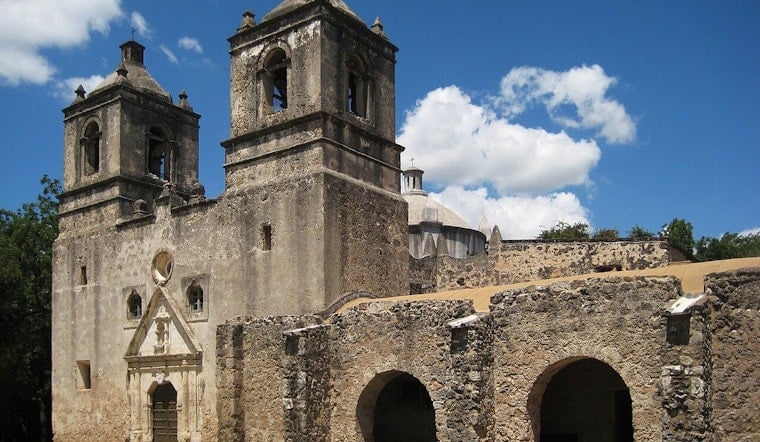
Hundreds of people packed into Mission Concepción in San Antonio Saturday evening, filling the 271-year-old stone church to capacity to watch sunlight pour through two separate windows at the exact same moment, illuminating both the altar's image of the Virgin Mary and the center of the sanctuary floor below the dome. The rare double solar illumination happens just once a year, every August 15, timed to the Feast of the Assumption on the Catholic calendar.
The phenomenon depends on a dome window and a small circular oculus, just under 11 inches wide, set into the church's western wall above the front entrance. As the sun sets each August 15, light streams through both openings simultaneously, according to a report from the San Antonio Express-News. So many extra visitors showed up this year that some watched a livestream from the neighboring Margil Center instead of squeezing into the packed nave, as reported by KENS 5.
A Colonial Design Meant to Teach
Historians say the Franciscans who built Mission Concepción used light deliberately, aligning the church's windows to connect with Indigenous people in the area, according to the same KENS 5 report. That reading lines up with scholarship from California State University, Monterey Bay archaeologist Rubén G. Mendoza, who has argued that Franciscan friars and colonial masons borrowed Roman architectural geometry to align mission windows with Catholic feast days and solar cycles, using the sun itself to communicate theology to Indigenous populations, per the San Antonio Report.
The mechanics behind the August 15 double illumination weren't formally documented until 2003, when volunteer researcher George Dawson spent years cataloguing local oral traditions about the church's light patterns before confirming how the alignment worked, the Express-News has reported. That research helped transform decades of parish folklore into the organized public event that now draws crowds every year.
The Church Behind the Light
Dedicated in 1755 after the mission relocated to San Antonio in 1731, Mission Concepción is recognized by the National Park Service as the oldest unrestored stone church in the United States and the only mission church in the Western Hemisphere with its original roof and walls still fully intact. The building's interior also holds 18th-century frescoes, including the so-called Eye of God, a sun motif with a mustache-bearing face painted on the ceiling that scholars view as a blend of Spanish Catholic and pre-Columbian Indigenous imagery, according to Mission Heritage Partners.
Much of that artwork stayed hidden for centuries until a major interior restoration completed by the Archdiocese of San Antonio in 2010 exposed the 250-year-old colonial frescoes in the sanctuary and nave, a discovery that significantly boosted public interest and attendance at the annual illuminations, the San Antonio Report notes. Mission Concepción is one of San Antonio's historic Spanish colonial missions, which were designated a UNESCO World Heritage Site in 2015, making them the first and only UNESCO site in Texas.
More Light, and History, Still to Come
Saturday's event wasn't a one-off. Similar solar alignments recur at Mission Concepción throughout the year, including a comparable illumination each December 12 for the Feast of Our Lady of Guadalupe, per KENS 5. Additional dates documented by the Express-News include April 13, August 29, December 8 for the Feast of the Immaculate Conception, and December 21 for the winter solstice, showing that solar tracking is a year-round feature of the church's design rather than a single summer spectacle.
The alignment phenomenon also isn't unique to Concepción among San Antonio's mission trail. At nearby Mission Espada, morning daylight passes above the entry door each October 4 around 7 a.m., lighting up a wall and statue dedicated to St. Francis of Assisi, according to KSAT. Concepción's grounds carry military history as well as religious significance: on October 28, 1835, the mission hosted the Battle of Concepción, where 90 Texian militia led by James Bowie and James Fannin defeated 275 Mexican troops in what became the first major armed engagement of the Texas Revolution, according to the Texas State Historical Association.




