

























































Madison High School junior Emily Lair spends her school days working toward a career in law enforcement, but the credential she's chasing just got demoted by the state that oversees her diploma. Texas has reclassified county jailer and telecommunications licenses as its lowest-value industry certification, even as local sheriff's offices and 911 centers keep hiring 18-year-old graduates straight out of programs like the one Lair attends at Madison.
The shift traces back to changes the Texas Education Agency made to its public school accountability system in 2023, according to San Antonio Report. State ratings for high schools combine test scores with College, Career and Military Readiness measures, and every graduate is now required to earn one CCMR point for their campus to count them toward readiness goals. Under the tiered system Texas built to rank certifications by career and wage outcomes, county jailer and telecommunications licenses landed in Tier 3, the bottom rung, alongside a broader industry certification list that the report notes has expanded to more than 500 state-approved credentials.
That downgrade will show up in real numbers soon. Texas plans to cap Tier 3 certifications used to calculate CCMR at just 5% of all certifications starting in 2028, and the new certification weighting won't even appear in official A-F scores until the 2027 ratings cycle, per the same reporting. Tier 1 certifications outrank Tier 2, which outranks Tier 3, effectively telling schools that a student who becomes a licensed jailer or dispatcher counts for less than one who earns almost any other industry credential.
Why the State Downgraded These Licenses
The reclassification didn't happen in isolation. Texas has also raised the bar for what counts as an overall passing grade — the share of graduates who must meet CCMR criteria for a campus to earn an A rating jumped from 60% to 88%, according to Montgomery ISD. That retroactive cut-score increase pushed many Texas high schools into lower letter grades even where test scores held steady, and it became so contentious that more than 120 Texas school districts sued the TEA over the 2023 accountability overhaul, delaying release of 2022-23 campus ratings until the 15th Court of Appeals cleared them for publication in April 2025, Montgomery ISD's account states.
Texas has also emphasized early college credit and penalized the use of remedial classes, especially in math, when measuring college readiness, and revised how students demonstrate that readiness more broadly, per San Antonio Report. JROTC students, meanwhile, can only earn a military-readiness CCMR point by scoring high enough on the Armed Services Vocational Aptitude Battery and enrolling in the military. Against that backdrop, a credential leading straight into a county jail or a 911 dispatch center reads to state accountability officials as evidence of a job, not evidence of academic readiness.
Local advocates dispute that framing. Yvonne Benton said students should retain the opportunity to earn a Tier 3 industry certification, according to the report, and Mario Ferron said students should not be discouraged from pursuing law enforcement careers. Tom Carnes, who teaches four criminal justice classes at Madison High School, said some students simply want to become more informed citizens — not necessarily future officers — through the coursework.
The Jobs Are Still There, and They Pay More Than They Used To
Whatever the state's accounting says, the labor market hasn't cooled. Correctional officers and jailers earn an average of $52,580 annually in the San Antonio-New Braunfels region, and telecommunications dispatchers earn an average of $50,200 annually in the same region, per San Antonio Report's figures. County jailer pay statewide has climbed 40% since 2022, the report notes, even as Texas faces growing demand for county jailers it has struggled to fill.
Locally, the Bexar County Sheriff's Office pays full-time Detention Cadets a starting salary of $3,750 a month — $45,000 a year — rising to $3,982 monthly after a one-year probationary period, according to the office's own careers listing. Candidates must secure their TCOLE Basic Jailer Certification within 12 months of hire. The sheriff's office has run a Blue Shirt Program since 2018 specifically so 18-year-old graduates can enter the detention academy and work facility security roles until they turn 19 and move into full detention officer positions, as KSAT reported when the program launched.
The age math works because of how state law treats these specific credentials. Texas Administrative Code Title 37 Rule §217.1, enforced by the Texas Commission on Law Enforcement, sets the eligibility age for a basic county jailer license at 18, unlike peace officer licenses that require candidates to be 21, according to Fort Bend County. A TCOLE Basic Telecommunications license carries similar requirements — a high school diploma or GED, minimum age 18, state-approved crisis and communications coursework, and passing the licensing exam within a year of hire, per guidance from TEEX.
How San Antonio Districts Are Adapting Instead of Cutting
Rather than dropping the programs, San Antonio-area districts are stacking them with something the state values more. Southside ISD plans to offer dual credit and is considering pairing its law enforcement certification with college credits, San Antonio Report reports. San Antonio ISD has said it will not sunset or disinvest from its law enforcement programs. District leaders across the region are exploring pairing law enforcement pathways with a second industry certification or dual-credit coursework, the outlet notes.
That dual-credit strategy has state money behind it. Texas House Bill 8, enacted in 2023, created the Financial Aid for Swift Transfer program to fund dual-credit courses for low-income high school students while tying community college funding to workforce outcomes, according to the Texas Higher Education Coordinating Board. Higher education is also building bridges from these licenses: Wayland Baptist University grants officers up to 9 college credit hours for holding a TCOLE Basic Jailer certification, alongside tuition scholarships, per the university.
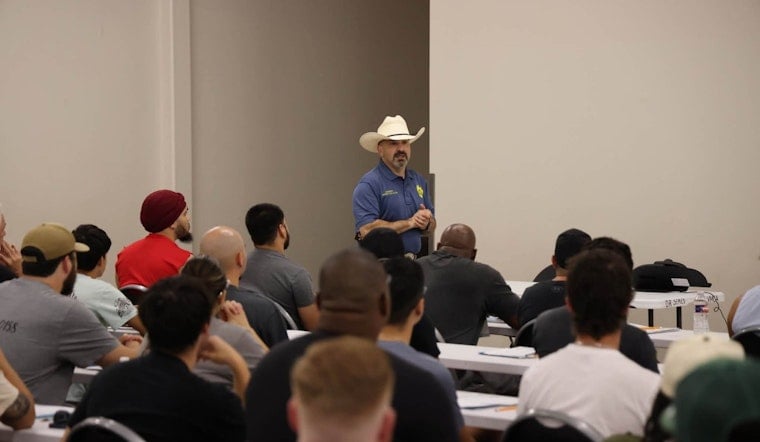
Madison High School's criminal justice program, which enrolls about 120 students, culminates in a telecommunications license from TCOLE. Lair participates in the SAPD Explorers program alongside classmate David Ankrom, who is 17. Elsewhere in the region, Jubilee Academies — which operates three pre-K-12 campuses in San Antonio — is expanding dual credit and AP classes across its network and has launched an early college high school program at Jubilee San Antonio, according to San Antonio Report.
A Statewide Overhaul Still Taking Shape
The certification list itself has been through a major rebuild. The TEA's final 2025-30 Industry-Based Certification list, released in November 2025, expanded state-approved credentials from 309 to 523 after reviewing 2,036 unique credentials submitted statewide, according to the Texas Education Agency. The agency evaluates certifications every five years against industry alignment, portability, and post-graduation wage outcomes, and plans its next update in 2030.
North East ISD, which includes Madison High School, offers 30 state-approved industry certifications across its Career and Technical Education programs and employs former practicing attorneys and first-responder veterans as instructors for law and public safety courses, per the district's own materials. Hoodline previously reported on a CTE instructor exit at the district's LEE High School, underscoring how much these programs lean on outside professionals to run hands-on coursework. For now, students like Lair and Ankrom are moving forward with credentials the state values less on paper, betting that local employers — and the paychecks they offer — will keep valuing them just the same.





