

























































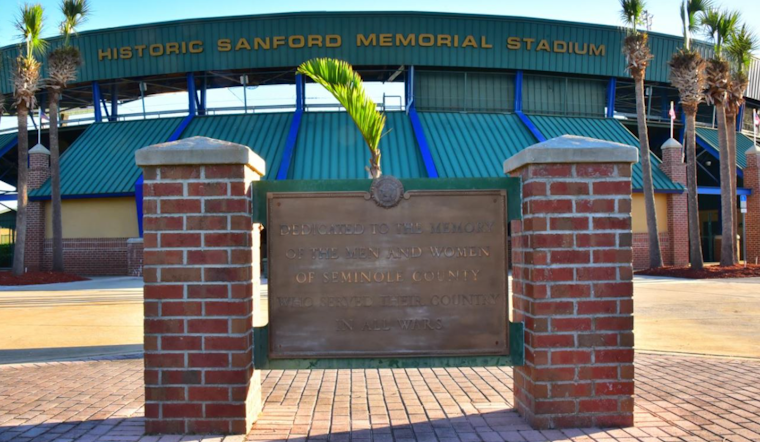
Rusted steel beams and worn-out fencing at one of Central Florida's oldest ballparks are getting a fix. Sanford city commissioners were scheduled to vote at a 7 p.m. meeting on a $166,981.36 repair contract for Historic Sanford Memorial Stadium, covering everything from structural uprights to new railings.
The repair work includes replacing two structural uprights, repairing structural steel, replacing fencing, and installing new railings, according to WESH. A site evaluation found deteriorated fencing and structural steel in several areas of the facility, and city staff said the fixes are needed to maintain the stadium's structural integrity and help ensure public safety. Facility supervisor Gene Manning told the station that steel in the stadium's round area has rusted over time.
The city has funding available in its budget for the project, and commissioners were weighing the lowest bid submitted for the work. Separately, a post from Sanford city officials on Facebook identified the contractor selected for the structural repairs at the upper rear of the stadium as XRC Commercial Builders, with the work funded through the city's General Fund and Capital Replacement Fund.
A Ballpark Built for the Long Haul
Manning said the goal is to preserve the stadium for future generations, adding that with these repairs, the stadium could remain standing for another 70 or 80 years. The repairs are expected to extend the life of a facility that has been in continuous use since 1951 — a stadium the WESH report describes as a longstanding community facility that remains a busy venue for sports and community events, hosting between 200 and 250 games each year.
The ballpark's roots actually stretch back further. The current structure was built in 1951 on the site of the former Sanford Field, which had opened a quarter-century earlier in 1926, according to Wikipedia. The modern stadium came about after the New York Giants requested an upgraded facility once the adjacent Naval Air Station Sanford was reactivated during the Korean War, and the team went on to use the site as its spring training home through the 1950s, per a Facebook video marking Sanford's history.
From Jackie Robinson to the River Rats
The stadium grounds carry a heavier historical weight than most small-city ballparks. In March 1946, Jackie Robinson made his integrated spring training debut at the original Sanford Field with the Montreal Royals, before local racial hostility forced team officials to relocate training operations to Daytona Beach, which then became the first Southern city to permit integrated spring training games, according to ClickOrlando.
Beyond Robinson, the site hosted Major League stars and Hall of Famers including Willie Mays, Early Wynn, Tim Raines and David Eckstein, several of whom spent spring training or early minor league careers there, according to the City of Sanford. Locally, the stadium houses the Buddy Lake Room, a multipurpose space named in 2001 after Bernard “Buddy” Lake, a Sanford pitcher who threw the Florida State League's first perfect game in 1948 and won a league batting title, honors that landed him in the National Baseball Hall of Fame's recognition, per a Legacy.com obituary.
Today the ballpark's primary tenant is the Sanford River Rats of the wood-bat Florida Collegiate Summer League, who have played there since 2007 and competed in the 2026 FCSL Championship Series, according to the Sanford Herald. The league showcases top college players preparing for professional careers, giving the aging facility a steady modern purpose alongside its historical one.
Preservation Through Periodic Investment
This is not the first time Sanford has poured public money into keeping the ballpark standing. In 2001 the city completed a $2 million renovation that officially renamed the venue Historic Sanford Memorial Stadium, adding an arc-design grandstand roof, upgraded press boxes and new clubhouses while preserving its 1950s architectural features, according to the Sports Planning Guide.
The venue, maintained by the City of Sanford Parks & Recreation Department, sits at 1201 S. Mellonville Avenue near Lake Monroe, less than a mile from Historic Downtown Sanford. It holds a total spectator capacity of 2,015, with 1,062 covered grandstand seats and 415 uncovered box seats, and its field stretches 330 feet down the foul lines and 385 feet to center, according to SCVB Sports Tourism data. Whether $167,000 will be enough to keep pace with the recurring rust and steel degradation that comes with Central Florida's humid climate remains an open question, one that will likely resurface the next time inspectors walk the grandstand's aging steel frame.




