

























































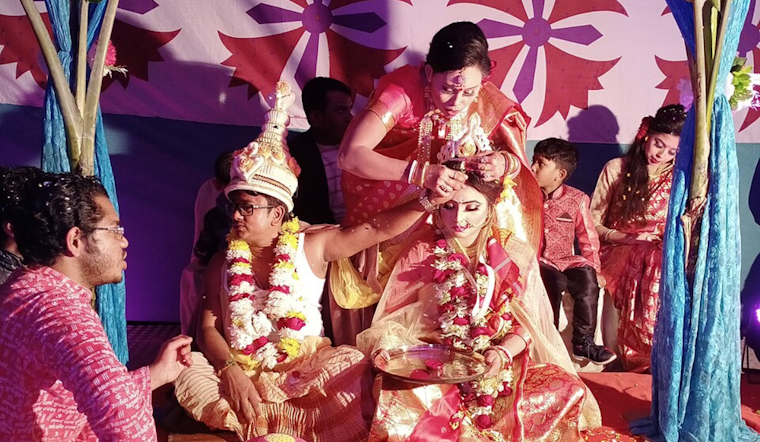
A Longwood immigration attorney wants to build an 11-acre cultural venue north of Vihlen Road in Sanford designed to host multi-day Indian weddings, traditional ceremonies and major performances, but the two wooded parcels he's eyeing are legally unbuildable in their current state, according to county planners. The site lacks access to a public road, sits partly within a FEMA floodplain, and carries a residential land-use designation that conflicts with the commercial event space envisioned in the proposal.
Ramachandran Balaraman submitted the Pandal Events Center proposal along with Sujatha Gangadharan and Niyanthri Ramachandran, according to the Orlando Sentinel. Balaraman is not listed as an owner of either parcel involved in the plan. The 1550 Freer Lane parcel, covering 5.55 acres, is listed under Bradley E. Hemann, while the adjoining 1570 Freer Lane parcel, covering 5.62 acres, is listed under Thoa N. Nguyen and Si Van Le. Together the two lots have a combined 2026 market value of $274,425.
Two Parcels, One Landlocked Problem
Seminole County planners, in pre-application review notes submitted in late July, reported that the proposed venue lacks public road access, sits on unbuildable parcels and conflicts with its residential land-use designation. County staff also found that an event venue is inconsistent with that designation, which currently allows primarily single-family housing up to four units per acre. The property carries A-1 agricultural zoning and a Low Density Residential future land-use designation, spanning 11.17 acres total.
Part of the trouble traces back to 1985, when the property was divided through quitclaim deeds without county approval, according to the pre-application notes cited by the Sentinel. Before Balaraman can request building permits, the parcels must be formally recombined through county approval. Planners also determined that private access easements currently serving the property are legally inadequate for a commercial assembly facility of this scale. Under Chapter 163 of Florida Statutes, shifting the land's future-use designation from residential to commercial would require a full Comprehensive Plan amendment, including public notice, planning board review and a vote by the Board of County Commissioners.
Wetlands, Floodplain and a Missing Road
The site itself adds further complications. It contains wetlands requiring a minimum 15-foot and average 25-foot undisturbed buffer, and part of the property lies within a FEMA floodplain, where county codes prohibit fill without equal volumetric compensation elsewhere on site. Sanford and Seminole County subdivision rules also require that private roads exceeding 2,000 feet have a secondary connection to a public road, and any nonconforming access points would need to be rebuilt to city or county standards.
Balaraman must now decide whether to pursue a land-use amendment, secure legal road access and recombine the parcels before submitting formal site plans, the Sentinel reported. The pre-application review granted no formal approvals or rejections, leaving the project's next steps entirely up to the applicant.
What the Venue Would Offer
Conceptual plans for the Pandal Events Center include a multi-use indoor auditorium, a lobby, verandas, bride and groom preparation suites, administrative offices and dedicated catering support space. The grounds would also feature an outdoor ceremonial lawn, landscaped gathering areas, an eastern stormwater retention basin, a surface parking lot, and vendor loading zones with passenger drop-off loops.
Balaraman told the Sentinel that Indian weddings typically last at least a couple of days and sometimes three, and that the venue would combine commercial and cultural functions to serve the community. Indian wedding rituals require the couple to look at the sun as part of the ceremony, since the sun is revered as a direct witness to marriage — a tradition that shapes the outdoor ceremonial space built into the conceptual design. Balaraman said he expects the venue would also appeal to destination wedding families from colder regions.
A Growing Community Without a Dedicated Venue
Seminole County has a growing Indian-American community, particularly along the Lake Mary high-tech corridor, where the Asian Indian population grew about 35 percent between 2010 and 2021, according to U.S. Census Bureau figures. That growth has been attributed to corporate technology hubs and highly rated public schools. The Lake Mary corridor alone hosts major employers including Deloitte, Chase Card Services, Liberty Mutual and Verizon, anchoring more than 50,000 corridor jobs as of 2026, according to MaxLife Realty. Seminole County Public Schools have also consistently earned an A grade from the Florida Department of Education, ranking among the top three districts out of 67 statewide.
The county's Indian cultural infrastructure already includes the Hindu Society of Central Florida temple in Casselberry, dining destinations along State Road 434 and U.S. Highway 17-92, and grocery stores such as Spice Bazaar and Patel Brothers. But the Hindu Society's 10-acre Casselberry complex, incorporated in 1987 and opened in June 2005 to serve more than 2,600 member families, was built primarily for religious worship rather than large, multi-day commercial wedding celebrations, according to historical reporting from the Orlando Sentinel. That same reporting notes Central Florida's broader Hindu population spans 7,000 to 10,000 families, encompassing both mainland Indian immigrants and a West Indian population of nearly 75,000 people primarily from Guyana and Trinidad and Tobago.
Sanford itself, situated along the St. Johns River and Lake Monroe, covers roughly 61,000 residents and serves as the northern terminus for the SunRail commuter rail line connecting to Orlando. For now, whether the Pandal Events Center becomes the county's first dedicated venue for large-scale Indian ceremonies depends on whether Balaraman can clear a legislative process that includes parcel recombination, a land-use amendment, zoning reclassification, and the civil engineering needed to build compliant public access and flood mitigation onto a site that currently has none of it.



