

























































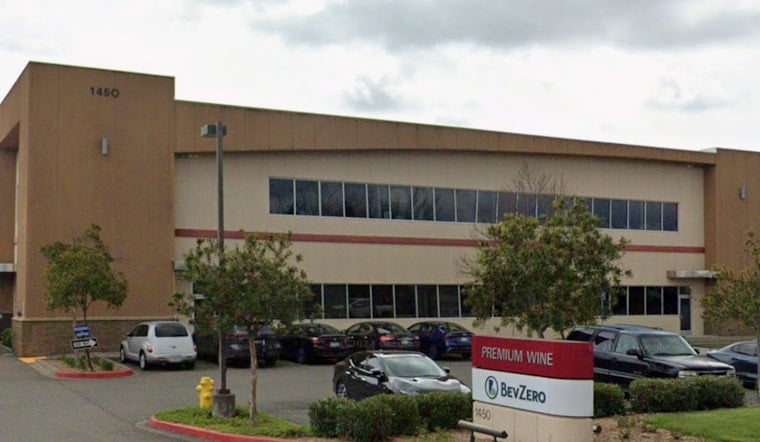
The Santa Rosa facility that strips alcohol out of wine for some of the country's best-known zero-proof drink brands has quietly changed hands, and its new owner just bought a Lodi winery to help it grow. Strategic Beverage Services Inc. has acquired BevZero's U.S. business under a franchise agreement, taking over the Santa Rosa plant at 1450 Airport Boulevard along with the brand's domestic processing operations.
The deal, first reported by The Press Democrat, caps a turbulent stretch for the plant's ownership. BevZero International reacquired its U.S. contract in March 2025 after Bronco Wine Company, which had acquired Santa Rosa's Wine Hooligans and briefly assumed oversight of the facility, decided to stick strictly to winemaking rather than run a dealcoholization business, according to the Wine Industry Network. Bronco did not take over the BevZero contract itself. Notably, an investor group reportedly offered more than Bronco's $20.3 million credit bid to acquire Wine Hooligans, but that offer was rejected, per the Press Democrat's reporting.
Under the new arrangement, dealcoholization services will keep operating under the familiar BevZero name, while packaging, canning, bottling, and co-packing shift to the Strategic Beverage Services brand, according to ZestNews. BevZero International, for its part, is divesting its U.S. franchise rights and domestic assets so it can focus resources on expanding dealcoholization services across Europe, where it still runs company-owned operations in Spain and South Africa, according to Just Drinks.
Who's Running the Show
Strategic Beverage Services is led by Pat Morgan, who serves as chief operating officer, alongside three partners, according to the Press Democrat's reporting. Morgan, 61, has spent roughly 35 years in the alcoholic beverage industry and reportedly spent the better part of a year assembling financing for the deal. Jack Garzella serves as chief financial officer, while Bruce Alexander and Chris Nix are listed as advisers to the company, which now employs 24 people.
The company's client roster includes brands such as Fraudonnay, Solubrea, Drink Nouvie, Yours, and Rayner Mansion, all of which rely on dealcoholization, product formulation, and recipe development services, per Just Drinks. Strategic Beverage Services also acquired a former Bronco entity called Wine Hooligans as part of the broader transaction. The Santa Rosa plant traces its technical roots to 1991, when it was founded in Sonoma County under the name ConeTech before rebranding as BevZero in 2021.
Inside the Vacuum Distillation Process
The Santa Rosa site uses three spinning cone columns, a type of vacuum distillation system that strips alcohol from wine and other beverages while capturing volatile aromatics that would otherwise cook off under conventional heat. The technology was developed in Australia by Flavourtech in the 1980s and brought to U.S. winemaking by ConeTech founder Tony Dann, using low-temperature vacuum distillation below 95 degrees Fahrenheit, according to background reported by Smithsonian.
Beyond simply removing alcohol, the plant also treats stuck or stalled fermentation and offers reverse osmosis and crossflow filtration services. It concentrates the ethanol byproduct it collects to at least 140 proof, which equals 70% alcohol by volume, and as high as 184 proof, equivalent to 92% alcohol by volume. Strategic Beverage Services expects to be able to supply 190-proof ethanol within about three or four months, proof strong enough to serve as a base for vodka and ready-to-drink cocktails. The Santa Rosa site removed over 2 million gallons of beverages last year, the Press Democrat reported.
That ethanol recovery triggers a dual layer of federal oversight. Dealcoholized wines finished under 0.5% alcohol by volume fall under FDA food facility and labeling rules rather than standard Alcohol and Tobacco Tax and Trade Bureau wine oversight, though the high-proof ethanol recovered during processing still requires TTB Distilled Spirits Plant licensing, according to Wine Business. Strategic Beverage Services is reportedly finalizing a deal with a local distiller who plans to purchase a still, tying the plant's ethanol byproduct directly into spirits production.
A Lodi Winery Becomes a Packaging Hub
On August 3, Strategic Beverage Services bought the Thomas Allen Vineyards and Winery production facility in Lodi. The property spans 45 acres and includes a 60,000-square-foot winery built in 2019, a bottling line sized for 1.8 million cases annually, and about 500,000 gallons of storage capacity.
The company plans to add canning, sparkling wine, and additional alcohol-removal capacity at the Lodi site, along with a bottling line for still and sparkling wines and a canning line equipped with a tunnel pasteurizer. Strategic Beverage Services is adding at least one more dealcoholization plant there, expanding beyond the Santa Rosa facility's existing footprint. The company is also targeting a Sonoma County facility within the next 12 months that would provide additional co-packing, bottling, and canning capacity, according to the Press Democrat.
Why the Zero-Proof Market Keeps Growing
The expansion tracks a broader shift in what Americans are drinking. Full-alcohol beverage sales totaled $110 billion last year but declined 3.4% nationwide, while no-alcohol beverage sales rose 19.2% from 2024 to reach $1.01 billion, according to NielsenIQ figures cited in the Press Democrat's reporting. Spirits-based ready-to-drink beverages grew even faster, climbing 25.7% to $13.6 billion and now representing 12.4% of all beverage alcohol sales.
Industry research firm IWSR forecast in January 2025 that the total U.S. non-alcoholic beverage market will reach nearly $5 billion by 2028, with non-alcoholic RTD cocktails and spirits growing at compound annual volume rates exceeding 20%, according to IWSR. Much of that demand comes not from teetotalers but from moderation-minded drinkers: NielsenIQ data shows 95% of alcohol-free beverage shoppers also bought alcoholic drinks, while IWSR separately found that roughly 92% of non-alcoholic buyers continue purchasing full-strength alcohol, with Urban Millennials representing the largest demographic in the category.
The Santa Rosa plant's ownership churn has unfolded against a backdrop of financial strain across Northern California's wine industry. Bronco's acquisition of Wine Hooligans in early 2025 came amid regional facility closures and layoffs tied to excess grape capacity across the region, as Hoodline previously reported in connection with Bronco's national distribution push with Sonoma's Jordan Winery. That same distress has apparently created openings for specialized processors like Strategic Beverage Services to pick up assets as traditional winemakers restructure. The Santa Rosa facility also maintains USDA Organic handling certification through California Certified Organic Farmers, allowing it to process organic-certified wines and functional beverages for eco-conscious brands, per CCOF's certification directory.





