

























































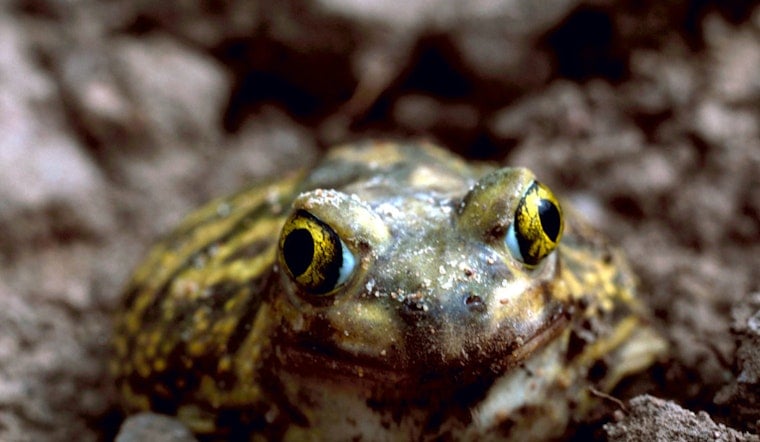
A century-old drawer of unlabeled toad bones sitting in a Los Angeles museum collection has turned into evidence of a species that vanished with the Ice Age. Researchers who reexamined fossils pulled from Rancho La Brea back in 1929 say the bones belong to a previously unknown, now-extinct amphibian they've named Spea labreae, a spadefoot toad relative that likely lived in the region more than a million years ago, when Los Angeles was colder and wetter than it is today. The find is only the second documented extinct Ice Age amphibian species identified anywhere in North America.
The discovery is credited to paleontologist Jos\u00e9 Alberto Cruz, who came across the new species while sorting through a bone collection that had gone largely untouched since it was pulled from the tar pits in 1929, according to LAist. Cruz first assumed the odd-looking bones came from a sick or injured member of a known spadefoot species, the outlet reports, but he eventually concluded that no existing spadefoot family could explain what he was seeing in the skeleton.
Testing a Hunch Against 80 Modern Skeletons
To rule out the possibility that he was simply looking at a deformed modern toad, Cruz compared the La Brea fossils against roughly 80 modern amphibian specimens borrowed from the Natural History Museum of Los Angeles County and UC Berkeley's Museum of Vertebrate Zoology, according to Scienmag. The formal description was published August 5, 2026, in the Journal of Vertebrate Paleontology under the title A New Extinct Pleistocene Species of Spadefoot Toad and Comments on the Paleoecology and Paleobiogeography of Anurans from Rancho La Brea, California, the outlet reports. Before Cruz's review, the amphibian and reptile fossils in the tar pits' collection hadn't gotten a comprehensive academic look in nearly 30 years, per the same report.
The holotype specimen used to formally describe the species is an incomplete sacro-urostyle bone, LAist notes. Detailed measurements showed Spea labreae ran about 7 percent larger than its living spadefoot relatives, according to Nautilus. Today's Western spadefoot, the smaller and lighter-colored toad currently native to the Los Angeles area, is the closest living relative, as reported by Popular Science.
A Toad From Southern Mexico Shows Up 1,500 Miles From Home
The same review turned up something else: the first fossil record of the Mexican burrowing toad, known scientifically as Rhinophrynus, anywhere in the southwestern United States. According to EurekAlert!, the finding shows the toad's Ice Age range stretched nearly 1,500 miles, or about 2,500 kilometers, farther north than the species' modern population in southern Mexico. Emily Lindsey, a vertebrate paleontologist at the La Brea Tar Pits, said climate shifts near the end of the Ice Age, or the arrival of humans, may have driven the Mexican burrowing toad to retreat south, per LAist.
Lindsey also said Spea labreae could offer clues about what Los Angeles actually looked like during the Ice Age, per the same account. Because researchers can infer ancient precipitation and temperature patterns from where amphibians turn up, the presence of both toads together points to a Southern California climate that looked little like today's drier landscape.
Why Tiny Bones Can Say More Than Mammoths
La Brea Tar Pits is best known for saber-toothed cats and mammoths trapped in its natural asphalt, but large mammals are mobile and can adapt to shifting regional climates in ways amphibians can't, according to Popular Science. Amphibians, by contrast, are tightly bound to local microclimates and water availability, making them far more sensitive indicators of ancient environmental conditions than their larger neighbors. The tar pits' bitumen has preserved a total of 19 extinct mammal species and 16 extinct bird species alongside the kind of delicate amphibian bones that rarely survive intact elsewhere, per Nautilus.
Before Spea labreae was identified, the only other extinct Pleistocene amphibian species documented in North America was a fossil tree frog found in Florida, per Scienmag. The species has so far been found only in Los Angeles, according to LAist, and researchers haven't turned up evidence of it anywhere else.
New Research Hub, and a Toad Exhibit, on the Way
The discovery lands as the La Brea Tar Pits museum sits closed for renovations, according to LAist, with plans to fold both toad species into its new format once it reopens. The site's ongoing expansion includes the Samuel Oschin Center for Global Ice Age Research, established this year with funding from the Mr. and Mrs. Samuel Oschin Family Foundation to combine excavation, research and public education in Hancock Park, according to La Brea Tar Pits.
Cruz and Lindsey's work isn't confined to Los Angeles. The pair also co-lead a Pleistocene excavation project at the Pampa La Brea tar pits in Talara, Peru, according to IFLScience, comparing asphalt-seep fossil sites across two continents to understand how ancient biodiversity responded to past climate shifts.





