

























































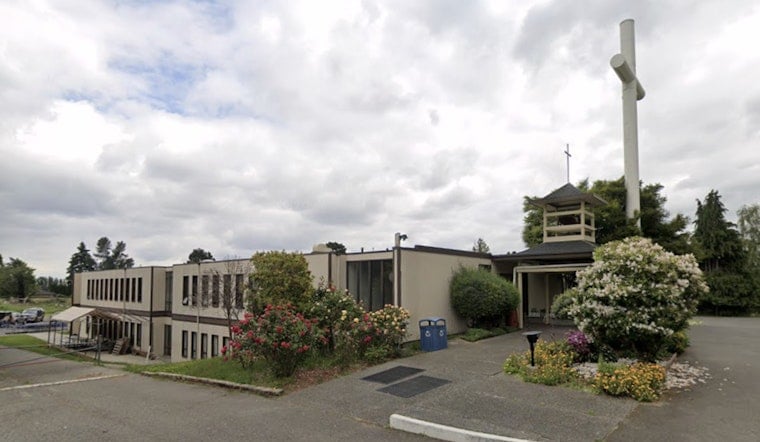
For 18 months, Riverton Park United Methodist Church in Tukwila has functioned as a makeshift regional shelter, taking in thousands of asylum-seeking migrants who had nowhere else to go. Seattle, meanwhile, has its own emergency shelter plan for exactly this kind of situation sitting unused, according to reporting examined on KUOW's Soundside program.
The church became a lifeline almost by accident. Seattle city workers were the ones who first sent asylum seekers to Riverton Park, according to a KUOW report on Soundside, which cited reporting from Seattle Times journalist David Kroman. Soundside host Libby Denkmann spoke with Kroman about what he described as a breakdown in how the region has handled migrant housing, and the reporting found that Mayor Bruce Harrell has refused to implement Seattle's emergency migrant shelter plan even as the Tukwila church absorbed the overflow.
King County's family shelter system has only a handful of beds open on any given night, leaving little capacity to handle a sustained wave of new arrivals. That scarcity is part of why Riverton Park, rather than a Seattle-run facility, ended up as the de facto intake point for the region.
A Church Never Built for the Long Haul
Riverton Park was never intended as permanent housing. City of Tukwila officials proclaimed a state of emergency on October 2, 2023, formally recognizing that the influx of asylum seekers at the church had become an acute humanitarian crisis beyond what the small city could handle on its own, according to the City of Tukwila's own proclamation. That declaration let the city seek regional emergency assistance and put up temporary heated shelter structures on church grounds. Between 2022 and 2024, the church, led by Pastor Jan Bolerjack, hosted and supported more than 2,000 asylum seekers, most arriving from Venezuela, Angola, and the Democratic Republic of the Congo, per data compiled by the Washington State Department of Commerce.
Federal law is a major driver of why so many migrants ended up stuck in shelter limbo rather than moving into their own housing. Asylum seekers must wait at least 180 days after filing their asylum application before they can legally receive work authorization, according to reporting from The Chronicle. That waiting period leaves newly arrived families unable to earn income or pay rent for months, forcing them to depend almost entirely on local government aid or church-based support in the meantime.
Money Poured In, But It Wasn't Enough
Regional and state governments have tried to plug the gap with emergency funding, though the aid has repeatedly run dry. King County Executive Dow Constantine approved $3 million in emergency relief in December 2023 to contract with Thrive International, moving up to 100 asylum-seeking families out of tents at Riverton Park and into local hotel rooms, according to the King County Executive Office. The county added another $1 million in February 2024 to keep those hotel stays going, as reported by the South Seattle Emerald.
The Washington State Legislature stepped in that same month, allocating more than $32 million in the state's supplemental budget for migrant support. The package included $25.3 million for the state Office of Refugee and Immigrant Assistance, $5 million for King County, and $2.5 million directly for Tukwila, the funding tied to House Bill 2368, which expanded state authority to help asylum seekers who don't qualify for federal refugee aid.
State and local sanctuary policy also shapes how agencies can respond. The Keep Washington Working Act, passed by state lawmakers in 2019, bars state and local government resources, property, and personnel from assisting or cooperating with federal civil immigration enforcement, according to King County. That statute restricts city and county agencies from using municipal resources to manage or report on migrants based on their legal status.
Federal Pressure Adds a New Layer of Risk
The stakes for a shelter like Riverton Park rose sharply in January 2025, when the U.S. Department of Homeland Security under the Trump administration rescinded long-standing policies that had restricted ICE agents from making arrests at sensitive locations such as churches and schools, according to FOX 13 Seattle. Church leaders responded by distributing know-your-rights guidance to the migrants still living on the grounds.
Seattle has since taken its own steps to limit federal immigration enforcement within city limits, even as it has left its emergency migrant shelter plan on the shelf. Mayor Harrell signed executive orders in October 2025 prohibiting non-uniformed or unidentifiable federal agents from staging or conducting immigration enforcement operations on Seattle city property, according to the City of Seattle Office of the Mayor. The orders were framed as a way to protect immigrant communities and keep municipal property out of federal roundup operations.
Seattle's budget priorities have also focused inward. Harrell proposed a $4 million safety net investment in September 2025 to backfill emergency shelter, housing vouchers, and legal defense programs facing federal funding cuts, a proposal that became part of the city's $8.9 billion budget signed into law in November 2025. That spending targets programs already operating inside Seattle rather than expanding emergency shelter capacity for the asylum seekers who have landed in Tukwila.
The Economic Case Advocates Are Making
Immigrant advocacy groups have pushed back against the framing of asylum seekers as a pure drain on public resources. Research relayed by the South Seattle Emerald in 2024 found that refugees and asylum seekers in Washington contribute an estimated $374.5 million annually in state and local taxes. Advocates have cited that figure while pressing state lawmakers to broaden safety-net programs to include undocumented residents.
None of that resolves the immediate question raised in the KUOW report: why Seattle's own emergency shelter plan for migrants remains unactivated while a small Tukwila congregation continues to carry the load. The Soundside segment, produced by KUOW as a member of the NPR network, laid out the timeline and the mayor's refusal to implement the plan, but left open what it would take for the city to change course.





