

























































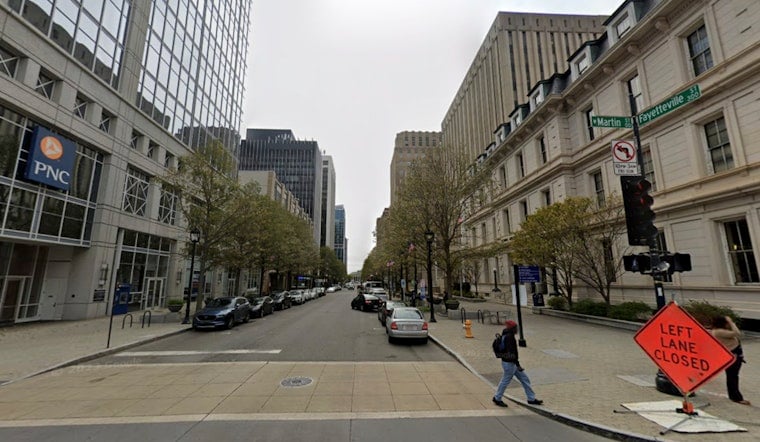
Crime scene tape closed off several blocks of Fayetteville Street in downtown Raleigh early Monday after a man was shot in the foot, marking the second shooting to shut down the corridor in less than 48 hours. Police vehicles lined the intersection of Fayetteville and Martin streets as officers responded to the scene, and the wounded man was taken to the hospital, where he is expected to recover.
According to WRAL, Raleigh police are searching for a gray vehicle believed to have transported the shooter, and investigators are reviewing security footage from nearby businesses as they work to piece together what happened. The station reports that Monday's shooting occurred less than 48 hours after four people were shot at a nightclub on Fayetteville Street on August 22, an incident Hoodline covered in its report on the nightclub gunfire. In that earlier shooting, officers arriving at Alive Nightclub found two gunshot victims on scene while two others reached the hospital by private vehicle, according to the Star News Facebook page, which reported that all four victims suffered non-life-threatening injuries.
A Corridor With a Troubling Pattern in 2026
Monday's shooting is the latest in a string of violent incidents that have repeatedly disrupted Fayetteville Street this year. In May, a female suspect shot two attorneys in an alley outside the old Wake County Courthouse following a civil court hearing, a case in which the suspect was later indicted on attempted first-degree murder charges, per the CBS 17 Facebook page. In April, a violent confrontation along the 200 to 400 blocks of the street left six adults hospitalized with serious stab wounds, according to WSOC-TV, which reported that police initially charged one man before prosecutors determined he had acted in self-defense.
Earlier this month, on August 9, a nightclub fight spilled outside on the same corridor and left a man stabbed in the arm, an incident Hoodline detailed in its report on the August stabbing near a nightclub. That victim drove himself to the hospital with non-life-threatening injuries. Taken together, the incidents point to a pattern of recurring late-night violence along the same stretch of downtown Raleigh throughout the spring and summer.
City Investment Meets Persistent Safety Concerns
The renewed violence lands awkwardly against the backdrop of the city's own efforts to revitalize the corridor. The Raleigh City Council allocated $1 million in November 2025 for the Fayetteville Street Streetscape Improvement Project, aimed at boosting outdoor seating, street activation, and public art through the summer, according to the City of Raleigh. The Fayetteville Street District spans roughly six blocks and includes more than 130 businesses, among them over 60 restaurants and 15 bars, within downtown's first designated social district, established in 2022, per the Downtown Raleigh Alliance.
The city has also built out dedicated public safety infrastructure for the area. The Raleigh Police Department operates a Hospitality District unit that uses bicycle, TRACE, and code enforcement officers to patrol downtown nightlife zones, established under the department's summer action plans. Separately, the Downtown Raleigh Alliance maintains safety and hospitality ambassadors who patrol 110 downtown blocks on foot, bicycle, and Segway until 3:30 a.m. on weekend nights, coordinating with emergency services under a program now managed by vendor Block By Block.
Statistics Versus Perception
Raleigh Police Department data for early 2026 showed that overall crime in the city had declined compared to the same period in 2025, even as a series of high-visibility violent incidents struck central districts, according to Raleigh Magazine. Police officials acknowledged that clustered incidents like those on Fayetteville Street disproportionately impact community perceptions of security, even when broader trends point downward.
Fayetteville Street's identity as a pedestrian gathering space has shifted before. The corridor operated as a car-free pedestrian mall from 1977 until 2006, when city leaders reopened it to vehicular traffic to spur economic activity after the closure had shuttered numerous downtown businesses, according to The Cultural Landscape Foundation.
As of Monday, it remains unclear whether the August 22 nightclub shooting and the latest shooting near Fayetteville and Martin streets are connected, and no suspect has been publicly identified in the search for the gray vehicle police believe transported the shooter. Whether city or police officials will impose new operational or security requirements on Fayetteville Street's nightlife venues in response also remains an open question.





