

























































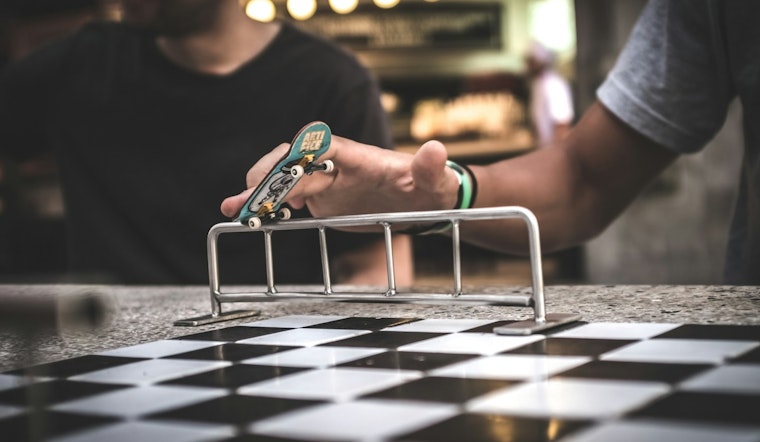
Tucked against dirt flood-control barriers along the Los Angeles River in Atwater Village, a tiny skatepark built for fingers instead of feet has quietly grown into a local phenomenon. The L.A. River Fingerboard Skatepark now stretches about 90 feet long and stands four feet tall, packed with miniature ramps, rails and hand-carved features that fingerboarders roll through with their fingertips rather than their sneakers.
The park sits on the opposite side of the Los Angeles River bike path, wedged between the Golden State Freeway and Glendale Boulevard near the Glendale-Hyperion Bridge, according to LAist. It has no exact address and was originally built by an unknown person or group, but it caught fire online after social media videos began showing people performing fingerboard tricks there in March, per the same outlet's reporting. Ryan Diaz recognized the spot's location after watching those clips and has since become its primary caretaker, managing and co-managing its social media accounts alongside Gilbert Medrano.
From a Six-by-Six Patch to a 90-Foot Build
Before Diaz got involved, the fingerboard setup measured just six by six feet. With help from other builders, he expanded it into the sprawling course it is today, adding ramps, rails, a large LA sign painted in Dodger blue, and even a quarter-pipe ramp bearing his shark tribute to Jaws. Independent documentation from Confusion Magazine in April described the secret build atop the flood barriers as featuring concrete ramps, metal rails, carved stair sets and a marble slab grind box.
The growth has continued steadily since then. Video posted by fingerboard channel The Chris Files in June showed the park had reached a continuous length of 47 feet at that point, marking one milestone in its rapid weekend-driven expansion. Diaz has discussed the challenges of keeping a public DIY spot alive against wear and environmental damage on The Bigspin Fingerboard Podcast, emphasizing that public builds like his require constant maintenance and active stewardship.
Weekly Build Days Draw Volunteers and Neighborhood Kids
Expansion work happens on Saturdays starting at 11 a.m., and the sessions double as informal art projects — volunteers decorate the park with graffiti alongside the building itself, LAist reports. Diaz has also taken on a mentorship role, teaching neighborhood children how to pour concrete during the builds. He says the goal is bigger than skate tricks: the park is meant to help people get outside, use their brains and discover the world, in his words to the outlet.
Diaz wants the park to last for years and keep drawing visitors, and he is pursuing an ambitious long-term goal — having it formally recognized as a city landmark. That process is not simple. Per Los Angeles City Planning, securing official Historic-Cultural Monument status requires a nomination through the Department of City Planning's Office of Historic Resources, evaluation by the Cultural Heritage Commission, and final approval from the City Council, with applicants needing to demonstrate significant historical, cultural or architectural contributions under municipal code criteria.
A Precedent — and a Regulatory Catch
Los Angeles has granted legitimacy to grassroots skate builds before, but rarely quickly. San Pedro's Channel Street DIY skatepark, built illegally under a freeway in 2002, took seven years of advocacy and city council intervention before it received retroactive permits and officially reopened in 2022, according to the Los Angeles Times. It remains the only DIY skatepark in the city to make that full transition from illegal build to permitted municipal park.
The fingerboard park's location complicates any path toward that kind of legitimacy. The dirt barriers it sits on were installed by the Army Corps of Engineers about a decade ago to control floods, LAist notes, and they sit within the Glendale Narrows — a 6.43-mile soft-bottom stretch of the LA River where high water tables prevented crews from pouring a concrete riverbed during 20th-century channelization, according to the U.S. Army Corps of Engineers. That entire channel system was built between 1936 and 1959 following severe regional floods between 1914 and 1934.
Federal rules require flood control channels and their surrounding right-of-way easements to stay clear of unauthorized obstacles, with violations subject to administrative penalties or mandatory restoration, per the Army Corps. The Corps and LA County Flood Control District share maintenance jurisdiction over those rights-of-way. Flood engineers also classify the Glendale Narrows as a critical choke point during storms, since sediment buildup and vegetation there can impede high-volume water flows, the Los Angeles Times has reported — meaning agency scrutiny of anything built in the channel tends to intensify ahead of winter rains.
Why People Keep Coming Back
None of that regulatory tension seems to be scaring off visitors. Levi Hernandez, who is from El Monte and has practiced fingerboarding for nearly a decade, visited the park for the fourth time in July and said the experience feels almost like real skateboarding, requiring genuine practice to get right. Jimmy Tran, from Chinatown, now visits daily on his way home from work. Tran stopped regular skateboarding after a bad injury and said fingerboarding lets him perform the same kinds of tricks without the risk, calling the park a place where he can relax and just be himself.
The park is open every day and has become part of a broader Southern California fingerboarding scene that includes dedicated commercial spaces like Slushcult's Mini Mart & Mini Skate Shop in Santa Ana, which hosts its own regular meetups and mini-ramp events, according to el Don News. For now, the Atwater Village spot remains an unofficial, unaddressed fixture along the river — one that keeps expanding a few feet at a time, one Saturday at a time.


