

























































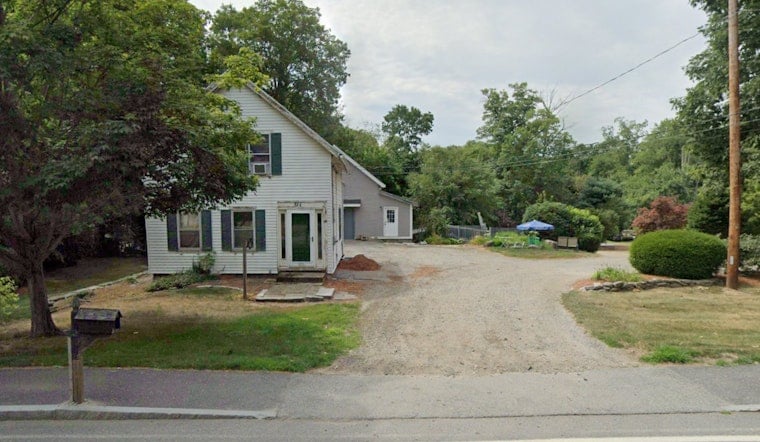
A Southborough homeowner is facing a lawsuit in Worcester Superior Court after town officials say he spent years clearing trees, dumping soil and storing debris in his backyard near protected wetlands without permits — and ignored repeated orders to stop. The town alleges Wayne Anderson, who owns the parcel at 200 Southville Road, violated both the Massachusetts Wetlands Protection Act and Southborough's local wetland protection bylaw.
According to the Community Advocate, the town alleges Anderson altered the rear of his property through tree clearing, soil disturbance, soil importation and excavation, equipment parking, and the storage of materials and solid waste. Southborough says it verified the existence of the alleged violations through several investigations, including a Conservation Commission site visit in March 2024. The Southborough Conservation Commission first sent Anderson correspondence notifying him of a reported Wetlands Protection Act violation, then followed up with an enforcement order outlining the allegations of waste and debris storage, structures, equipment parking, and soil importation and excavation.
The commission ordered Anderson to cease and desist from the activities and asked him to stop work in his backyard, according to the outlet's reporting. He did not appeal the citations, the paper reports, and the town alleges he failed to comply with the lawful orders, did not remedy the violations, and did not reply to prior correspondence. Anderson was also requested to attend the commission's April meeting, per the report.
Fines Piling Up Since Spring 2024
The town sent Anderson correspondence on June 3, 2024, and later issued what it called a final pre-litigation demand, the Community Advocate reports. Daily fines tied to the alleged violations began accumulating on May 31, 2024, according to the outlet, and the case remained ongoing as of May 2026 before landing in Worcester Superior Court. In its complaint, Southborough writes that it seeks to abate conditions deemed to endanger or materially impair the protected wetland resource areas on the property — specifically what the town describes as continued, unpermitted work.
Municipal scrutiny of the Southville Road property did not start with the wetlands case. Southborough's Board of Health investigated the address in September 2023 and again in April 2024 following complaints about an unpermitted temporary trailer housing unit that reportedly lacked proper running water and sewage disposal, according to Town of Southborough Board of Health records, which also prompted inquiries from the town's Building Department and Zoning Board. Certified letters sent by health officials during that period were signed by a bookkeeper or went unanswered, the records show.
Why the Town Went to Court
Massachusetts law limits what local conservation commissions can do on their own to enforce fines. A 2017 clarification from the Massachusetts Appeals Court, detailed by the law firm McGregor & Legere, P.C., held that commissions cannot independently assess or collect statutory criminal fines or civil penalties without judicial authorization or adherence to non-criminal citation procedures. That is why accumulated daily fines have to be enforced through a superior court injunction rather than town action alone — explaining why Southborough's long-running administrative enforcement effort ultimately escalated into a formal complaint filed in Worcester Superior Court.
The stakes are significant under state law. Under Massachusetts General Law Chapter 131, Section 40 — the Wetlands Protection Act — civil penalties can reach up to $25,000 per violation, while criminal penalties include fines up to $25,000, up to two years in prison, or both, with each day of non-compliance treated as a separate offense, according to The General Court of the Commonwealth of Massachusetts. Southborough's own local wetland regulations go further than the state baseline, establishing a strict 20-foot setback prohibiting permanent structures near resource areas and requiring Conservation Commission approval for any work within a 100-foot buffer zone, per guidance reviewed by the Town of Tewksbury.
What the Wetlands Rules Are Meant to Protect
The Wetlands Protection Act exists to safeguard eight specific public interests, including drinking water supplies, groundwater quality, flood control, storm damage prevention and wildlife habitat, according to guidelines published by the Massachusetts Association of Conservation Commissions. Disturbing soil or dumping fill within a buffer zone can destabilize those protections for an entire local watershed, the group notes. Property owners bear sole legal responsibility for unpermitted alterations or fill on their land under M.G.L. c. 131 § 40, regardless of whether the work was performed by the owner or by a third party — meaning not knowing exactly where a wetland boundary sits is not a legal excuse.
Commercial directory listings show Anderson operating a landscape contracting business registered at the Southville Road address, according to Houzz, which offers a possible explanation for the equipment and materials the town alleges were parked and stored on the 1.5-acre residential parcel. Municipal tax records from 2021 list Wayne B. Anderson as the property's owner, with a total assessed valuation of $366,200. Southborough conservation officials have continued to track the matter closely: the Conservation Commission held an executive session in March 2025 specifically to evaluate legal strategy on the pending litigation, and conservation staff presented an updated report as recently as this June detailing the ongoing court proceedings, litigation status and enforcement steps tied to the property.





