

























































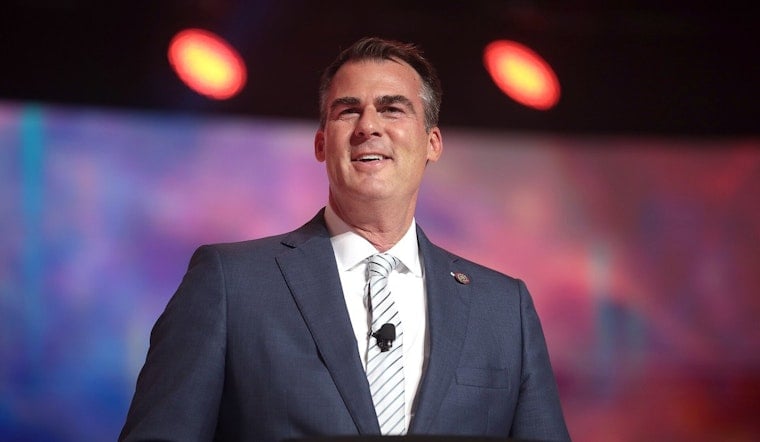
Oklahoma Governor Kevin Stitt signed an executive order on Wednesday directing state public safety agencies to investigate whether the Council on American-Islamic Relations, the Muslim Brotherhood, or affiliated groups pose a public safety or terrorism threat within the state. The order tasks the Oklahoma Department of Public Safety and the state Office of Homeland Security with conducting the intelligence-based assessment, and it also directs those officials to push federal agencies to formally designate CAIR and the Muslim Brotherhood as Foreign Terrorist Organizations.
According to The Oklahoman, the move marks the latest instance of state politicians targeting Oklahoma Muslims, with Stitt directing agencies to investigate organizations tied to the Islamic faith for connections to terrorism. The governor's office says the order builds on responsibilities already assigned to state agencies under the Oklahoma Homeland Security Act and the state's Antiterrorism Act. Notably, the order cites Hamas's historical emergence from the Muslim Brotherhood as part of its justification for urging a federal terror designation — but Foreign Terrorist Organization status is a determination made exclusively by the U.S. Department of State, not by any state government.
A Regional Pattern Takes Shape
Oklahoma's action does not stand alone. In November 2025, Texas Governor Greg Abbott issued a proclamation designating CAIR and the Muslim Brotherhood as foreign terrorist and transnational criminal organizations under state law, a move that barred the groups from acquiring real property in Texas and triggered an ongoing federal lawsuit, according to the Office of the Texas Governor. Hoodline previously reported on Abbott's push to strip CAIR's status and on Texas Attorney General Ken Paxton's subsequent lawsuit seeking to shut down the group's Texas chapter.
Florida has followed a similar path. Governor Ron DeSantis signed the Domestic Terrorist Designation Act in April, creating a state legal mechanism to label organizations as domestic terror entities and cut them off from public contracts, according to the ACLU. That law built on a December 2025 executive order targeting CAIR that remains tied up in federal court, where judges have already issued preliminary injunctions against Florida's earlier action on First Amendment grounds. Stanford Law's Legal Aggregate has described the pattern as a broader trend of Republican governors moving to brand civil rights groups as security threats, even though state-level designations carry no federal criminal authority.
Oklahoma's Own History With Anti-Sharia Measures
The executive order also revives a fight Oklahoma has waged before. Voters approved State Question 755 in 2010, amending the state constitution to bar courts from considering Sharia law, but federal courts permanently struck the measure down in 2013 in Awad v. Ziriax, ruling it violated the First Amendment's Establishment Clause, per the ACLU. That lawsuit was brought by an Oklahoma Muslim resident with support from the ACLU and CAIR itself.
Lawmakers tried again this year. State Representative Gabe Woolley filed House Joint Resolution 1040 in January, seeking a constitutional amendment that would prohibit state courts from applying Sharia law or foreign legal codes, arguing such law was incompatible with the U.S. Constitution, according to BillTrack50 records. The resolution died in committee in May.
CAIR's Background and the Holy Land Foundation Reference
Founded in 1994 and headquartered in Washington, D.C., CAIR describes itself as the nation's largest Muslim civil rights and advocacy group, with regional chapters operating in more than 20 states, including Oklahoma, according to its Wikipedia entry. The organization says its work includes anti-discrimination advocacy, media monitoring, and civil rights representation.
Critics of CAIR, including state officials pursuing these designations, frequently point to its listing by federal prosecutors as an unindicted co-conspirator in the 2007 Holy Land Foundation terrorism-financing trial. CAIR was never charged with any crime in that case, and Legal Aggregate notes that federal courts later ruled the practice of publicly naming unindicted co-conspirators violated due process rights.
Stitt's Broader Security Track Record
Wednesday's order fits a pattern for Stitt, who has repeatedly used executive authority to mandate state-level security measures. In January 2025, he signed an executive order establishing the Secure Oklahoma NOW Initiative, directing state public safety agencies to require security protocols for large-scale public events and creating a 12-member advisory council to publish annual event safety guides.
State officials have pointed to a real counterterrorism case in justifying the new scrutiny. Afghan national Nasir Ahmad Tawhedi pleaded guilty in Oklahoma City federal court in June 2025 to conspiring to provide material support to ISIS, after an FBI-led task force foiled his plot to carry out an Election Day mass-shooting attack in Oklahoma in November 2024, according to the U.S. Department of Justice. Stitt publicly praised law enforcement following Tawhedi's arrest that October.
Civil rights attorneys and legal scholars have pushed back on the broader campaign, noting that states lack constitutional authority to issue foreign terrorism designations — a power reserved strictly for the federal government. In Texas, that tension has also produced political friction within the GOP; Hoodline reported earlier this year that Muslim Texas Republicans threatened to leave the party over the escalating rhetoric. Whether Oklahoma's assessment produces findings, legal challenges, or both remains to be seen.



.jpg)