

























































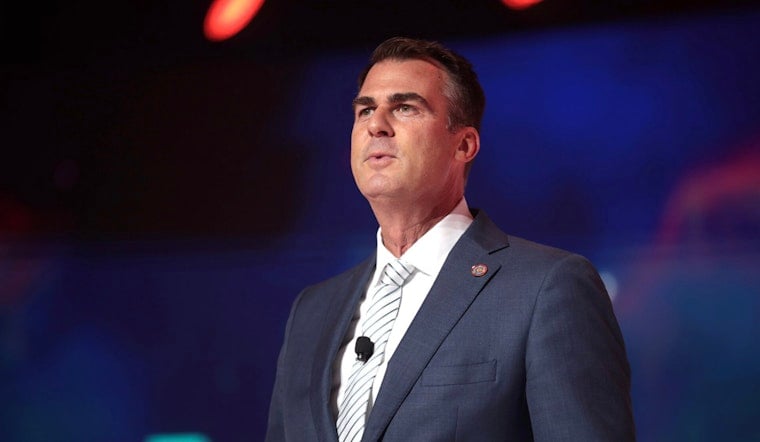
Oklahoma Gov. Kevin Stitt released a 30-page report on the state's public school finances on August 12, criticizing districts for seeking additional education funding while sitting on large unspent balances. The report found that school districts' carryover funds grew from approximately $2.8 billion in 2019 to $4.5 billion in 2025, a jump the governor says shows plenty of money is going unused rather than reaching classrooms.
Stitt commissioned the review through Executive Order 2026-12, issued in March 2026, calling for an investigation into Oklahoma's public school system. The finance report itself was produced by former Oklahoma Secretary of Education Dan Hamlin and formally released by the governor's office, according to the Office of the Oklahoma Governor. “There is more work to do to make sure every education dollar is being allocated and spent efficiently,” Stitt said, adding that every education dollar should reach the classroom and make a difference for children, as reported by The Journal Record.
Hamlin stepped down from his Cabinet post in July to become dean of the College of Education at the University of Texas at Austin, a move Hoodline previously covered when he left Stitt's Cabinet for the Texas post. He had served less than a year as the governor's top education adviser after previously working as a professor and director of the Oklahoma Center for Education Policy at the University of Oklahoma.
Why Districts Say They Need a Cushion
Not everyone sees the reserves as a problem. Kaleb Swboni, principal of Tannehill Public School in McAlester, told the Journal Record that schools are not holding unnecessary piles of money and that rural schools are trying to stretch every dollar to care for children. He said carryover funds can represent responsible budgeting and stewardship rather than neglect.
The report itself acknowledges the cash-flow challenge driving that argument. State aid is distributed equally over 11 months, excluding July, while property tax funding arrives primarily in January with an additional distribution in April. That gap leaves July through December as lean months for districts, when rural school districts in particular, which rely more heavily on property tax funding, can see expenditures exceed monthly revenue collection. School districts maintain financial buffers specifically to get through that stretch.
Still, the scale of the reserves has drawn scrutiny. The report found that 16% of Oklahoma districts had 40% of their revenue carrying over to the following fiscal year in 2025. Separately, according to the Oklahoma Council of Public Affairs, districts accumulated more than $25 billion in cumulative year-end carryover balances between 2019 and 2025, generating roughly $359 million in interest earnings over that period, including $121.5 million in 2025 alone, even as average district interest returns stayed under 3% in both 2024 and 2025.
How State Law Already Caps Reserves
Oklahoma law already sets limits on how much districts can carry over. State law sets an allowable carryover sliding scale based on a district's general fund expenditures: districts with less than $1 million in general funds may maintain carryover as high as 48%, while districts with more than $10 million in general funds may retain no more than 17%. State aid is reduced if a district exceeds its limit for two consecutive years.
The council's own analysis places the carryover surge in a longer funding arc. Total annual revenue for Oklahoma public schools grew from $6.3 billion in the 2017–2018 school year to over $9.5 billion in 2024–2025 following funding increases enacted after the 2018 teacher walkout, but state finance records cited by the council show more than 64%, or $2.12 billion, of that $3.28 billion net increase was deposited into district carryover reserves rather than spent directly in classrooms.
A Two-Year Calendar Gap and an A-Grade Waiver Rule
Beyond the dollar figures, the report examined how districts structure their school years. A review of 12 district school calendars found an annual spread of 31 in-person instructional days, ranging from 141 to 172 days, which Hamlin noted equates to a loss of more than two full years of classroom learning over the course of a K–12 education, according to the McCarville Report. Oklahoma law currently allows districts to build their calendars around either 1,080 instructional hours or 180 days.
To address that variance, the report recommended prohibiting the Oklahoma State Department of Education from granting instructional-day waivers unless the requesting district maintains an A letter grade on the state report card. Districts currently have flexibility in meeting minimum calendar thresholds through such waivers.
Teacher Pay, Charter Funding and Four More Proposals
The report recommended exempting districts from excess-carryover penalties when those funds are earmarked for teacher compensation, and it proposed letting districts create dedicated restricted endowment funds specifically for long-term teacher pay. It also called for requiring a portion of carryover balances and related interest earnings to support teacher recruitment and retention, along with instructional specialists and high-quality instructional materials.
Separately, the report urged state lawmakers to establish a comprehensive policy strategy to close the funding gap between traditional school districts and brick-and-mortar public charter schools, which do not receive local ad valorem property tax revenues. Under existing Oklahoma public finance statutes, voter-approved school bond proceeds and sinking fund revenues are strictly restricted to capital projects and debt service, legally barring districts from using bond dollars for teacher salaries or general operating expenses — a restriction the report's recommendations would require lawmakers to revisit. The report included four additional policy recommendations addressing school years, public charter school funding, bond use for teacher pay, and expenditure classification codes, all of which could shape debate ahead of Oklahoma's 2027 legislative session.





.jpg)