

























































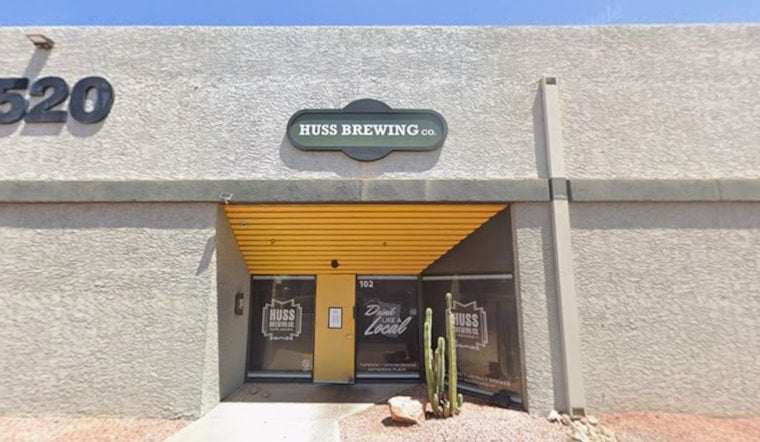
Huss Brewing Company is sending its Scorpion Venom IPA line across state lines, landing the cans on shelves at Albertsons and Vons stores throughout Southern Nevada. The Tempe-based brewery is making the push into the Las Vegas market this month as it also celebrates its 13th anniversary.
The expansion was reported by Arizona's Family, which detailed how the brewery is scaling up distribution of its Scorpion Venom beers into new grocery chains. Shawn Weller, vice president of sales and chains with Huss Brewing Company, discussed the brewing process behind the beers now heading to Nevada coolers. The Scorpion Venom lineup includes a West Coast IPA at 7.6% ABV and 76 IBUs alongside an Imperial IPA at 8.8% ABV, both sold in six-pack cans and 19.2-ounce single cans, according to product listings on DoorDash.
Huss Brewing brews IPAs, wheat beers, lagers and pilsners at its Tempe location, where the company produces over 30 beer styles total, per the same account. Weller said the yeast strain used determines how long the brewing process takes, with the full process running between 10 and 21 days from start to finish. Beer served at the brewery's taproom is transferred from on-site bright tanks into kegs and then into the cooler behind the taps, the station's report notes.
A Brewery Built on Merger and Acquisition
Scorpion Venom was originally a PHX Beer Co. brand before that company merged with Huss Brewing in August 2025 under a new parent firm named Zonafide Beverages LLC, uniting Arizona's second-largest and 12th-largest craft breweries into a single enterprise with projected annual production of nearly 30,000 barrels, according to the Phoenix New Times. Jeff Huss assumed the role of brewmaster for the consolidated brewing operations in Tempe following that deal.
Jeff Huss and his wife Leah Huss founded Huss Brewing in Tempe in August 2013, with Jeff bringing formal brewing education from Chicago's Siebel Institute and Munich's Doemens Academy, while Leah brought 14 years of co-ownership experience at Papago Brewing Company, according to historical reporting cited by Brewbound. Leah managed business and marketing operations while Jeff oversaw brewing on an initial 30-barrel system. In September 2016, Huss acquired the Papago Brewing Company beer brands outright, including the best-selling Papago Orange Blossom mandarin wheat beer, a deal that made Huss Arizona's third-largest craft brewery at the time.
Local Footprint Shifts as Grocery Reach Grows
Huss Brewing now operates two locations in Phoenix and Tempe, a smaller local footprint than it once had. The company's flagship taproom and kitchen in Phoenix's Uptown Plaza, which opened in April 2017, permanently closed in early 2025; that space was later occupied by Dynamite Beer Co. before a Hoodline report on the Uptown shakeup detailed The Sleepy Whale moving in.
Huss still maintains a high-profile downtown presence through a two-story brewpub at the Phoenix Convention Center along Monroe Street, launched in January 2020 in partnership with the City of Phoenix and caterer Aventura. The brewery is also the official craft beer of Sun Devil Athletics, operating the Huss Hideout, a hangout space on the fourth floor of the upper east side of Mountain America Stadium that is available before and during games.
Beer Sales Tied to Student-Athlete Fund
Huss brews the Devil's Halo lager and Devil's Halo IPA under its Devil's Halo line and allocates a portion of proceeds from every Devil's Halo sale to the Sun Angel Collective, an organization that supports student athletes through name, image and likeness compensation. Weller said fans can support Sun Devil athletics simply by purchasing Devil's Halo beer.
The Las Vegas expansion arrives as the craft beer industry nationally faces sustained pressure. U.S. craft beer production contracted by 5.1% in 2025 to 21.86 million barrels, with brewery closures outnumbering new openings for a second straight year, according to data reported by Forbes. Arizona itself was home to 124 craft breweries in 2025, ranking 24th nationally and generating a $1.187 billion economic impact for the state, per Brewers Association statistics. Arizona Craft Brewers Guild leadership has pointed to rising packaging costs and aluminum tariffs as ongoing margin pressures pushing local brewers toward wider retail distribution beyond their home markets.




