

























































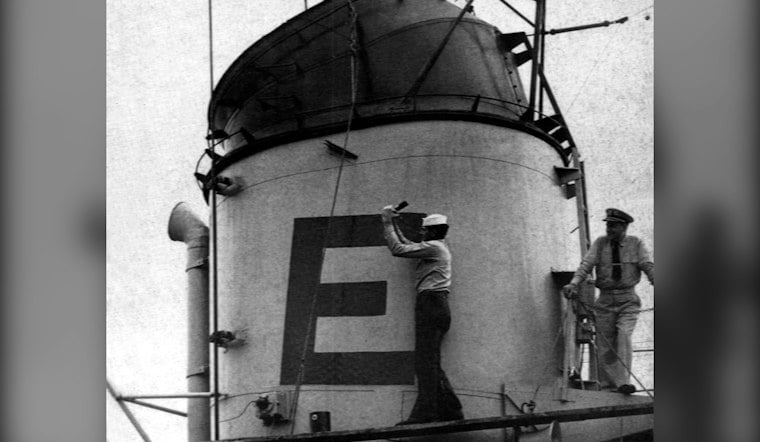
Ozzie Martin was 96 years old and still remembered exactly what it felt like to turn his back on an atomic bomb. He had done it four times as a young sailor stationed aboard the USS Walker in the Marshall Islands, bracing for the flash, then the heat that arrived a few seconds later. This weekend, the Laughlin resident and Korean War veteran boards a very different kind of flight, one bound not for a blast zone but for the war memorials of Washington, D.C.
Martin is one of the local Korean and Vietnam War veterans preparing to join Honor Flight Southern Nevada's trip to the nation's capital, according to FOX5 Vegas. The group leaves Friday morning and will tour the WWII Memorial, the Korean War Memorial, the Women's Vietnam Memorial, the Vietnam Memorial Wall, the Air Force Memorial, and Arlington National Cemetery over the course of the three-day trip, the station reports. FOX5 Vegas says it plans to travel with the group to document the journey.
Before any of that, Martin served as a sonar man aboard the Walker, scanning the deep for enemy submarines in the Pacific. He learned to tell a whale from a threat by ear alone, describing a whale's signature as a mushy echo compared to the sharp ping of a submarine, the station reports. During the Korean War, Martin and his crew worked to destroy a railway North Korean forces were building to move supplies, firing five-inch shells from about a mile offshore while the USS Iowa's 16-inch shells flew overhead toward the same target, according to the same report. The railway was ultimately destroyed, per the station's account.
Witnessing the Birth of the Hydrogen Bomb
Years earlier, Martin's ship carried him into an entirely different kind of combat zone. He observed U.S. atomic bomb blast tests in the Marshall Islands at Enewetak Atoll, watching four separate detonations from positions the station reports were as close as four miles and as far as seven miles from the blasts. He prepared for each one by taking cover and turning his back, catching only the bright flash before the delayed wave of heat rolled over the ship.
Enewetak Atoll and Bikini Atoll were among the main U.S. nuclear testing sites in the Pacific, according to the Atomic Heritage Foundation. The tests Martin witnessed were almost certainly part of Operation Greenhouse, a series of four detonations conducted at Enewetak in the spring of 1951 that were designed to reduce the size and weight of nuclear weapons while increasing their yield, paving the way toward the hydrogen bomb, according to Atomic Archive. The USS Walker served as an escort vessel at Enewetak during that test series before later deploying to the western Pacific to support United Nations naval operations in the Korean War, according to background compiled on Wikipedia — a timeline that links Martin's brush with the atomic age directly to the combat that followed.
At the time, nobody explained to the young sailor what he was being exposed to. Radiation exposure was not discussed, Martin has said, and it was only later, reading his own service record, that he saw it documented in black and white: a measurement of radiation exposure recorded in roentgens, per FOX5 Vegas. Martin says he has experienced no ill effects or sickness from the exposure in the decades since.
Decades of Silence, Now Lifted
Martin's inability to speak freely about what he saw wasn't unusual. Between 1945 and 1962, an estimated 235,000 to 550,000 U.S. service members took part in atmospheric nuclear testing, according to the Eisenhower Presidential Library. Congress repealed the Nuclear Radiation and Secrecy Agreements Act in 1996, allowing atomic veterans to share their stories. For more than four decades, that meant atomic veterans like Martin could not discuss radiation doses with their own doctors or families.
The generation that lived through it is now vanishing. The National Association of Atomic Veterans estimates that only around 400 military personnel who witnessed atmospheric nuclear tests remain alive nationwide as of 2025, per WVOW. National Atomic Veterans Day is observed each July 16, marking the anniversary of the 1945 Trinity test in New Mexico, a designation President Ronald Reagan first established in 1983, according to the VA Minneapolis Health Care system.
Compensation for atomic veterans has had a bumpy legal history. Congress established the Radiation Exposure Compensation Act in 1990, authorizing tax-free lump-sum payments of up to $75,000 for military personnel who developed covered radiogenic cancers after participating in atmospheric testing, according to the U.S. Department of Justice. That program lapsed in mid-2024, leaving future claims in legislative limbo.
A Hero's Welcome Decades in the Making
Away from the battlefield and the blast zone, Martin has kept himself sharp on the lanes. He stays active by bowling and rolled a perfect game at age 70, then bowled a second perfect game just two weeks later, per FOX5 Vegas's reporting.
Honor Flight Southern Nevada is bringing veterans to Washington, D.C., for a three-day trip.
The public is invited to welcome the veterans home Sunday around 3 p.m. at Harry Reid Airport, with a gathering planned near the shops above baggage claim, FOX5 Vegas reports. For a man who once turned his back on the atomic age, it is a different kind of flash to be ready for this time: a terminal full of strangers ready to say thank you.





