

























































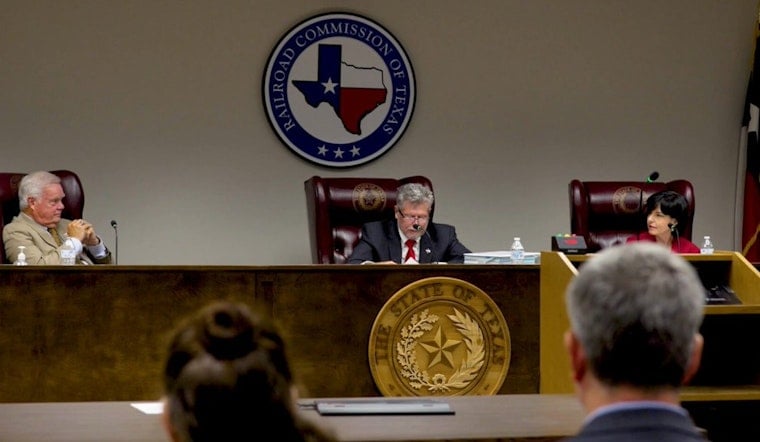
The Railroad Commission of Texas, the state's top oil and gas regulator, voted 2-1 last week to strip public comment from its monthly open meetings, replacing it with staff-run listening sessions that elected commissioners will not attend. The vote came at the commission's August 18 meeting, where the public was not permitted to weigh in on the very policy change eliminating its right to speak.
Commissioners Wayne Christian and Jim Wright voted for the new Public Engagement and Participation Policy, while Commissioner Christi Craddick voted against it, according to the San Antonio Current. Christian introduced the policy himself, and per the Current's reporting, it was not circulated to the public before he brought it forward. Under the old rules, residents could register to speak for up to three minutes at the end of each meeting, but were explicitly barred from addressing anything already on that day's agenda — a restriction Craddick underscored during the meeting by telling speakers, “You are not to speak about things that were posted.”
A Vote the Public Couldn't Weigh In On
The irony was not lost on at least one longtime commenter. Virginia Palacios, who the Current reports has provided public comment at nearly every open meeting since 2021, pointed out the contradiction in real time: “You just approved an agenda item on public participation without allowing public participation.” Commissioners did not call on Palacios to comment on the proposed policy itself, and the commission voted on the measure without reading it into the record, the outlet reported.
The new policy does leave a narrow opening: individual commissioners can still request that a public comment agenda item be added to a future meeting, but the policy does not guarantee comment will happen if no commissioner makes that request. In place of the old floor-comment slot, the agency's Office of Public Engagement — which the commission says educates the public about its work — is now mandated to host listening sessions at least 12 times a year in Austin or online, according to the Railroad Commission of Texas's own order. Those sessions let residents bring concerns directly to commission staff, but not to the three elected commissioners who set policy and vote on enforcement.
Commission Defends the Change as Expanded Access
Railroad Commission spokesperson Bryce Dubee said the policy expands public outreach and accessibility, the Current reported. Christian himself framed the shift in similar terms, saying the policy makes the commission more accessible and that listening sessions provide, in his words, “a more meaningful forum for Texans to ask questions and raise concerns.” The change is the latest piece of Christian's broader push to reshape agency operations: he launched the commission's Delivering Oil and Gas Efficiently, or DOGE, Task Force in June 2025 to streamline permitting and rule-making, and expanded it into a second phase this past June.
Watchdog group Commission Shift sees it differently. In a blog post, the organization argued that listening sessions should not substitute for open meetings, noting that the commission holds one open meeting each month in Austin where the public previously had a formal, if limited, chance to speak. Commission Shift also pointed out that the Railroad Commission does not accept public comment over the phone during open meetings, a contrast with peer agency the Texas Commission on Environmental Quality, which continues to offer remote public comment by phone or video during its own open meetings.
What Texas Law Actually Requires
The commission's move sits within a legal gray area. Under Section 551.007 of the Texas Government Code, enacted through House Bill 2840 in 2019, governmental bodies must allow public comment on posted agenda items — but general, unagendaed public comment periods at state agencies remain discretionary under the Texas Open Meetings Act. That distinction gave the Railroad Commission legal room to eliminate its open-floor comment slot without violating state transparency law, even as critics argue it undercuts the spirit of public accountability.
The Railroad Commission regulates the largest oil and gas industry in the country, along with pipelines and surface mining in Texas — a scope far removed from the agency's original mission. It was founded in 1891 to regulate railroads, but lost its remaining statutory authority over rail transportation in 2005 when the Legislature transferred that oversight to the Texas Department of Transportation. The Texas Sunset Advisory Commission recommended renaming the agency in 2016-17 to better reflect its actual energy-regulation role, but the commission has not acted on that recommendation, and past name-change efforts died in the Legislature amid opposition from oil and gas industry groups.
A Familiar Debate Over Accountability
The policy shift lands amid a broader statewide reckoning over how much scrutiny the commission's three elected officials face. As The Texas Tribune has reported, oversight of the agency became a flashpoint in the 2026 election cycle, with candidates sparring over whether the commission does enough to ensure transparency and environmental enforcement. That debate plays out against a backdrop of significant regulatory strain: state records from December 2025 showed Texas had roughly 155,000 inactive oil and gas wells and more than 11,000 orphaned wells, the kind of environmental liabilities that have historically driven landowners and residents to speak up at commission meetings, as Hoodline previously reported on a rancher's fight over barely-pumping wells on her land.
Whether staff-run listening sessions can fill the accountability gap left by the vote remains an open question. Commissioners themselves do not attend those sessions, meaning residents who once used their three minutes to confront elected regulators directly will now be speaking only to agency employees — with no guarantee their concerns reach the commissioners who actually cast votes.





