

























































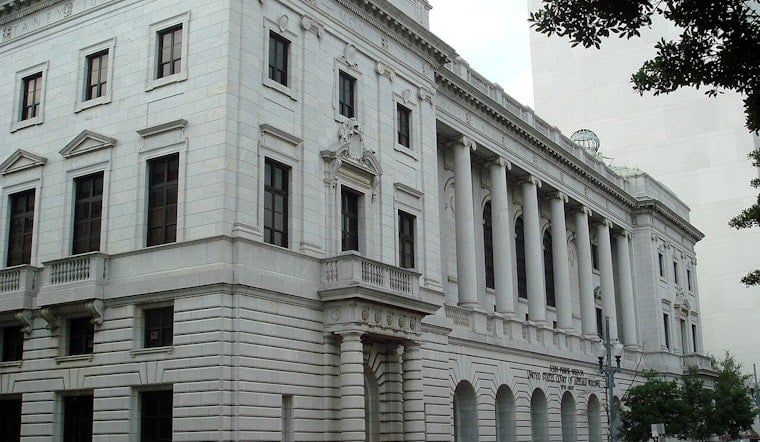
A federal appeals court is now deciding whether a 155-year-old law written to stop Ku Klux Klan violence against Black voters can be used to punish a Texas man for surrounding a Biden campaign bus with his truck in 2020. Eliazar Cisneros, who organized a convoy of Trump supporters that trailed the bus along Interstate 35 between San Antonio and Austin, is asking the U.S. Fifth Circuit Court of Appeals to overturn a $40,000 verdict a federal jury handed down against him in September 2024.
The Fifth Circuit heard oral arguments on Tuesday over whether the Ku Klux Klan Act of 1871 applies to the October 30, 2020 incident, in which roughly 40 vehicles flying Trump flags surrounded the bus and forced it to slow to between 15 and 25 mph during a 90-minute encounter on the interstate, according to Courthouse News. Cisneros eventually side-swiped a campaign volunteer's SUV during the confrontation, and court records show he later bragged about the crash on social media, per the original report from Chron.
The 2024 trial ended with a federal jury finding Cisneros liable while clearing five other defendants of any responsibility. Jurors ordered him to pay $40,000 total to three plaintiffs — bus driver Timothy Holloway, former state senator Wendy Davis, and campaign staffer David Gins — structured as $10,000 in compensatory damages to Holloway and $30,000 in punitive damages shared among the three, according to The Week.
Arguing Over an 1871 Law's Reach
Cisneros's attorney, Quico Canseco, told the panel that the Reconstruction-era statute — 42 U.S.C. § 1985(3) — requires proof of either state action or racial animus, and that applying it to an ordinary political highway encounter would create overbroad federal liability, according to the same Chron report. Canseco argued the law addressed conspiracies tied to racial violence and government action following the Civil War, not a modern-day dispute between private citizens on a public road, and warned that expanding its reach could chill the electoral process.
The Ku Klux Klan Act of 1871, enacted under President Ulysses S. Grant, was passed during Reconstruction specifically to combat white supremacist groups using armed violence to intimidate Black voters. It contains what legal scholars at the Harvard Law Review describe as a rarely litigated Support or Advocacy Clause, an obscure provision that creates a civil cause of action against private political conspiracies targeting supporters of federal candidates. Unlike other federal voter-protection statutes, such as provisions in the Voting Rights Act of 1965 or the Civil Rights Act of 1957, Section 1985(3) explicitly lets private citizens sue private conspirators for monetary compensatory and punitive damages, per research from Georgetown Law.
Erica Ross, who represents Davis, Gins and Holloway, countered that the convoy's actions went far beyond routine political speech. She argued the confrontation was not normal partisan back-and-forth, telling the panel the evidence showed the convoy created a dangerous situation on the highway that included brake-checking and surrounding the bus, and that the convoy's conduct ultimately caused an accident, per the Chron report.
Judges Press Both Sides on Where the Line Falls
The three-judge panel pressed both attorneys on where the statute's boundaries should sit, questioning whether government involvement is required to trigger liability and whether the relevant section of the law even creates its own independent right to sue. Judge Andrew Oldham, appointed by President Trump, appeared skeptical that the Reconstruction-era law should apply to the 2020 convoy, according to Bloomberg Law's account of the hearing cited in the Chron report.
Oldham posed a hypothetical to Ross, asking whether someone could bring a Ku Klux Klan Act claim against people who drove onto private property and destroyed political signs. Ross responded that such conduct could support a cause of action. The judges took the case under submission and did not immediately rule, with a decision expected at a later date.
A Trail of Settlements and Reforms Before Trial
Tuesday's hearing is only the latest chapter in a legal saga that began well before the 2024 verdict. Two of the original eight defendants, Hannah Ceh and Kyle Kruger, reached a confidential settlement with the plaintiffs back in April 2023 and issued public letters of apology for driving within inches of the campaign bus and for using social media hashtags like #operationblockthebus, according to Protect Democracy. The remaining six defendants proceeded to trial, where the jury cleared five of them.
Separately, the City of San Marcos paid $175,000 in October 2023 to settle a federal lawsuit brought by four bus passengers who alleged that local police officers and dispatchers ignored multiple 911 distress calls during the freeway pursuit. As part of that settlement, first reported by the San Antonio Current, the city agreed to mandate specialized training for all police officers and professional staff on recognizing and intervening in incidents of political violence and voter intimidation.
Court records filed before the 2024 trial also detailed Cisneros's history: he had posted a photo of a firearm online before the incident, previously drove his truck into a Black Lives Matter protest in 2020 without facing criminal charges, and traveled to Washington, D.C. on January 6, 2021, according to Texas Public Radio. Plaintiffs used those records to establish what they characterized as a pattern of political aggression.
The original 2020 confrontation had real-world consequences for the campaign itself. The Biden-Harris campaign was forced to cancel three scheduled events in Central Texas, including stops in San Marcos and Austin, on the final day of Texas early voting due to safety concerns, according to Courthouse News. Plaintiffs cited those cancellations as evidence that voter advocacy was directly suppressed by the convoy's actions.
Whatever the Fifth Circuit ultimately decides, the ruling could set precedent for how an 1871 civil rights statute applies to modern political demonstrations and mobile campaign harassment — an outcome that will resonate well beyond the stretch of interstate where the bus was surrounded nearly six years ago.





