

























































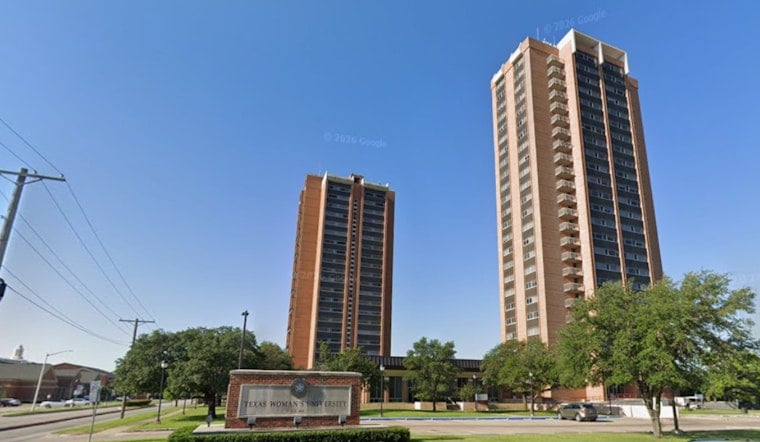
Texas Woman's University wants to open a college in downtown Dallas built specifically for students the higher education system has never managed to reach — nearly 8,000 of them from a single graduating class. The university's Board of Regents approved moving forward with the plan on August 14, setting a target launch of fall 2027 for a campus that would combine a low-cost associate degree with a guided path into a bachelor's program.
The proposed TWU Downtown Dallas College would be leased space rather than a new building, and as reported by The Dallas Morning News, TWU has not yet announced the specific location, though the university is negotiating a lease now. Downtown Dallas is served by DART's red, blue, green and orange light rail lines, a detail that matters because TWU has committed to providing participating students with annual DART passes, laptops and meals as part of the program.
The model driving the plan comes from the Come To Believe Foundation, a national framework that creates degree-granting two-year colleges embedded within four-year universities for low-income students underrepresented at selective schools, according to the Dallas Morning News's reporting on the university's plans. The foundation has committed a $500,000 implementation grant to TWU, which the university expects to use for startup costs before any students enroll, and TWU is also seeking matching philanthropic support. Christopher Johnson said TWU is modeling the college as an access college rather than a remedial college, according to the same report.
A Model Born at a Jesuit College in Chicago
The Come To Believe approach traces back to 2014, when Fr. Steve Katsouros founded Arrupe College at Loyola University Chicago to give low-income, first-generation students affordable, structured two-year degrees embedded within a four-year university, according to the Come To Believe Network. Arrupe served as the pilot before the foundation was created to replicate the framework nationally. Across institutions that have adopted it, two-year completion rates run nearly three times the national community college average, and more than 80 percent of graduates transfer into four-year bachelor's programs, per data cited by Loyola University Chicago — a stark contrast with national two-year community college graduation rates that linger near 13 to 15 percent.
TWU joins a growing list of schools adopting the framework, including Butler University in Indiana, the University of St. Thomas in Minnesota, and the University of Mount Saint Vincent in New York, per the Come To Believe Network. But the Dallas Morning News reports that the TWU proposal would make it the first public university in the country to implement the Come To Believe model, a distinction that puts the state-supported system in unfamiliar territory as it tests whether the framework can work outside a private university setting.
Reaching Students the Pipeline Never Caught
The recruitment target is specific: TWU is aiming for the 7,944 students in the 2025 Dallas County Promise graduating class who have not enrolled in college, the Dallas Morning News reports. Dallas County Promise is a scholarship and advising initiative for eligible high school seniors that covers remaining tuition after other financial aid is applied, and it has grown substantially since its 2017 launch, when it served roughly 9,000 seniors across seven school districts. By 2025, according to the Dallas Regional Chamber, the initiative served 28,000 high school seniors across 85 high schools in 11 public school districts and two charter networks, covering more than 80 percent of graduating seniors in the county.
TWU also plans to recruit through community organizations, faith-based groups, nonprofit organizations and other institutions, per the Dallas Morning News's account of the university's outreach strategy. Applicants must meet TWU's general undergraduate admissions requirements and have at least a 2.5 high school GPA, and students may enter with dual-credit coursework already completed.
The economic stakes behind that recruitment push are laid out in Georgetown University Center on Education and the Workforce projections showing that 63 percent of Texas jobs will require postsecondary education by 2031. Yet only 22 percent of Black and 18 percent of Hispanic young adults in Dallas County currently reach living-wage benchmarks, a gap Hoodline examined in its Dallas County wage gap analysis. The living wage benchmark for a one-adult, one-child household in Dallas County is $62,407.
How the Money and the Schedule Work
Students in the program would attend classes four days a week, generally from 9 a.m. to 3 p.m., with a fifth day reserved for internships or work, according to the Dallas Morning News. TWU hopes to create a paid employment opportunity for every student who wants one, though the university will not guarantee any particular student a particular job. Students will pay regular TWU tuition and fees, but the university plans to limit each student's out-of-pocket contribution to about $1,000 per year.
The financial model behind that limit relies on layered funding sources: roughly $2,200 per student per year in state formula funding, another $2,200 in Texas Grant funding, and about $6,500 in federal Pell Grant and Supplemental Educational Opportunity Grant support, all per the Dallas Morning News's reporting on the university's projections. TWU will rely on regular federal Pell Grants rather than Workforce Pell. Once enrollment reaches 300 students, the model also includes about 50 workforce-funded slots at $7,500 per student per year and roughly 30 employer-sponsored slots at $5,250 per student per year.
The first cohort could enroll about 150 students, with the college eventually growing to serve about 300. Its first academic pathway would be a low-cost Bachelor of Business Administration, and students could earn an Associate of Science in business after completing 60 credit hours — with the option to stop at the associate degree without immediately continuing toward the bachelor's.
Approvals Still Needed Before Fall 2027
The college cannot enroll students until it receives required state and accreditation approvals. TWU plans to submit a prospectus to the Southern Association of Colleges and Schools Commission on Colleges and a proposal to the Texas Higher Education Coordinating Board by December 31, according to the Dallas Morning News. SACSCOC requires the prospectus because TWU would be adding an entirely new associate-degree level to its offerings, and the plan also needs sign-off from the Texas Higher Education Coordinating Board. TWU has said it does not anticipate the approval process affecting the planned fall 2027 launch, per the university's own statements to the Dallas Morning News.
That timeline follows a February 2026 update TWU Dallas President Monica Christopher gave to the Board of Regents outlining plans to double university enrollment in Dallas, which included initiating the feasibility study for the embedded associate degree model in partnership with the Come To Believe Foundation, according to Texas Woman's University. The downtown plan would sit alongside TWU's existing Dallas footprint at the T. Boone Pickens Institute of Health Sciences, an eight-story, 190,000-square-foot facility in the Southwestern Medical District that opened in February 2011 and primarily houses upper-level and graduate healthcare programs.
It also follows another recent expansion: TWU opened a $107 million, 136,000-square-foot Health Sciences Center on its Denton campus in February, backed by $100 million approved by the Texas Legislature to help address statewide nursing and healthcare shortages, as Hoodline reported in its coverage of the Denton health hub. TWU and Dallas College will continue their existing transfer partnerships, and the university has said the downtown college is meant to complement Dallas College rather than replace it.
A Funding Landscape Rewarding Completion
The timing also lines up with a shift in how Texas funds its public universities. The Texas Higher Education Coordinating Board rolled out a proposal in July to move public university funding toward a performance-based model that allocates 60 percent of state incentive money to completion of credentials of value and 40 percent to student milestone credit thresholds, with extra funding weights for Pell Grant recipients and high-demand fields, as Hoodline detailed in its report on the pay-for-performance proposal. An outcome-focused model like TWU's downtown college would align closely with that funding direction.
Founded in 1901, TWU became fully coeducational in 1994 and formally transitioned into a university system in 2021, and it remains the nation's largest state-supported university primarily for women, operating campuses in Denton, Dallas and Houston that serve more than 15,000 students. Several details remain unsettled: the exact downtown lease location has not been disclosed, the formal SACSCOC and THECB approval timeline runs through the end of the year, and how employer workforce partnerships will be structured to guarantee paid student slots has not yet been spelled out.





