

























































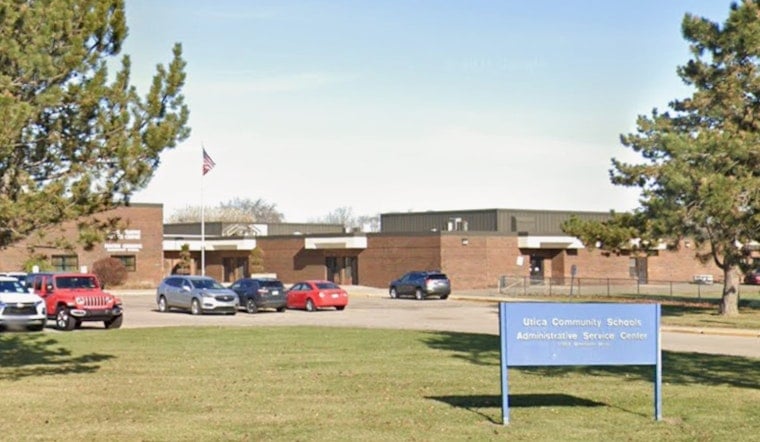
Utica Community Schools plans to open the newly rebuilt Swinehart Stadium on Sunday, capping a $16.9 million overhaul that took more than a year to complete and doubled the venue's seating capacity to nearly 4,000 fans. The stadium serves as the shared home field for Eisenhower and Utica High Schools, and a ribbon-cutting will mark the official completion of the project.
The renovation was funded through the district's $550 million Safety and Success Bond, which voters approved in 2023, according to WXYZ 7 News Detroit. Utica Community Schools Superintendent Robert Monroe said $16.9 million is a lot of money and that the district wants to stretch its dollars for both communities it serves. Construction began in 2025, and crews were still putting on finishing touches during a recent visit to the site, per the same report.
For Angela Micinski, Utica High School's head varsity cheerleading coach since 2014, the upgrade fixes a problem she has lived with for over a decade. She described the stadium as her home field and said the old speakers reverberated and the sound system was off. The old speaker setup, located near the lights, created problems during games and performances, and Micinski said she is most excited about the new field-level speaker system now installed at the stadium.
A Fresh Start for a Shared Rival Field
The rebuilt stadium also includes an enhanced press box and improved concourse and entrance points, upgrades that arrive alongside the new seating and sound system. For Eisenhower High School senior and slot receiver Nico Smith, the opening carries personal weight. Smith, who had previously only driven by the stadium, visited Swinehart for the first time as part of the outlet's report and said he is excited to be part of the first senior group to play at the rebuilt venue.
Swinehart's finished capacity is double that of the old facility, a jump that reflects how central the stadium is to game days on both sides of the Eisenhower-Utica rivalry. The district's zero-tax-rate-increase structure for the bond meant the overhaul was funded without raising the millage rate for local homeowners, a fiscal mechanism Utica Community Schools has described as central to how the $550 million package was pitched to voters back in 2023.
Traffic Fixes and a Sequenced Renovation Plan
Off the field, the Swinehart project also brought a new signalized intersection and a redesigned entrance layout along Shelby Road, aimed at easing the severe game-day traffic backups long shared with nearby Wiley Elementary School, according to The Arrow. That congestion had built up over years of overlapping school pickup hours and athletic events at the same access point.
District officials also intentionally staged construction so that renovations at Runkel Field, which serves Henry Ford II and Stevenson High Schools, would not overlap with the Swinehart project. Utica Community Schools plans to begin work at Runkel immediately after the fall 2026 season, with completion scheduled for fall 2028, ensuring the district's high schools do not lose their home venues at the same time.
Part of a Much Larger Bond Program
Swinehart Stadium is only one piece of a broader capital overhaul tied to the 2023 bond. The same funding package financed $9 million to $10 million athletic complexes at Stevenson, Henry Ford II, and Eisenhower High Schools, including synthetic turf baseball and softball fields and expanded tennis courts, as reported by C & G Newspapers. Utica Community Schools, the second-largest public school district in Michigan, serves more than 25,200 students across 38 facilities spanning Utica, Shelby Township, Sterling Heights, and portions of three surrounding townships, which helps explain why a single shared stadium carries so much weight for so many families.
Ground broke on the Swinehart reconstruction on January 29, 2025, kicking off more than 18 months of work that stripped the old facility down to replace grandstands, sound systems, concourses, and press boxes. Beyond athletics, the same bond program is funding the conversion of retro-era open-concept elementary schools into walled classrooms, the installation of shatter-resistant security glass, and complete rebuilds of Graebner and DeKeyser elementary schools. Effective in fall 2027, the district will also move every school to a standardized K-5, 6-8, 9-12 grade structure, retiring its long-standing junior high system.
Named for a Coach Who Launched a Major League Career
The stadium's name honors former Utica High School baseball coach Barney Swinehart, who is remembered for helping launch the professional career of 1950s pitcher Duke Maas by arranging a 1948 tryout for him with the Detroit Tigers at Briggs Stadium, according to the Society for American Baseball Research. Maas went on to pitch seven seasons in Major League Baseball, including 21 starts for the New York Yankees in 1959.
Utica's bond fits into a wider Metro Detroit pattern of suburban districts asking voters for enormous, zero-tax-rate-increase packages to address aging buildings, as Hoodline detailed in its report on Metro Detroit's mega school bonds. Troy voters approved a $555 million bond in 2022, and Novi put forward a $425 million proposal in 2025, both part of an effort to chip away at a statewide infrastructure shortfall that a state-commissioned study pegged at more than $5 billion in critical short-term school repair needs across Michigan.
For now, the attention in Utica is squarely next Sunday's ribbon cutting and the first football games to be played under the new lights and speakers. Smith and his fellow seniors will be the first class to call the rebuilt Swinehart home, while Micinski's cheer squad finally gets a sound system that, in her words, will replace years of reverberation and off-audio with something that actually works.





