

























































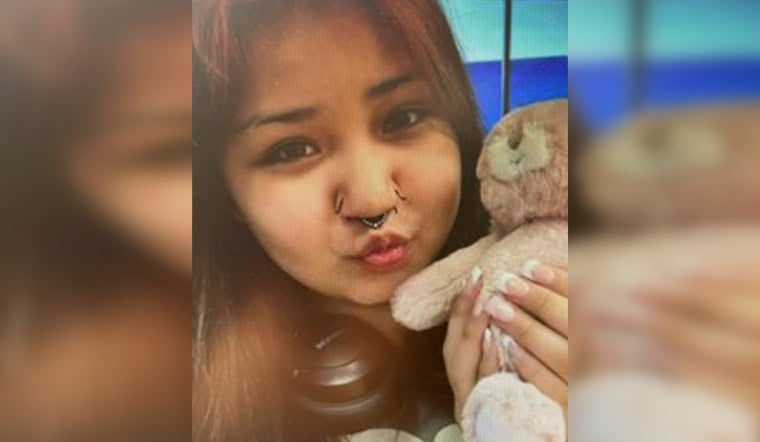
A 15-year-old girl with teal-dyed hair has been missing from Vancouver, Washington since the morning of July 24, and state troopers only issued a statewide alert for her Wednesday — more than two weeks after she disappeared. Jimiah Fornsby-Soloman was last seen around 7:30 a.m. in the area of NE 118th Avenue, walking on foot in an unknown direction, wearing a green hoodie, gray cargo shorts, and carrying a black backpack.
The Washington State Patrol activated the Missing Indigenous Person Alert on behalf of the Vancouver Police Department, according to a post from WSP Missing Person Alerts. The agency says it received the request to activate the alert on August 12, roughly 18 days after Fornsby-Soloman was last seen. She is described as 5 feet 2 inches tall, 135 pounds, with brown eyes. Her case has been assigned number 2026-13505, and anyone who spots her is asked to call 9-1-1; the Vancouver Police Department's non-emergency line, 360-696-4461, is also listed for tips that aren't urgent.
The National Center for Missing & Exploited Children has also registered an active national missing child record for Fornsby-Soloman, according to the organization, meaning her case is being tracked through federal clearinghouse channels in addition to Washington's state-level alert system. Nationally, NCMEC assisted law enforcement with 29,568 missing child reports in 2024 and recovered 91 percent of those youth, per the Office of Juvenile Justice and Delinquency Prevention.
Why the Alert Took Nearly Three Weeks
The gap between Fornsby-Soloman's disappearance and the formal alert request raises questions about how her case was initially classified, though the dossier does not specify why the request came 18 days after she vanished. What is clear is that Washington law did not require investigators to establish additional proof of danger before seeking a statewide alert. Under the state's Missing Indigenous Person Alert framework, a missing person's Indigenous identity alone satisfies the legal endangerment requirement needed to trigger a broadcast, according to Washington State Patrol's Missing and Unidentified Persons Unit as reported by KIRO 7 News Seattle.
Washington became the first state in the nation to build a dedicated alert system of this kind when House Bill 1725 was signed into law in March 2022, taking effect that July, as KING 5 News reported at the time. The system was designed to streamline communication between tribal, municipal, and state law enforcement agencies, which is why Vancouver police were able to route their request for Fornsby-Soloman through the state patrol rather than issuing a purely local bulletin.
A System With a Strong Track Record — and a Stark Backdrop
Since the alert type launched, it has posted notably high recovery numbers. Between July 2022 and April 2026, the Washington State Patrol issued 220 Missing Indigenous Person Alerts statewide, resulting in 203 successful recoveries, a resolution rate exceeding 92 percent, according to data compiled for the state's Missing and Murdered Indigenous Women and People Task Force by the Washington State Attorney General's Office. Over that same span, the task force's data showed 12 individuals remained missing and five were found deceased.
The alert system exists because of a demographic disparity that researchers have flagged for years. Native Americans account for nearly 6 percent of all missing persons cases in Washington despite making up less than 2 percent of the state's population, per Washington State Patrol data highlighted by Seattle's Urban Indian Health Institute and reported by OPB. Separate state patrol figures published in 2024 found Indigenous residents go missing at a rate of 34.32 per 100,000 people, more than four times the general state population's missing rate of 8.04 per 100,000, according to Real Change, which noted Washington had the fifth-highest overall missing persons rate per capita in the country.
Washington has continued building out its response infrastructure since the alert law passed. In 2023, the state enacted House Bill 1177, creating the nation's first specialized Cold Case Investigations Unit inside the Attorney General's Office dedicated exclusively to missing and murdered Indigenous people cases, a unit that assists tribal, federal, and local agencies including city police departments, according to Washington Courts records. As of late last year, the state had more than 910 active missing persons cases on file, including over 100 open cases involving missing Indigenous individuals tracked by the Washington State Patrol, per the AWARE Foundation.
Part of a Broader Pattern in Recent Weeks
Fornsby-Soloman's case is the latest in a string of Missing Indigenous Person Alerts issued in Washington within the past two weeks. On Tuesday, Hoodline reported on a 16-year-old missing from Aberdeen who also disappeared on foot, and days earlier covered a 28-year-old Westport motorcyclist who has been missing since July 31. Vancouver police did not immediately provide additional detail on Fornsby-Soloman's circumstances beyond what state troopers released, and no further updates on her whereabouts have been reported.





