

























































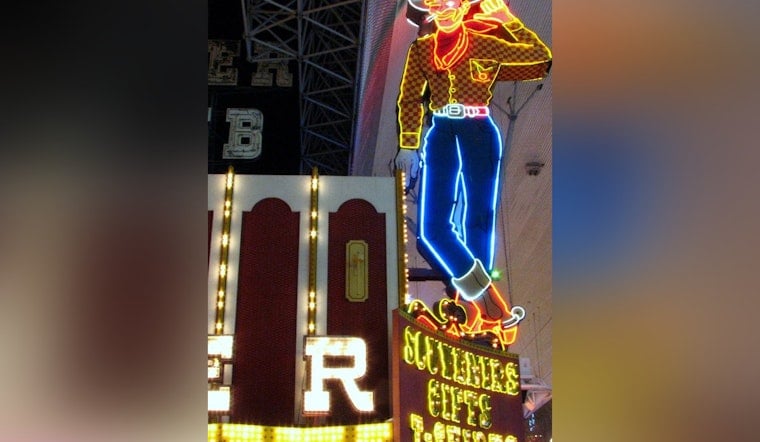
Vegas Vic, the 40-foot neon cowboy who has loomed over Fremont Street since 1951, has become something of a broken promise to the city that made him famous. His mechanical arm hasn't waved since 1991, his recorded greeting has been silent since the mid-2000s, and residents and tourists keep complaining that the lights meant to keep him glowing are frequently off or malfunctioning.
The sign, described as a 70-year-old Las Vegas legend by The Independent, sits on East Fremont Street and has long served as an unofficial welcoming symbol for Sin City. It's also featured in various media over the decades, cementing its place as one of the city's most recognizable pieces of neon history. Yet its future, according to the outlet, remains uncertain.
City standards require signs like Vegas Vic to stay illuminated from one hour before dusk to one hour before dawn and to be kept in good structural condition, per the same report. The City of Las Vegas confirmed a restoration effort in 2023 intended to ensure the sign was fully lit, but residents and tourists continue to complain about Vic's lights being off or his arm failing to wave, using the hashtag #FixVic to voice their frustration.
A Preservationist's Case for a Full Overhaul
Aaron Berger, CEO of the Neon Museum, has suggested that Vegas Vic requires a thorough restoration, not just spot fixes. Any such restoration would require a significant investment from the sign's property owners, the same account notes, underscoring why a truly comprehensive fix has remained elusive even after previous city-backed efforts.
Vic's story stretches back to a very different Fremont Street. Designed by Pat Denner and built by the Young Electric Sign Company, the sign was commissioned by the Pioneer Club's owners at an estimated cost of $25,000, according to Guinness World Records. When it debuted, it wasn't just a static neon cutout — it featured a waving arm, a moving neon cigarette, and a recorded “Howdy Podner!” greeting that played every 15 minutes, voiced by then-Las Vegas Chamber of Commerce President Maxwell Kelch.
Decades of Silence and Small Indignities
Vic's voice hasn't always been welcome. In 1966, actor Lee Marvin, staying at the neighboring Mint Hotel while filming *The Professionals*, complained that the recording was too loud, and casino executives turned off the audio greeting for nearly two decades, according to the Las Vegas Sun. Local lore even holds that Marvin and his co-stars shot arrows at the sign from their hotel room in an attempt to quiet it down.
The voice was briefly revived in the 1980s before being permanently silenced in the mid-2000s, and the arm itself stopped waving back in 1991, per Guinness World Records. Structural changes have taken a toll too: during construction of the 90-foot Fremont Street Experience canopy in 1994 and 1995, crews had to trim several feet off the brim of Vic's cowboy hat just so the sign could fit beneath the new structure, according to Nevada Magazine.
What Happened to Vic's Neon Sweetheart
Across the street, a 25-foot neon cowgirl named Vegas Vickie once stood as Vic's counterpart — the two signs were even symbolically “married” in a 1994 ceremony. Vickie was removed in 2017 and restored inside Circa Resort & Casino's atrium in 2020, according to the Neon Museum, offering one model of how a historic sign can be preserved by moving it out of the elements entirely.
Vic never got that option. The Pioneer Club closed its gaming operations in 1995, and the property was purchased in 1998 by Schiff Enterprises, which converted the interior into a souvenir shop while keeping the sign on the building's exterior, per Classic Las Vegas. Because there's no gaming revenue behind the property anymore, day-to-day maintenance has fallen to retail operators rather than a resort with deep pockets.
A Nevada Cousin Points to One Possible Fix
Vic isn't the only mid-century neon cowboy showing his age. Wendover Will, a 63-foot “cousin” sign built by YESCO in 1952 in West Wendover, Nevada, got a full refurbishment in late 2023 for $175,000, converting its traditional neon tubing to modern LED lighting, according to YESCO. West Wendover funded that overhaul specifically to cut down on energy and maintenance costs going forward.
YESCO leadership has said Vic is expected to remain traditional neon rather than switch to LED, which means frequent maintenance visits to replace burnt-out glass tubes will likely continue indefinitely. Neon purists and local preservationists tend to favor keeping the original gas-filled tubing over an LED retrofit, even though that choice makes the sign more labor-intensive to keep running. A similar YESCO creation, a twin replica called River Rick built in 1981 for the Pioneer Hotel & Gambling Hall in Laughlin, has fallen into complete disrepair and was non-operational as of 2024, illustrating how these mid-century landmarks can decay without dedicated intervention.
For now, Vegas Vic remains upright but diminished — a static neon outline of the animated cowboy that once greeted Fremont Street with a wave and a shout. Whether the sign gets the full restoration Berger and the Neon Museum have called for likely depends on some combination of the property owners, city agencies, and preservation advocates deciding who foots the bill for keeping a 70-year-old piece of Las Vegas history glowing the way it used to.





