

























































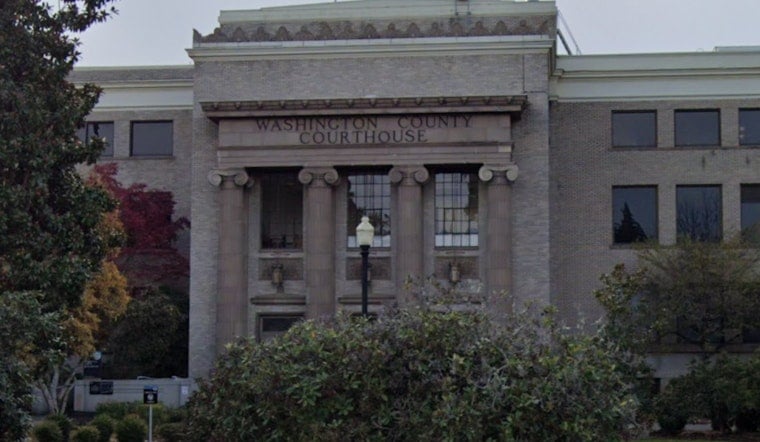
A 40-year-old Washington County man is facing six misdemeanor charges after prosecutors say he recklessly set fire to a Seventh-day Adventist church, threatened a man aboard public transit, and disrupted traffic on a public way. David Warren Stipe was charged on August 3 in Washington County Circuit Court and appeared in custody, according to court records.
The charges stem from an incident in which Stipe allegedly damaged Seventh-day Adventist church property by setting a fire, as reported by KPTV. He was charged with reckless burning, a Class A misdemeanor, along with second-degree criminal mischief, also a Class A misdemeanor, for intentionally damaging church property. The charging document was signed by Deputy District Attorney Alicia Gerten on behalf of Washington County District Attorney Kevin Barton.
Prosecutors also allege that Stipe attempted to place a man named Steven Wesley Judd in fear of imminent serious physical injury while on a public transit vehicle or station, according to the district attorney's information. That conduct led to a menacing charge, a Class A misdemeanor. Stipe was additionally charged with interfering with public transportation, also a Class A misdemeanor, after allegedly obstructing vehicle or pedestrian traffic on a public way. Two counts of second-degree disorderly conduct, a Class B misdemeanor, round out the six-count filing, stemming from disorderly conduct authorities say Stipe engaged in.
What the Charges Actually Mean Under Oregon Law
Notably, prosecutors did not pursue felony arson charges against Stipe. Under Oregon law, reckless burning under ORS 164.335 covers reckless property damage by fire as a Class A misdemeanor, while intentional burning of a structure would fall under first-degree arson, a Class A felony carrying up to 20 years in prison. The distinction hinges on proving intent — Oregon courts require specific evidence that a defendant deliberately set fire to a dwelling or protected structure before a felony arson charge can go to a jury.
Second-degree criminal mischief under ORS 164.354 applies when a person intentionally damages another's property or recklessly causes damage exceeding $500, a threshold that separates it from the lesser third-degree offense. Menacing, defined under ORS 163.190, requires intentionally attempting by word or conduct to place someone in fear of imminent serious physical injury. Meanwhile, interfering with public transportation under ORS 166.116 covers a range of conduct, from unlawfully entering transit property to obstructing transit movement or subjecting passengers and employees to harassment — a law Oregon lawmakers strengthened in 2024 to bolster transit safety enforcement.
Potential Penalties and Prosecutorial Posture
Under Oregon Revised Statutes 161.615 and 161.635, each Class A misdemeanor — including reckless burning, criminal mischief, menacing, and interfering with public transportation — carries a maximum of up to 364 days in jail and fines of up to $6,250 per count. That ceiling, once a full year, was trimmed by one day in 2017 specifically to avoid triggering federal immigration consequences tied to a full-year sentence. The two Class B disorderly conduct counts carry lighter maximum penalties of up to six months in jail and $2,500 in fines each. Taken together, the six counts against Stipe could expose him to significant cumulative jail time and fines if he is convicted on all charges.
The case arrives amid heightened local attention to crimes against houses of worship in Washington County. At a September 2025 town hall in Beaverton addressing church vandalism, District Attorney Kevin Barton said his office focuses on strict accountability and ensuring punishments fit the crime for offenses against community institutions, according to KGW. Barton's office employs roughly 150 people in a jurisdiction where the overall crime rate runs about 30 percent below the Oregon state average, per county records.
Open Questions and Broader Context
It remains unclear whether the fire at the Seventh-day Adventist church was an isolated act of recklessness or connected to any broader pattern targeting religious institutions. If investigators were to determine the fire was intentional and religiously motivated, it could draw federal review under the Church Arson Prevention Act, which makes intentionally defacing, damaging, or destroying religious property a federal crime enforced by the U.S. Department of Justice. Nationally, federal statistics show an average of 103 house-of-worship arsons per year, with roughly half of all reported fires at such facilities determined to involve arson.
No additional details on the investigation's origin, the extent of the church's fire damage, or the specific transit line involved in the menacing incident were available in the charging information. Stipe's case will proceed through Washington County Circuit Court, where the six misdemeanor counts remain pending.





