

























































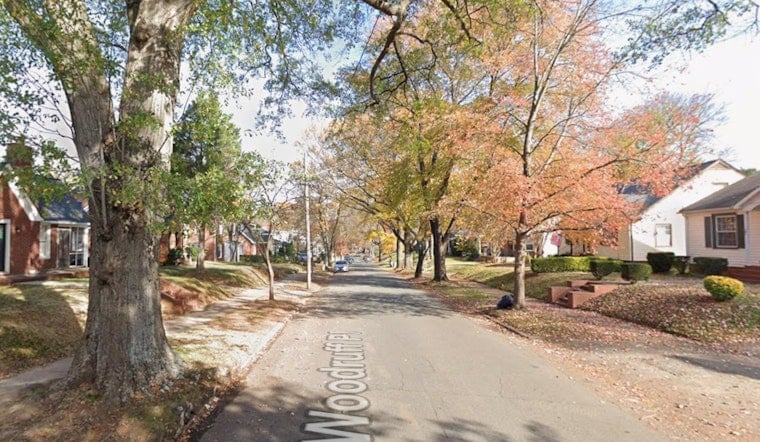
Dan Crawford and Dean Forbis started noticing something odd across the street from their Wesley Heights home: heavy renovations transforming a modest house on Woodruff Place into something far bigger. By last month, their neighbors had planted handmade signs up and down the block reading no to PadSplit and no to room-by-room rentals, and a fight over the future of one of Charlotte's oldest streetcar suburbs was underway.
The house at 705 Woodruff Place, along with a second property at 701 Woodruff Place, are both undergoing renovations that neighbors allege are turning them into six-bedroom properties marketed for PadSplit listings, according to The Charlotte Observer. Permit applications filed with Mecklenburg County Code Enforcement state that 705 Woodruff Place will become a six-bedroom, six-bathroom single-family home. Before the project began, that same house had just two bedrooms and one bathroom, while 701 Woodruff Place had three bedrooms and one bathroom. Both properties were purchased in June 2022 and their deeds are held by Michelle Harrison, a Charlotte-area real estate agent, under two separate LLCs, per the same account. As of Saturday, construction at 705 Woodruff Place was still ongoing, according to Crawford.
A PadSplit Pitch Video Set Off Alarm Bells
The dispute traces back to a video posted in June by Dominique Rice, who visited the Wesley Heights neighborhood with a video crew and identified 705 Woodruff Place as a six-bedroom, six-bathroom PadSplit in the footage. Rice said the property was being converted from two bedrooms and one bathroom into six bedrooms and six bathrooms, and the video mentioned a targeted completion date of August 1, 2026. Rice previously worked as an account executive for PadSplit before leaving the company and co-founding a consulting firm dedicated to co-living development.
Rice, now managing partner at Summit Bridge, went on to co-host investor webinars this month titled Charlotte, NC Co-Living: Why It's One of PadSplit's Hottest Markets, aimed at recruiting real estate investors into local co-living conversions, according to an Eventbrite listing for the events. PadSplit itself has denied any involvement in the purchases, selection, development or permitting of the Woodruff Place properties, and the company says it is not affiliated with the construction at either address.
Zoning Rules at the Center of the Dispute
Wesley Heights is zoned primarily for single-family residences, and Charlotte's zoning code allows up to six unrelated people to live together in a single-family home, a threshold that helps explain why investors are configuring conversions right at that six-bedroom cap. But under the city's Unified Development Ordinance, a rooming house is legally defined as a property where the owner permanently resides on-site while renting rooms to tenants for at least seven consecutive days — and rooming house owners are required to live on the property under the UDO. Rooming houses are technically permitted in Wesley Heights' zoning district, but neighbors have raised concerns about whether the Woodruff Place properties actually comply with that ordinance, since Harrison holds the deeds through LLCs rather than living on-site.
Adding to the confusion, PadSplit requires a 12-week minimum commitment from renters, though members do have the option to pay to leave early and prospective tenants are not allowed to tour a place before renting. North Carolina's legal definition of transient occupancy covers any stay of less than 90 consecutive days, and PadSplit's minimum stay falls within that definition — a wrinkle residents point to when arguing the arrangement doesn't function like an ordinary single-family household.
Neighbors Organize, City Says It's Reviewing
Frustration boiled over at a Wesley Heights community meeting last month, on July 14, and a Change.org petition opposing the conversions has since reached more than 500 signatures. Wesley Heights is located in Charlotte City Council District 2, represented by Council Member Malcolm Graham, who said the situation was concerning and told the Observer he was waiting for more feedback on whether the properties adhered to zoning ordinances. City officials are reviewing the issue, according to Jack Vandertoll, per the Observer's reporting.
The Wesley Heights Historic District dates to 1911 as Charlotte's first westside streetcar suburb, was designated a Local Historic District in 1994, and is listed on the National Register of Historic Places for its 1920s bungalow architecture — context that helps explain why residents are especially protective of structural changes on these blocks. Separately, city Historic District Commission filings from May show Harrison requesting approval to replace 11 windows and trim on the circa-1941 American Small House structure at 705 Woodruff Place, confirming the property remains under municipal historic review even as the room conversion proceeds.
Why PadSplit Is Booming in Charlotte
PadSplit, founded in Atlanta in 2017, expanded into Charlotte in 2024, according to founder and CEO Atticus LeBlanc, and the platform now has nearly 500 rooms listed across the Charlotte metro area — though none currently in Wesley Heights itself. The company allows property owners to list individual furnished rooms, and in the Charlotte metro area, rooms with shared bathrooms average about $1,040 a month, or roughly $243 a week, including furniture and utilities. That undercuts the area's average one-bedroom apartment rent of $1,324 a month, according to Zillow data cited by the Observer.
PadSplit members pay a one-time fee and have a median annual income of $32,500, the company says. LeBlanc has maintained that PadSplit adheres to all federal, state and local laws. Edward Peugh, co-owner of CLT Buyers LLC and a PadSplit host in Charlotte, described his tenants as people who generally needed a place to stabilize.
PadSplit's platform guidelines require all listed bedrooms to comply with HUD safety codes, including smoke detectors, two points of egress, and a minimum room size of 80 square feet with a minimum wall length of 7 feet. Nationally, the company reported an 86% mature occupancy rate across more than 26,000 rooms in late 2025 even as Southern apartment vacancy rates climbed to 9.0% amid more than two years of declining traditional rents. PadSplit has since surpassed 30,000 rooms and 70,000 residents nationwide, and in April it secured new growth financing from ORIX USA to keep expanding.
For now, the fight in Wesley Heights remains unresolved. Neighbors are waiting on the city to determine whether the Woodruff Place conversions run afoul of the UDO's rooming house rules, while construction on at least one of the two houses continues.



