

























































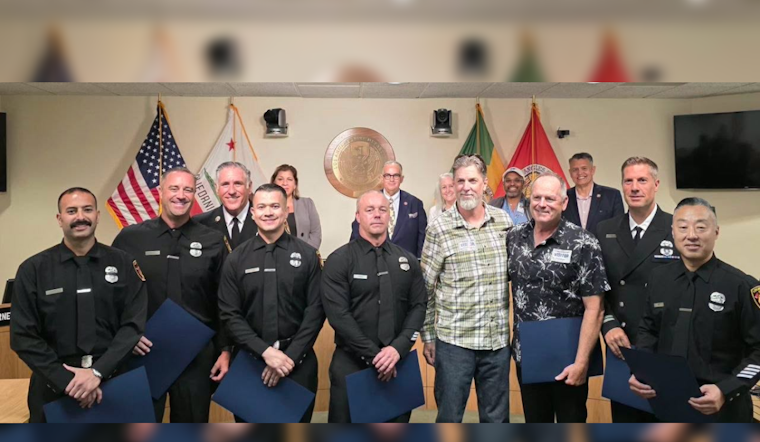
When Ronald Brock collapsed at his Winnetka business on January 5, he had no pulse and the statistics were stacked against him. Sudden cardiac arrest kills the vast majority of people it strikes outside a hospital, but Brock is alive today and fully recovered, thanks to a chain of people who acted before firefighters ever arrived.
A Dispatcher's Voice on the Phone
According to the Los Angeles Fire Department, Brock's business partner, Tim Coleman, began performing hands-only CPR after Firefighter Roee Losycer, a dispatcher with Metro Fire Communications, walked him through the steps over the phone. That guidance started the resuscitation effort before any emergency crew reached the scene, and Brock had no pulse at that point, per the department's account.
When LAFD Engine 104 and Rescue Ambulance 104 arrived, personnel took over with high-performance CPR, deploying a LUCAS mechanical chest compression device and delivering advanced life support, the fire department said. Brock cycled in and out of cardiac arrest during the intervention, and crews administered four defibrillation shocks before he achieved return of spontaneous circulation.
The Local Station Behind the Response
Fire Station 104, which responded to the emergency, is located at 8349 Winnetka Avenue and serves as the primary fire and rescue station for the Winnetka neighborhood in the San Fernando Valley, operating under LAFD's Valley Bureau, Hoodline has previously reported. The same station has been a fixture of emergency response in the area, and its involvement in Brock's rescue underscores how local crews are woven into the broader survival chain that begins the moment someone calls 911.
Why Early Action Made the Difference
Cases like Brock's remain the exception rather than the rule. Approximately 350,000 out-of-hospital cardiac arrests occur annually in the United States, with roughly 90% of cases resulting in death, according to American Heart Association data. The organization's guidelines also note that CPR administered immediately after cardiac arrest can double or triple a patient's chance of survival, and that more than 70% of out-of-hospital cardiac arrests occur at private residences or businesses.
Bystander intervention like Coleman's is still not the norm nationally. The 2025 Cardiac Arrest Registry to Enhance Survival annual report found that 42.5% of adult out-of-hospital cardiac arrest patients received bystander CPR, while just 13.9% of cardiac arrests in public settings had an automated external defibrillator applied by a bystander, per the American Red Cross. A 2025 study analyzing more than 194,000 witnessed cardiac arrests, published on PubMed, found that starting bystander CPR within the first two minutes yielded the highest odds of survival to discharge and favorable neurological recovery, though benefits persisted up to 10 minutes.
Legal Protections for Bystanders Who Step In
California law shields people like Coleman from liability for jumping into action. California Health and Safety Code Section 1799.102, the state's Good Samaritan Law, protects individuals who render voluntary emergency medical or non-medical care in good faith at an emergency scene from civil liability, according to Pines Salomon Personal Injury Lawyers. Separately, Health and Safety Code Section 1797.196 and Civil Code Section 1714.21 extend legal immunity to both trained and untrained laypersons who operate an AED during a medical emergency, per Safety Training Pros. California does not require bystanders to act, but the law removes the fear of a lawsuit for those who do, absent gross negligence.
Part of a Wider Local Pattern
Brock's rescue is not an isolated case in the Los Angeles area this year. Hoodline reported in August on a Bel Air pickleball rescue in which bystanders used CPR and an AED to save a man who suddenly collapsed. In April, a Los Angeles dancer was saved from cardiac arrest by an off-duty nurse who administered immediate CPR at a rehearsal. Together with Brock's case, these incidents point to what emergency responders call the Chain of Survival — the sequence of dispatcher-assisted CPR, rapid EMS deployment, advanced field cardiac life support, and mechanical CPR devices that can turn a historically fatal event into a full recovery.




