

























































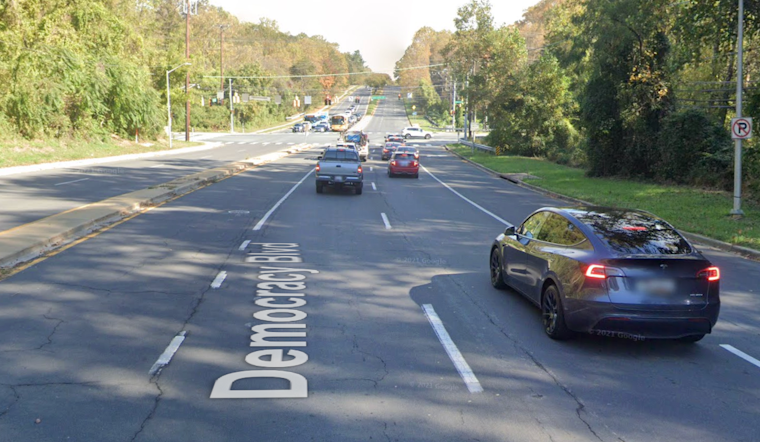
A Ford Mustang traveling the wrong way down southbound I-270 slammed head-on into a Toyota sedan just south of Democracy Boulevard in Rockville on Saturday evening, killing both occupants of the Toyota. The crash happened just after 6:45 p.m. in Montgomery County, and the Mustang's driver was taken to a local hospital.
According to Maryland State Police as reported by WUSA9, the two people killed were both riding in the Toyota that the wrong-way Mustang struck. FOX 5 DC also reported on the fatal collision, noting it left two people dead on the heavily traveled interstate. It remains unclear how the Mustang ended up traveling southbound in the wrong direction, and investigators have not said whether impairment or disorientation played a role.
The condition of the hospitalized driver has not been disclosed, and that detail, along with the exact circumstances that put the car in oncoming traffic, remains an open question as police continue investigating.
How Investigators Piece Together a Wrong-Way Fatal Crash
Fatal interstate collisions like this one typically fall to a specialized statewide unit, the Maryland State Police Crash Team, which uses drone photogrammetry and 3D digital scene mapping to reconstruct what happened before submitting findings to the local State's Attorney's Office for a decision on potential charges, according to agency procedures documented in 2024 and 2025 records reviewed by PIX4D. That kind of detailed reconstruction is often necessary in wrong-way cases, where the sequence of events leading up to impact is not immediately obvious from the wreckage alone.
Crashes of this type tend to be especially lethal. An NTSB special investigation found that more than 80 percent of fatal wrong-way crashes on divided highways involve head-on impacts at high closing speeds, according to a report from the National Transportation Safety Board. Those combined speeds drastically shorten reaction time for both drivers and multiply the force of impact, which helps explain why such crashes so often prove fatal to everyone involved.
A Persistent, Deadly Pattern Nationwide
Research published in March 2021 by the AAA Foundation for Traffic Safety found that wrong-way crashes on divided highways killed 2,008 people nationwide between 2015 and 2018 — an average of roughly 500 deaths a year and a 34 percent increase from prior years, per the AAA Foundation. NTSB data cited in that same research indicated that about 60 percent of fatal wrong-way crashes on divided highways involve alcohol-impaired drivers, with older age and driving without passengers also flagged as common risk factors, since passengers often help a driver recognize a wrong-way entry before disaster strikes.
Maryland's own numbers underscore the scale of the state's traffic safety problem. The Maryland Motor Vehicle Administration recorded 207 traffic deaths statewide during the first seven months of 2026. Between 2019 and 2023, motor vehicle collisions in Maryland caused 2,858 fatalities and 208,587 injuries, according to National Highway Traffic Safety Administration data analyzed by state highway officials and reported by The BayNet, with male drivers accounting for more than 70 percent of driver fatalities during those five years.
I-270's Traffic Volume Raises the Stakes
The stretch of I-270 where the crash occurred is one of the region's busiest commuter corridors, carrying between 180,000 and 210,000 vehicles a day on its central segments, according to Maryland Department of Transportation traffic studies cited by Op Lanes Maryland. That volume means a single wrong-way entry can put an enormous number of oncoming drivers at risk within seconds.
Maryland's Vision Zero statute legally requires state agencies to apply a data-driven Safe System Approach aimed at eliminating all traffic fatalities and serious injuries on public roads by 2030, according to the Maryland Department of Transportation. The policy rests on the premise that human error is inevitable, but fatal roadway trauma is preventable through better road design and technology. Separately, transportation safety studies from the Washington State Department of Transportation and other research groups have found that automated wrong-way detection systems — thermal cameras and flashing signs installed at freeway exit ramps — can cut wrong-way entries and collisions by more than 40 percent, alerting both traffic management centers and state police while giving errant drivers a chance to self-correct.
Saturday's crash adds to a string of similarly devastating wrong-way collisions on highways sharing the I-270 designation elsewhere in the country this year, though the Maryland incident remains under active investigation with no findings yet released on cause.





