

























































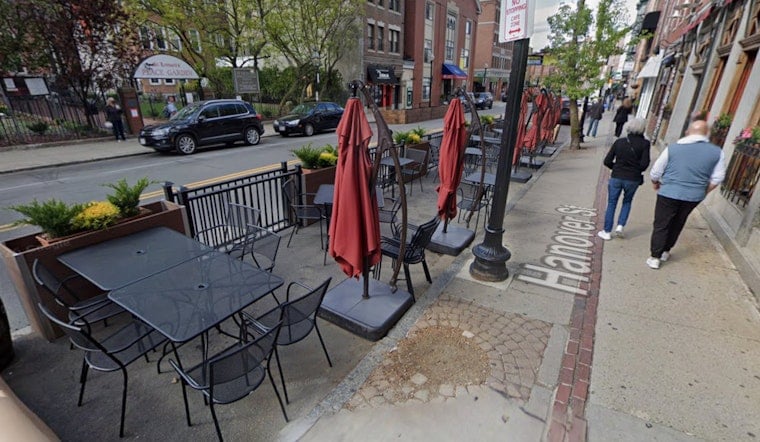
Boston’s North End patio war just got a split decision: Mayor Michelle Wu’s administration won the discrimination fight, but restaurant owners still have a legal lane to challenge the fees that helped ignite the feud.
In its Thursday ruling, the U.S. First Circuit Court of Appeals upheld the dismissal of five claims brought by nearly two dozen North End restaurants and the neighborhood’s chamber of commerce. The court said the city’s outdoor-dining restrictions did not plausibly violate the restaurants’ constitutional rights, while sending the fee-related claim back for dismissal without prejudice in the First Circuit opinion.
Why The City Won The Discrimination Claims
The judges rejected the owners’ argument that Boston targeted them because they are white and Italian, as well as their claim that the policy was retaliation for protesting and suing. The court pointed to the North End’s complaints about parking, traffic, noise, trash, rodents and congestion, writing that addressing those quality-of-life issues is “plainly a legitimate state interest,” according to Boston.com.
The ruling also criticized the restaurants’ 202-page complaint as repetitive and overloaded with irrelevant detail, including an extended discussion of the history of Italians in the North End. In practical terms, the court said the city’s different treatment of the neighborhood could have a rational explanation even if restaurant owners strongly disliked the policy.
The Numbers Behind Boston’s North End Plan
Under the 2022 plan, North End restaurants faced a one-time $7,500 impact fee and a $480 monthly charge for every parking space used by an outdoor patio. The neighborhood’s dining season was also limited to five months, compared with eight to nine months elsewhere in Boston.
The court’s opinion said 62 North End restaurants participated that year, while Boston collected about $300,000 in impact fees and spent nearly $800,000 on the program. Almost 70% of that spending was tied to an electric street sweeper that was decorated for the North End but used citywide, a detail that gives the fee dispute an especially awkward aftertaste.
A Long Feud That Started With Outdoor Tables
The case grew out of a broader fight over whether the city’s pandemic-era outdoor dining program was saving restaurants or overwhelming one of Boston’s tightest neighborhoods. Hoodline previously detailed the original lawsuit, which followed an earlier 2022 case that restaurant owners voluntarily dismissed.
Boston later banned on-street dining in the North End for subsequent seasons while continuing to allow some compliant sidewalk patios. The restaurants argued that the city had singled them out, while officials said the neighborhood’s dense concentration of eateries, narrow streets and resident complaints justified a separate approach.
The Tax Fight Survives On Narrower Grounds
The appeals court did not decide whether the 2022 fees were actually an unlawful tax under Massachusetts law. Instead, it said that question belonged in state-law proceedings after the federal claims were dismissed, leaving the restaurants able to revive that narrower challenge, Boston.com reported.
So the city has its appellate victory on discrimination, due process and retaliation claims, but the fee fight is not completely buried. For North End restaurateurs, the patio battle has lost several tables in court—but one disputed bill is still sitting on the check.





