

























































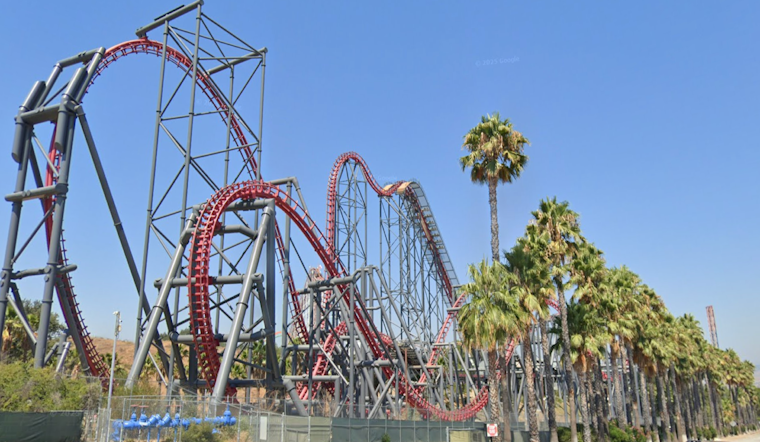
A ride on one of the world's most intense roller coasters ended with an unconscious passenger, a shuttered attraction, and a state safety investigation at Six Flags Magic Mountain. The X2 coaster in Valencia has been closed since a rider incident on July 5, and it remains offline while Cal/OSHA's Amusement Ride and Tramway Unit examines what happened.
The Los Angeles County Fire Department responded to the park after receiving a report of an unconscious person, according to fire officials cited by KTLA. Fire crews and park medical staff handled the incident, per the Los Angeles County Sheriff's Department, though the sheriff's office did not open its own investigation into the matter. KTLA reported it was unable to independently confirm the rider's condition, and Six Flags Magic Mountain officials have not commented publicly on the July incident beyond confirming the ride remains closed at this time.
Cal/OSHA representatives responded to the incident and opened an inspection that is still ongoing, the outlet's report notes. The agency's oversight of theme parks includes reviewing rides after major modifications and responding to complaints, accidents and other safety issues, and under California's Permanent Amusement Ride Safety Inspection Program, operators must report serious rider injuries or fatalities within 24 hours, according to the California Department of Industrial Relations. State law also bars a ride involved in a major incident from reopening until inspectors complete their evaluation and authorize it to resume operation.
A Coaster Built on a Troubled Pedigree
X2 is billed as the world's first fourth-dimensional roller coaster, a top attraction at Magic Mountain known for seats that rotate independently as the train travels through drops and inversions. It reaches speeds of up to 76 mph along a 3,600-foot track, and Six Flags Magic Mountain describes the ride as delivering total sensory overload throughout. It's part of what the park calls its 55-year history as the self-proclaimed thrill capital of the world.
The coaster's engineering history has been rocky from the start. It debuted in 2002 as “X,” a roughly $45 million prototype built by Arrow Dynamics as the company's last coaster, but design defects and severe cost overruns contributed to Arrow Dynamics filing for Chapter 11 bankruptcy in December 2001, according to Theme Park Insider. S&S Power acquired the bankrupt manufacturer's assets in October 2002, and Six Flags later invested $10 million in 2007 to overhaul the ride into X2, adding lighter third-generation trains and updated restraint systems before it reopened in May 2008, per Wikipedia.
Pending Wrongful-Death Trial Looms Over the Case
The July incident arrives as Six Flags faces litigation tied to a previous X2 rider's death. Christopher Hawley, a 22-year-old from Garden Grove, rode X2 in June 2022 with his younger brother and cousin when the coaster jolted to a halt as they neared the end of the ride, according to the lawsuit. Hawley lost consciousness after exiting the ride and was treated at Henry Mayo Newhall Hospital in Valencia, where a CT scan showed he had suffered a catastrophic subdural hematoma; he died the following day.
Hawley's family filed a wrongful death lawsuit in Los Angeles County Superior Court in March 2025, alleging the sudden jolt caused the fatal brain injury and accusing Six Flags of operating a defective attraction without adequate warnings, according to the Los Angeles Times. A jury trial in that case is scheduled to begin in September, according to reporting on the lawsuit cited by KTLA. Six Flags Magic Mountain has not offered a public statement on the lawsuit, citing ongoing litigation.
A Pattern of Safety Incidents at the Park
Magic Mountain has weathered other serious safety episodes involving its thrill rides over the years. In June 2001, a 28-year-old woman died after riding the park's Goliath coaster, then briefly the world's tallest and fastest hypercoaster reaching speeds up to 85 mph; an autopsy determined the stress and G-forces of the ride triggered the rupture of a pre-existing brain aneurysm, according to the Los Angeles Times' archived coverage. A study published in the journal Neurology has separately linked high-speed coasters featuring rapid acceleration and head jolting to traumatic brain injuries, including subdural hematomas caused by the tearing of cerebral bridging veins.
In July 2014, the park's Ninja coaster derailed after striking a fallen pine tree branch, leaving four people with minor injuries and stranding 22 riders 20 to 40 feet above the ground for nearly three hours, as reported by The Guardian. More recently, Hoodline reported on a fire that briefly halted X2 in June, weeks before the July rider incident, and the park closed entirely in May after bomb threats prompted a law enforcement sweep.
How Long Could the Closure Last?
There's no firm timeline yet for X2's reopening. Cal/OSHA's investigative process has moved quickly in other recent cases — the agency's Amusement Ride & Tramway Unit inspected Disneyland's Tiana's Bayou Adventure after separate rider safety incidents in June and cleared it to reopen the following day, according to reporting referenced by the Los Angeles Times. Whether X2 follows a similarly fast path depends on what state inspectors find, and Six Flags Magic Mountain officials say only that the ride remains closed at this time.
Six Flags Entertainment Corporation, which completed a merger of equals with Cedar Fair in July 2024 to become North America's largest regional amusement park operator with 42 properties, has not indicated when the investigation might conclude. For now, one of Magic Mountain's marquee attractions — alongside rides like Tatsu, billed as the world's tallest, fastest and longest flying coaster, and Wonder Woman Flight of Courage, the tallest and longest single-rail coaster — sits idle while regulators sort out what went wrong.





