

























































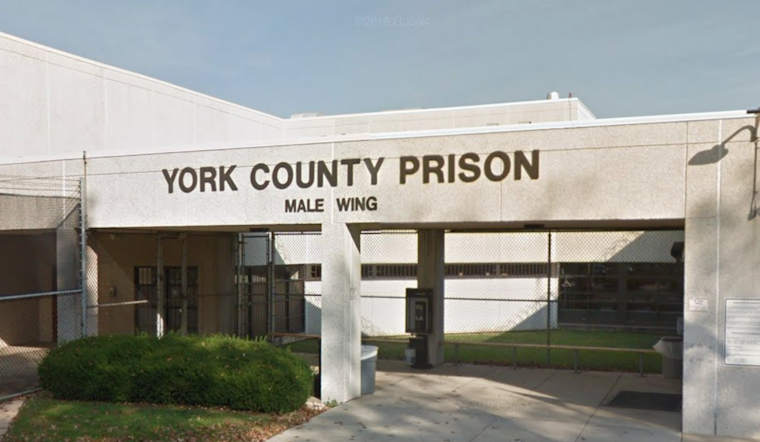
A 19-year-old inmate at York County Prison is facing felony charges after he allegedly sprayed a nurse and a corrections officer with liquid from an empty shampoo bottle, an incident staff believed involved urine because of its smell and yellow color. Gardiner Fryberger insists he only used water, telling investigators the spray was payback after a guard made comments about his mother.
The incident happened on May 5, 2026, when Fryberger allegedly sprayed a corrections officer in the eye while the officer walked past his cell, according to Local 21 News. Some of the liquid also splashed onto a nurse who was nearby. Per an affidavit cited in the report, Fryberger told investigators he sprayed the officer with water, not urine, and said he did it because the officer was saying things about his mother.
Fryberger, who kept the water in an empty shampoo bottle, has been charged with two felony counts of assault, one misdemeanor count of simple assault, and a summary charge for harassment. He told investigators he knew the action was wrong and said he wanted to apologize to the corrections officer, the outlet reported. His preliminary arraignment is scheduled for September 1, 2026.
What the Law Says About Bodily Fluids Behind Bars
Pennsylvania law treats fluid-spraying incidents inside correctional facilities as serious offenses regardless of injury. Under 18 Pa.C.S. § 2703.1, known as “aggravated harassment by prisoner,” intentionally causing or attempting to cause staff to come into contact with bodily fluids such as urine, blood, or saliva is classified as a felony of the third degree, according to Pennsylvania court records. A conviction on that charge carries a statutory maximum of up to seven years in prison and a fine of up to $15,000 per count, per sentencing guidance from the Palissery Law Offices. That statute applies whether the liquid turns out to be urine or, as Fryberger claims, plain water — the legal exposure hinges on intent and belief at the time, not a lab result confirmed in the dossier.
A Facility Under Sustained Scrutiny
The spraying incident unfolded amid a stretch of intense safety scrutiny at York County Prison, located at 3400 Concord Road in Springettsbury Township under Warden Adam Ogle. Pennsylvania State Police have been investigating the April 14, 2026 death of 19-year-old inmate Jacob Brady inside the jail as a homicide, a case Hoodline detailed in its report on the teen inmate slain inside the lockup. That investigation remains active alongside other legal challenges facing the facility.
In July 2026, the U.S. Court of Appeals for the Third Circuit affirmed summary judgment in Goines v. Ogle, a civil rights lawsuit stemming from a June 2024 inmate-on-inmate assault that left a prisoner with a fractured back and orbital bone, according to research published by the Villanova University Charles Widger School of Law. Separately, reporting by The Appeal in July 2026 noted an ongoing federal lawsuit alleging medical neglect against PrimeCare Medical, the private healthcare vendor that supplies medical and nursing staff inside the prison. In November 2025, the York County District Attorney's office arrested a corrections officer at the facility on felony charges for allegedly attempting to smuggle Suboxone contraband inside.
Mental Health Data Behind the Population
Data presented to local planning officials showed that 86% of inmates housed at York County Prison as of June 2024 had a mental health diagnosis, while 34% had a substance use disorder and 22% were receiving medication-assisted treatment for opioid use disorder, according to figures reported by Savvy Citizen. The facility has a design capacity of up to 2,400 inmates plus a 276-bed work release facility, though its average daily population had dropped to 1,001 inmates in early 2024 from 1,613 a decade earlier, according to York County Prison Board records. Those figures offer context for the behavioral and staffing pressures facing officers and medical personnel who work directly inside the cell blocks.
Fryberger's case now heads toward its September 1 arraignment as one more entry in a run of incidents that have drawn outside attention to conditions and safety protocols at the Concord Road facility. Whether the liquid involved was water or urine remains a disputed point between Fryberger's account and the belief held by the nurse and officer at the time, and no additional resolution of that question appears in the record reviewed for this report.





