

























































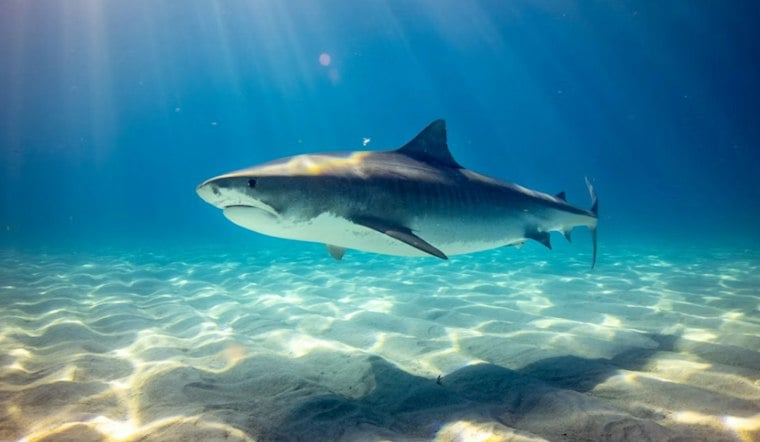
A 24-year-old surfer walked away with only leg abrasions and a broken board after a 12-foot tiger shark clamped down on his surfboard and sent him flying into the open ocean at China Walls, one of Oahu's most notorious South Shore breaks. Albert Westpfal was paddling through turbulent ocean swells near the reef around 4:30 p.m. on September 7 when the shark struck, biting through the tail of his board before charging him a second time.
Westpfal, who was riding a Tokoro surfboard inscribed with the words “Jesus loves you” on its back bottom stringer, told his story to the New York Post, which first reported the account with original reporting credit to Fox Weather. He said he heard the surfboard's fiberglass crunch behind him just before the shark launched him into the water. When the animal charged again, Westpfal punched it in the nose and kicked it in the head, and the shark eventually backed off.
The City and County of Honolulu confirmed the severity of the encounter through an official HNL Alert civil defense message sent at 5:17 p.m. on September 7, warning the public that Ocean Safety lifeguards had confirmed an aggressive shark measuring more than 12 feet at China Walls, according to a post shared by Stolen Stuff Hawaii. Honolulu Ocean Safety separately responded to a report of an aggressive shark encounter in the Portlock area, where China Walls is located.
A Buddy System That Made the Difference
Westpfal was surfing with his college friend Zach Sheerer when the attack happened. After the shark launched Westpfal off his board, Sheerer paddled over to help him, and Westpfal has credited his friend with coming to his aid during the encounter. Westpfal sustained abrasions on his leg from kicking the shark's skin but exited the water safely, and he said afterward that he was thankful to have escaped with only a broken board and leg scrapes.
China Walls has a fearsome reputation independent of any marine life. Professional surfer Jamie O'Brien dubbed it the “most dangerous surf spot on the South Shore” in 2023, pointing to its shallow reef, cliffside takeoff, and violent backwash that crashes against lava-rock walls, as detailed by The Inertia. The break in Oahu's Portlock neighborhood is already known for rogue-wave injuries and swift-water rescues, long before any shark enters the equation.
Storm Swells and Murky Water
The attack unfolded as Hurricane Lowell approached Hawaii as a Category 3 storm, fueling towering waves across the islands. Hawaii DLNR marine biologists note that tiger sharks are opportunistic feeders often drawn to murky or turbid water stirred up by heavy storm runoff and large swells, where reduced visibility increases the likelihood of exploratory bites, per the Hawaii Department of Land and Natural Resources' shark safety fact sheet. Under standard state protocols, warning signs remain posted across a one-mile radius until at least noon the day following an encounter while personnel survey the water, according to Newsweek's earlier reporting on the agency's procedures.
The China Walls bite was not an isolated event this year. Just two weeks earlier, on August 26, a 10-foot tiger shark bumped and bit a surfer's board in turbid water off Ala Moana Beach Park, with that surfer escaping unhurt, per state incident records. And on May 30, an 8-foot Galapagos shark inflicted major lacerations on a 38-year-old surfer's calf and foot off Cromwell's Beach, just west of Portlock along the South Shore.
A Pattern Along Oahu's South and Leeward Shores
Oahu's Leeward and South Shores have logged repeated shark advisories over the past year, including warnings for an 8-foot shark at Makaha in December 2025 and a 10-foot shark at Electric Beach in April 2026. Despite the recent cluster of sightings and strikes, the Hawaii Department of Land and Natural Resources reports that the state averages just three to four unprovoked shark incidents per year across all islands, underscoring how rare severe encounters remain relative to the millions of ocean visitors Hawaii sees annually.
Research from the Hawaii Institute of Marine Biology helps explain why the state relies on advisories and temporary closures rather than culling. Satellite tagging studies cited by the institute found that historic 20th-century shark culling programs failed to reduce attack risks because tiger sharks roam vast home ranges across the Hawaiian Islands instead of defending fixed coastal territories, making localized eradication efforts largely ineffective.





