

























































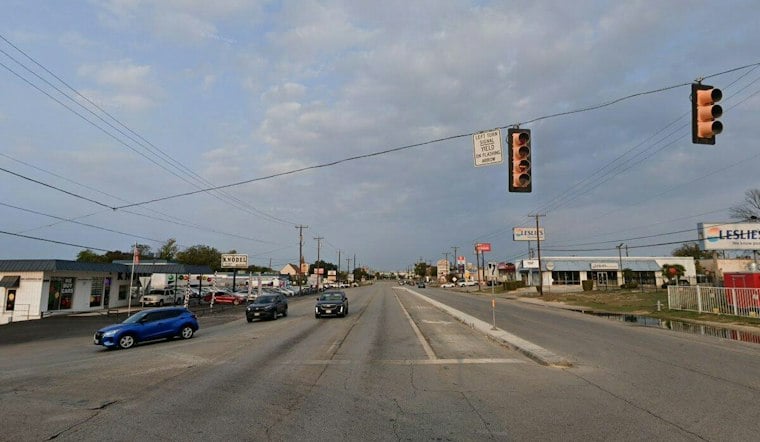
An 80-year-old woman was hospitalized Tuesday after a vehicle struck her while she was crossing Austin Highway at Perrin Beitel Road, reviving longstanding complaints from neighbors that the mid-block pedestrian beacon at the intersection has been malfunctioning for weeks. San Antonio police said the driver was traveling at roughly 30 to 35 miles per hour at the moment of impact, and the crosswalk signal was not working at the time of the collision.
According to WOAI, the pedestrian crossing signs at the location are designed to flash to alert drivers to slow down and stop for people crossing, but people who live and work nearby say the beacon lights have been dark. Jason Chavarria Lopez, who spends time in the area, told the station that people usually do not stop for pedestrians and that the lights are not working, adding that he has watched the beacon work and then stop working again. He said visibility is a problem at night and described the area as very dark after sundown.
Chris Zepeda, another nearby resident, said he was not surprised by the crash and suggested the city install a red light instead of a blinking beacon, arguing that drivers need to stop when people are crossing. City officials told the station they were not aware of the beacon problem in the weeks before Tuesday's crash and plan to investigate. The City of San Antonio said it had not received notification of the malfunction before the collision, even though the Texas Department of Transportation installed the mid-block beacon a few years ago and the city is responsible for maintaining it.
A Corridor With a Documented History
This is not the first fatal or near-fatal pedestrian collision at this exact stretch of roadway. In November 2025, 68-year-old Habiba Adan was struck and killed in a marked crosswalk near the same intersection by multiple vehicles, according to KSAT, in a crash where one driver stopped to render aid while others fled the scene. San Antonio adopted its 2024 Vision Zero Action Plan.
The problems along this stretch of Austin Highway go back further still. A 2017 investigation by KSAT found that marked crosswalks between the 2000 and 2300 blocks were spaced more than half a mile apart, leaving long sections with poor night lighting and sporadic sidewalks — conditions that preceded at least four pedestrian deaths along the same corridor between 2016 and 2017.
Roadway Jurisdiction and Beacon Maintenance
Austin Highway is designated State Loop 368 and falls under Texas Department of Transportation jurisdiction. The City of San Antonio is responsible for maintaining the pedestrian beacon.
Texas law places an obligation on drivers, subject to specific conditions, regardless of whether a beacon is functioning. Under Texas Transportation Code Section 552.003, drivers must stop and yield to pedestrians in a marked or unmarked crosswalk when traffic control signals are absent or not operating if the pedestrian is on the vehicle's half of the roadway or approaching closely enough from the opposite half to be in danger; the duty does not apply when a pedestrian suddenly enters the vehicle's path, according to FindLaw. Separately, the Lisa Torry Smith Act, codified as Transportation Code Section 545.428 and passed in 2021, makes it a Class A misdemeanor or state jail felony for a driver who operates a vehicle with criminal negligence in a crosswalk and causes bodily injury or serious bodily injury to a pedestrian.
A Citywide Pattern of Pedestrian Danger
The Austin Highway crash lands within a broader regional trend. Pedestrian-involved collisions across the eight-county San Antonio metro area exceed 1,000 annually. In San Antonio, 2024 saw 769 pedestrian-involved incidents and 83 deaths.
In response, the city launched a federal Safe Streets for All-funded campaign called Keep Crossings SAfe in November 2025, placing life-size silhouettes near high-risk corridors to boost driver awareness. Elsewhere in the city, infrastructure fixes have shown results: newly installed pedestrian hybrid beacons on Pleasanton Road helped cut total corridor crashes by 13 percent amid longstanding safety concerns. Residents near Austin Highway and Perrin Beitel now hope similar repairs and improvements arrive soon, saying they want to prevent another person from being hurt at the intersection.





