

























































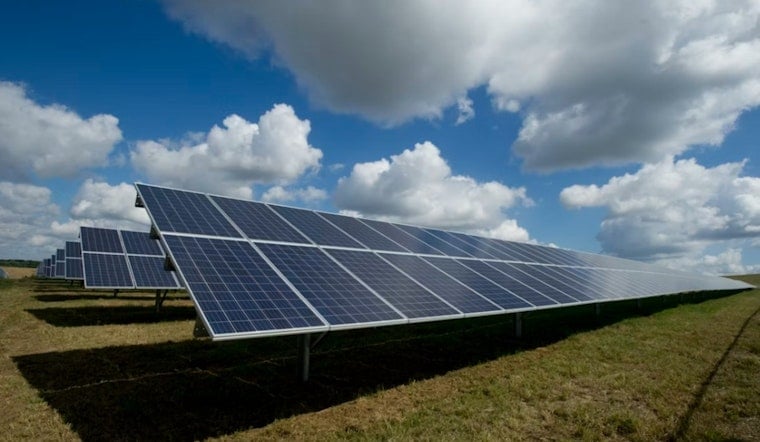
A 97-acre solar farm capable of powering several thousand homes could soon rise between Union and Washington, just northwest of Highway 47 and Clearview Road, after developers pitched the project and a package of local tax breaks to Franklin County officials this week. The 20-megawatt array would sit on land owned by the Franklin County Land and Cattle Company LLC, with landowners Kurt Unnerstall and Greg Hoberock leasing the site to the project's developer.
James Holzman, a partner with Clean Energy Design Group, presented the proposal on September 3 and formally asked Franklin County commissioners for a tax agreement, according to the Missourian. Holzman spoke directly with Unnerstall, Franklin County attorney Mark Piontek and Second District Commissioner Ken Cox during the presentation. Commissioners are expected to make a final decision on the project later this year.
Why Franklin County, Not the State, Sets the Tax Terms
The tax break Holzman is requesting would run through Missouri's Chapter 100 program, which lets local governments issue industrial development revenue bonds, take nominal title to a project's land or equipment, and lease it back to the private developer in exchange for structured payments in lieu of taxes, per the Missouri Department of Economic Development. That county-by-county negotiation has become the standard path for solar developers since August 2022, when the Missouri Supreme Court ruled in Johnson v. Springfield Solar 1, LLC that a statewide statutory property tax exemption for solar systems was unconstitutional. The ruling, detailed by Husch Blackwell, forced commercial developers statewide to negotiate custom local abatement deals instead of relying on a blanket exemption.
That local negotiating leverage matters beyond Franklin County. In a May filing with the Missouri Public Service Commission, utility Ameren Missouri cited county-level Chapter 100 agreements as a key mechanism letting solar developers pair predictable local tax structures with federal investment tax credits covering 30% to 50% of capital costs.
No Special Zoning Fight Required
Unlike some proposed solar projects elsewhere in the state, the Highway 47 array doesn't need a special zoning hearing to proceed, because the underlying land already carries heavy industrial zoning. Franklin County commissioners discussed drafting local solar farm regulations, including a possible temporary moratorium, in late 2025, but paused that effort to prioritize data center rules instead, according to the same Missourian report. That pause leaves solar development legally permitted on qualifying land without additional local zoning approval, at least for now.
Sheep Instead of Lawnmowers
Rather than mowing the site, Clean Energy Design Group plans to graze roughly 300 sheep beneath the panels as part of an agrivoltaics approach meant to keep the land in productive agricultural use while generating power, the Missourian reports. Developers also carved out a 25-acre strip of the property fronting Highway 47 that will stay out of the solar footprint entirely, preserving that high-visibility frontage for potential future commercial development along the corridor.
The project fits into Clean Energy Design Group's broader operating model in Missouri. The company holds a virtual power purchase agreement with the City of Columbia designed to feed power into the regional grid during periods of peak summer demand, the outlet notes.
A Cheaper Path Than Going It Alone
Unnerstall and Hoberock had actually looked into building a solar farm on the site themselves about two years ago, but shelved those self-development plans once cost estimates climbed past $24 million, per the Missourian's reporting. Partnering with a specialized developer like Clean Energy Design Group, which is co-led by managing partner Holzman and operates out of St. Louis and Illinois serving municipal, educational and commercial clients according to Illinois Solar for All, offered a more financially viable route to getting the project built.
Looking ahead, proposed Missouri state legislation would require county commissions to make solar developers submit engineer-approved decommissioning plans and post a bond covering 125% of equipment removal costs before construction begins, according to BillTrack50. Whether that standard factors into Franklin County's eventual decision remains to be seen, but it reflects the kind of land-restoration safeguards county leaders may weigh alongside the tax agreement before their final vote later this year.





