

























































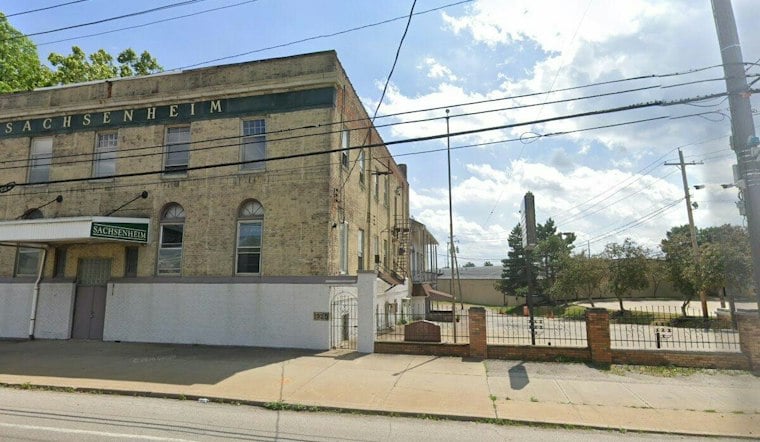
A 116-year-old German-American social hall on Cleveland's West Side is expected to close this month amid financial difficulties and the need for a roof replacement. Sachsenheim Hall, located at 7001 Denison Avenue in the Stockyards neighborhood, plans to wind down operations on September 27, unless something drastic occurs, according to people familiar with the situation.
The building's name translates as “home of the Saxons,” and for well over a century it functioned as exactly that for the local Transylvanian Saxon community, hosting meetings, dances, concerts, weddings, baby showers, bowling leagues, political fundraisers and fish fries, as reported by Cleveland Scene. Sachsenheim Hall's board has not provided comment on the planned closure. The property traces back to 1907, when Transylvanian Saxon immigrants with the First Transylvanian Saxons Sick Benefit Society bought a residential house on the site and converted it into a social hall, according to Cleveland Historical. Major expansions in 1910 and 1925 added a second-floor ballroom, bowling alleys, a dining room and what became the Rathskeller bar.
From Private Club to Neighborhood Fixture
The hall's transformation into a public gathering spot largely traces to Scott Lindell, who ran the restaurant and bar there for more than 20 years before selling his Tremont diner Grumpy's. Lindell opened Sachsenheim Hall's food service to the public, expanding the menu to include nontraditional dishes while keeping many German staples on offer, and he launched both Cleveland Taco Tuesdays and Wing Wednesday. The Rathskeller served traditional German food, weekly fish fries and catering for special events under his watch.
“It was a big piece of my history,” Lindell said of his time at the hall, per the same Cleveland Scene report. He also recalled the beer program's growth on his watch: “When I first started there they had two beers on tap and when I left there were 14 and they were all German.” That public-facing food operation later drew wider notice — Hoodline's own 2019 roundup of cheap eats named Sachsenheim Hall one of Cleveland's top affordable Mexican food spots, pointing to its weekly Taco Tuesday specials. The hall also served fish fries alongside German specialties like schnitzel and paprikash.
A Roof the Hall Couldn't Afford
The hall has faced financial difficulties and requires significant capital for maintenance, repairs and renovations, including a total roof replacement it could not finance. The building has weathered damage before: a 1968 fire wiped out its bowling alleys. Today its 400-seat ballroom and 120-seat dining room sit dark more days than not.
The “Help Preserve Sachsenheim Hall's Historic Legacy” GoFundMe campaign, launched in April 2026, sought financial help and support toward a $116,000 goal — but the campaign's organizer said maintenance and repairs had become costly over time, and the fund raised an amount far below that target. Branch 1 purchased the hall site in 1907, while Lindell later opened its food service to the public.
A Fraternal Society With Deep Cleveland Roots
The Alliance of Transylvanian Saxons was founded in Cleveland in May 1895 as a sick benefit society by 27 men, according to the Encyclopedia of Cleveland History. It later moved its national headquarters to Parma in 1974. Sachsenheim Hall was not the only such venue the alliance once ran in the city — an East Side counterpart at 1300 East 55th Street, established in 1911 by Alliance Branch 33, operated for more than five decades before closing around 1963.
The building also nurtured cultural institutions beyond its dining room. The German Music School was formed in 1967, and Sachsenheim Hall served as the German Music Society's home from 1967 to 2013, according to the German Music Society. The society offered music instruction and performances at the hall. The Cleveland Saxon Dance Group and Eintracht Saxonia Sachsenchor are also associated with Sachsenheim.
Maintaining a Historic Hall
Sachsenheim Hall's struggles reflect the challenge of maintaining an aging building and funding needed repairs.
The closure also lands amid other shifts in the surrounding Stockyards neighborhood. Non-profit developer CHN Housing Partners announced plans in August to build 65 affordable single-family homes across the Stockyards and Clark-Fulton neighborhoods. For now, Sachsenheim Hall's board has said nothing publicly about what becomes of the building itself once the hall is expected to close on September 27, unless something drastic occurs.




