

























































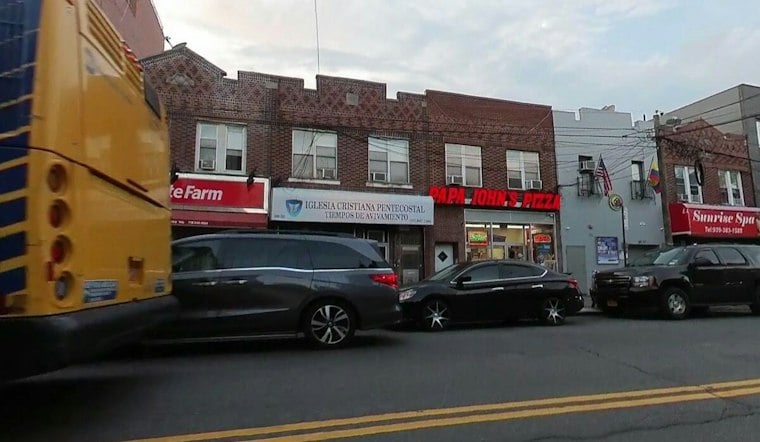
A vacant lot in Elmhurst that once served as a burial ground for as many as 300 formerly enslaved and freed Black New Yorkers is headed toward a foreclosure auction, and New York's attorney general wants to make sure whoever buys it knows exactly what lies beneath the pavement. The property at 47-11 90th Street has spent recent years functioning as a storage and parking lot for vehicles, even though it holds graves dating back to 1818.
On September 18, the New York State Office of the Attorney General filed a motion to intervene in the pending Queens County Supreme Court foreclosure case, 90 Street Realty LLC v. 90 Queens, Inc., et al., according to the NY AG James
office's own statement on the matter. In a post announcing the filing, the office said it was “fighting to protect a historic cemetery for formerly enslaved people in Queens” as the property heads to auction, adding that the goal is to ensure “future owners understand their legal obligation to protect these unmarked graves.”
The legal motion, filed under the New York Real Property Actions and Proceedings Law, asks the court to require that any prospective buyer at auction receive explicit written notice that human remains rest on the property, along with notice of the statutory obligations to protect them, according to the New York State Office of the Attorney General. The filing is designed to make sure the foreclosure process itself does not erase legal protections for the unmarked graves, per the same filing.
Roots Tracing Back to New York's Abolition Era
The burial ground's story begins in the earliest years of Black freedom in New York State. It was established informally around 1818 and formally organized a decade later, in 1828, by the United African Society of Newtown — founded by freed Black New Yorkers just a year after the state fully abolished slavery in 1827, as detailed by Patch. Newtown, the historical name for this part of Queens, became an early enclave where newly emancipated Black residents built their own civic and religious institutions.
The site was historically tied to St. Mark African Methodist Episcopal Church, which tried to relocate all the interred remains to Mount Olivet Cemetery in 1928. The city denied the permit at the time, and only 20 bodies were ever transferred — leaving more than 300 remains behind at the Elmhurst site, according to the Historic Districts Council. That single bureaucratic decision nearly a century ago is why the burial ground still exists at all, even after the church congregation itself moved on.
An Iron Casket at the Site
In 2011, construction workers excavating the property discovered an iron casket containing the remains of a woman.
Even after that discovery, the city's protections proved thin. New York City had placed restrictive declarations on the property back in 2006, per 6sqft. Despite those declarations, construction and commercial activity continued on the site in the years that followed, and the lot was eventually paved over entirely for vehicle storage and parking.
Parallel Push for Landmark Status
While the attorney general's office pursues its court motion, local preservationists are working a separate track. In September, the Elmhurst History & Cemeteries Preservation Society, together with the pastor of St. Mark AME Church, filed a Request for Evaluation with the New York City Landmarks Preservation Commission seeking official landmark status for the property, 6sqft reports.
Community leaders, preservation groups and elected officials are pushing for an even more permanent fix: they want New York City to buy the property directly out of foreclosure and turn the vacant lot into a public memorial and educational center, according to ABC7 New York. Advocates argue that municipal acquisition is the only way to guarantee the site's protection indefinitely, rather than relying on notice requirements attached to a private sale.
The Elmhurst burial ground is tied to the history of Newtown's post-emancipation Black community, where newly freed African Americans built civic and religious institutions in the years after New York's 1827 abolition, according to the Historic Districts Council. Whether a court-ordered notice to future buyers will be enough to keep the ground undisturbed remains an open question as the case moves through Queens County Supreme Court.




