

























































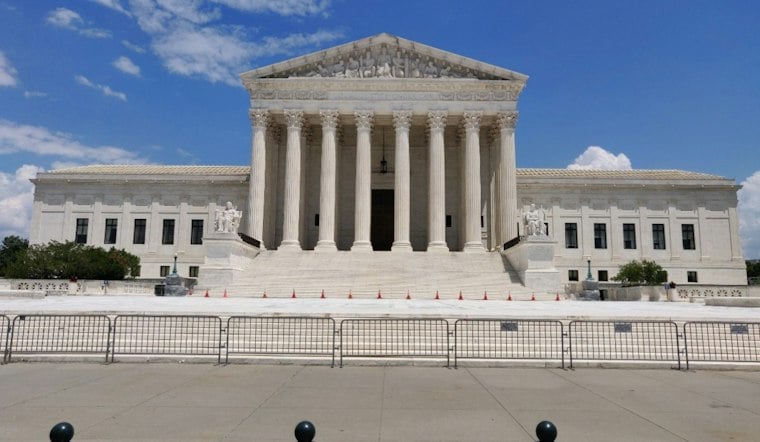
Consumer Watchdog is asking Justice Samuel Alito to recuse himself from Suncor Energy Inc. v. County Commissioners of Boulder County, a climate-liability case scheduled for argument on October 5, 2026. The group points to Alito's reported investments in ConocoPhillips and Phillips 66 and to a mineral lease involving his family's land in Oklahoma.
The Supreme Court's docket identifies the dispute as Suncor v. Boulder and lists it for argument on Monday, October 5. The case concerns whether Boulder County's claims against fossil-fuel companies may proceed under state tort law, an issue that could influence similar state and local lawsuits.
What the recusal request alleges
Consumer Watchdog says Alito's 2025 financial disclosure listed individual holdings in ConocoPhillips valued at up to $15,000 and in Phillips 66 valued between $15,001 and $50,000, according to the group's report. The Journal Record also reported that the group cited a mineral lease involving Alito's wife and family land in Oklahoma. Those facts form the basis of the advocacy group's argument; they do not by themselves establish that recusal is legally required.
The group argues that the companies' own investor disclosures have treated climate litigation as a potential business risk. ConocoPhillips and Phillips 66 are not parties to Suncor v. Boulder, however, and a Supreme Court spokeswoman said Alito had no financial interest in a party to the case and did not need to recuse, The Journal Record reported.
The decision belongs to Alito
The Supreme Court's Code of Conduct says justices follow the same general principles and statutory standards for recusal as other federal judges, including rules concerning financial interests. It also says individual justices, rather than the Court as a whole, decide recusal questions. That leaves the decision in this case to Alito himself rather than to a vote by the full Court.
The Journal Record reported that Alito had recused himself from earlier proceedings involving the Boulder litigation and from a related Honolulu climate case involving the same companies, but not from the current Supreme Court petition. The reason for the different decisions has not been publicly explained in the material reviewed here.
Why the case matters beyond Boulder
The underlying litigation is part of a much wider body of climate-related legal action. The United Nations Environment Programme reported that 3,099 climate-related cases had been filed across 55 national jurisdictions and 24 international or regional courts, tribunals or quasi-judicial bodies as of June 30, 2025. That global count is broader than the U.S. state and local lawsuits at issue in Boulder, so it should not be read as a count of cases that would be directly controlled by the Supreme Court's ruling.
The immediate legal question is narrower than the broader debate over corporate responsibility for climate change: whether claims framed under state tort law can proceed against fossil-fuel companies. Suncor and Exxon have argued that the Boulder claims represent a larger group of lawsuits and that a ruling in their favor could affect parallel cases, while the American Petroleum Institute has urged the Court to reject the use of state tort law in these disputes, The Journal Record reported.
The recusal dispute therefore has two distinct dimensions. Consumer Watchdog is challenging Alito's impartiality based on reported personal investments and family mineral interests, while the Court's stated position focuses on whether he has a financial interest in a party to the case. Alito's decision on whether to participate will be made before the Court hears a case whose ruling could shape the next stage of climate-liability litigation.





