

























































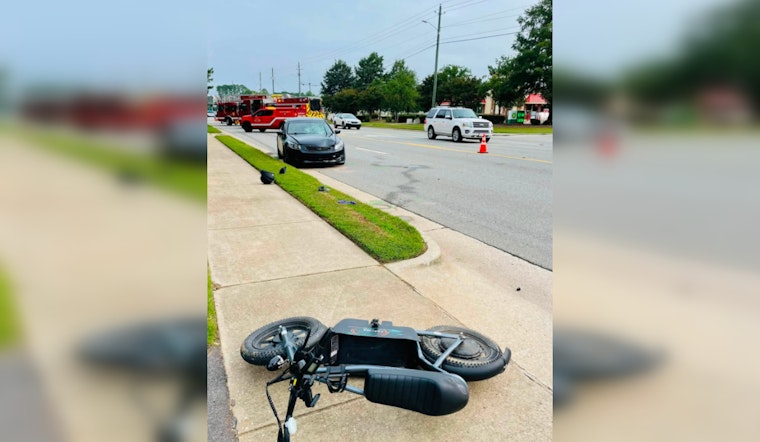
An electric-bike rider suffered significant injuries Wednesday evening after colliding with a vehicle on East Williams Street in Apex, a stretch of roadway that also carries N.C. Highway 55 traffic through the heart of town. Apex Police and Apex Fire both responded to the scene of what officials described as a serious collision between the e-bike and a vehicle.
The crash, detailed in a social media post published Wednesday at 8:27 p.m., prompted the Apex Police Department to renew warnings about the dangers e-bikes face when they share the road with cars and trucks. The department said collisions involving electric bikes can cause severe or deadly injuries, noting that riders have far less protection than vehicle occupants do. East Williams Street is no quiet side road — as part of N.C. 55, the corridor carries between 20,600 and 31,200 vehicles a day, according to a North Carolina Department of Transportation traffic study, a volume that helps explain why crossing or entering the roadway carries elevated risk for anyone on two wheels.
Police Renew Calls for Caution From Riders and Drivers Alike
In its post, Apex Police urged e-bike riders to use extra caution when entering or crossing a roadway and to ride as though drivers may not see them at all. The department also called on riders to wear a properly fitted helmet with the chin strap securely fastened, follow all traffic laws, and understand exactly how their vehicle is classified under state law. Drivers, meanwhile, were told to remain alert, slow down, and watch carefully for riders sharing the road.
Classification is not a small detail. Depending on its speed, power, and design, an electric two-wheeled vehicle may legally count as a bicycle — or as a moped or motorcycle, each carrying different licensing, registration, and insurance requirements. Apex Police have run into this confusion before: in October 2025, the department issued a public alert after a crash involving a youth named Colton revealed that what was first reported as an e-bike was actually a higher-speed electric motorcycle requiring a driver's license, registration, and insurance to operate legally.
A Pattern of Youth E-Bike Incidents Across the Region
Wednesday's crash is not the first e-bike-related incident Apex has dealt with this year. In July, Apex Police investigated a hit-and-run at Apex Peakway and Branch Line Lane after a teenager riding an e-bike in a reckless manner collided with another vehicle and fled before officers arrived. Neighboring Cary Police Department issued its own public safety warning in June, stating that operators of non-compliant e-bikes and electric motorcycles on Wake County roadways face citations, criminal charges, and even vehicle impoundment. In Union County, Monroe Police responded to a comparable crash in June when an e-bike rider was hospitalized with major injuries after colliding with a Chevrolet Tahoe SUV at a city intersection, according to WSOC-TV.
The concerns extend beyond individual towns. Nearby Holly Springs adopted local regulations restricting e-bikes on public streets and greenways after residents complained about teenagers riding recklessly in active traffic lanes, a move that offers a template other Wake County municipalities may eventually consider.
National Numbers Show a Sharp Rise in Youth Injuries
The local incidents fit into a much larger national trend. Estimated nationwide emergency room visits for e-bike injuries climbed to 102,777 in 2025, a 71% single-year increase, with head and face trauma accounting for 29% of all injuries, according to Consumer Product Safety Commission data analyzed by ERideHero. Children 14 and younger have been hit especially hard: emergency room visits for that age group jumped from 6,444 in 2024 to 17,206 in 2025, making youth the fastest-growing demographic for e-bike trauma, per the same CPSC data.
North Carolina's legal landscape around these vehicles is also shifting. Under current state law, an electric assisted bicycle must have operable pedals, a motor capped at 750 watts, and a maximum motor-powered speed of 20 mph — anything faster is legally a moped or motorcycle requiring licensing, registration, and insurance, according to Ebike Oracle. Starting December 1, Session Law 2026-46 will adopt the federal three-class framework, formally legalizing 28 mph Class 3 pedal-assist e-bikes on North Carolina roads while mandating helmets for Class 3 riders under 18. Separately, state law already requires all bicycle and e-bike riders and passengers under 16 to wear a helmet, with a $10 civil penalty for non-compliant parents or guardians that can be waived with proof of a helmet purchase.
Apex Police have not released further details on the condition of the injured rider or the circumstances leading up to Wednesday's collision. The department's message to the community remained straightforward: understanding how a vehicle is classified, and riding or driving accordingly, can make the difference in preventing the next serious crash on a road like East Williams Street.





