

























































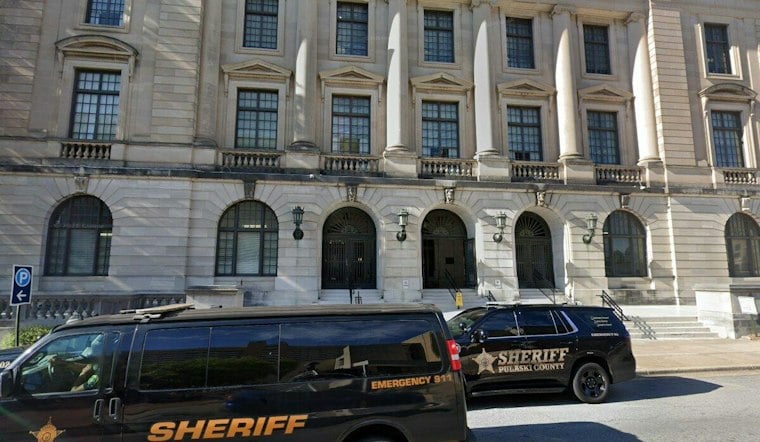
A Pulaski County circuit judge will hold the first hearing Monday morning in a lawsuit that could reshape how Arkansas enforces one of the strictest abortion bans in the country, even as the state pushes to have the case thrown out entirely. The hearing, set for 9 a.m. at the Pulaski County Courthouse, comes in Waldorf v. Arkansas, a suit brought on behalf of six women and one OB-GYN who argue the state's near-total ban violates their constitutional rights to life, liberty, equality and the pursuit of happiness.
The case, filed by Amplify Legal — the litigation arm of Abortion in America — argues that Arkansas's ban forces hospital staff and legal teams, rather than treating physicians, to make life-or-death calls about emergency care, according to the group's own account of the suit posted at Amplify Legal. As reported by Arkansas Times, the lawsuit's namesake, Emily Waldorf, began miscarrying at 17 weeks with an unviable pregnancy and had to be transferred to a hospital in Kansas to receive an abortion. She reportedly received no response from Governor Sarah Sanders after reaching out.
A Ban With Narrow Exceptions and Steep Penalties
Arkansas's abortion ban took effect after Roe v. Wade's defeat in 2022 and includes only a narrow exception to save the life of the mother, with no carve-out for cases of rape or incest, per the same Arkansas Times account. Under Arkansas Code § 5-61-304 and § 5-61-404, performing or attempting an abortion outside that narrow emergency exception is an unclassified felony punishable by up to 10 years in prison and fines up to $100,000, though the pregnant patient herself is explicitly exempted from prosecution, according to Justia Law.
Doctors in Arkansas fear criminal convictions for treating pregnant women, the Arkansas Times reports, a dynamic lawmakers attempted to address in March 2025 when the General Assembly passed Act 387 to clarify the “reasonable medical judgment” standard for emergency exceptions. That law explicitly affirmed that psychological threats, self-harm risks, and treatable non-life-threatening conditions do not qualify for emergency abortions, according to the Arkansas State Legislature.
Sovereign Immunity and a Fight Over the Governor's Emails
The state has filed a motion to dismiss the suit, arguing Arkansas is immune from lawsuits in its own courts and cannot be sued in this manner, the article's source notes. Arkansas has also moved to block efforts to depose Governor Sarah Huckabee Sanders, who is named as a defendant in the case; the deposition request sought information about communications between Sanders's office and Waldorf's family and friends, as well as internal communications about the abortion ban itself.
The case has already survived one attempted dismissal. Pulaski County Circuit Judge Cara Connors initially dismissed the case, relying on a 2025 law assigning constitutional statute challenges to the Arkansas Court of Appeals instead of circuit courts. The Arkansas Supreme Court struck down that law, ruling it unconstitutionally infringed on circuit court jurisdiction, which revived the lawsuit, according to KFF. Arkansas Times blogger Matt Campbell has written that the state Supreme Court still awaits as the final arbiter should plaintiffs succeed in circuit court.
Two More Plaintiffs, Two Harrowing Stories
Two additional plaintiffs were added to the case in April 2026. Theresa Van of Fort Smith joined the lawsuit after learning at her 22-week ultrasound in 2023 that her fetus lacked amniotic fluid and could not survive; she was forced to carry the unviable pregnancy to term because doctors feared criminal prosecution and she lacked the funds to travel out of state, per Abortion in America.
Co-plaintiff Leitaea Lowrimore joined the suit after being turned away from three separate emergency rooms across Arkansas and Oklahoma during a life-threatening ectopic pregnancy crisis in early 2026, waiting six days before she was able to travel to Kansas for emergency treatment, Abortion in America's reporting states. Plaintiffs have requested a preliminary injunction that would halt enforcement of the ban while the lawsuit proceeds, along with an evidentiary hearing that has not yet been scheduled.
Zero Official Abortions, Thousands Still Leaving the State
The Arkansas Department of Health's own vital statistics reported zero abortions performed within state facilities in both 2023 and 2024, a stark drop from 1,621 in 2022 before the trigger ban took effect, according to KPBS. But that official tally doesn't capture the full picture: an estimated 2,580 Arkansas residents traveled to other states for clinical abortion care in 2024, while at least 3,860 medication abortion regimens were shipped to Arkansans from out-of-state clinicians under shield laws in 2025, per the Charlotte Lozier Institute's tracking.
The state's restrictions trace back to Amendment 68, approved by Arkansas voters in 1988, which established state policy to protect the life of every unborn child from conception until birth, according to the Center for Reproductive Rights. Direct efforts to loosen the ban through the ballot box have also stalled — in July 2024, Secretary of State John Thurston disqualified a citizen initiative that sought to establish a constitutional right to abortion up to 20 weeks, ruling that organizers failed to submit required paid-canvasser documentation despite collecting more than 101,000 signatures.
Part of a Broader National Legal Pattern
Waldorf v. Arkansas is the first lawsuit filed by Amplify Legal, the litigation arm of Abortion in America, and it mirrors patient-led constitutional challenges elsewhere, including Texas's Zurawski v. State of Texas, in which patients denied emergency care sued state officials over vague exception language. The Texas Supreme Court ultimately upheld that state's ban in May 2024, a reminder of how difficult these cases have been to win even when patient harm is well documented.
The Waldorf case has attracted national attention, and Molly Duane has said people need to understand what Arkansans and their families went through under the ban. Monday's hearing marks the first real test of whether a circuit court will let the case move forward toward the preliminary injunction and evidentiary hearing the plaintiffs are seeking, or whether the state's sovereign immunity argument will bring it to another halt.





