

























































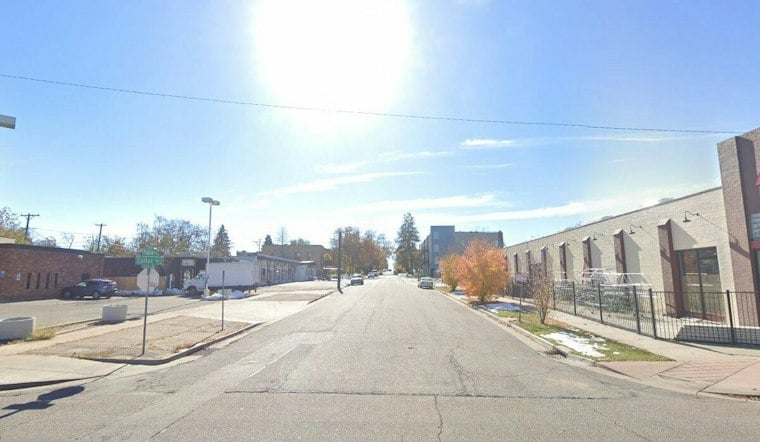
Late Sunday night, Aurora officers on routine patrol along Colfax Avenue spotted a car weaving through traffic, alternating between slow crawls and sudden bursts of speed. When they ran the plate, they found it had been reported stolen. The driver refused to stop, kicking off a pursuit that ended with two suspects arrested — one of them found hiding inside a porta-potty.
According to the Aurora Police Dept
, officers initiated the stop after noticing the vehicle showing signs of driving under the influence. The driver fled instead of pulling over, and officers pursued the car until it stopped near Colfax and Poplar Street, where both occupants bailed out and ran. Officers deployed stop sticks during the pursuit, and the department's Real Time Information Center began tracking the fleeing suspects using drones, with operators guiding ground officers on the suspects' movements.
Thermal Cameras Cut Through the Dark
The drones used infrared imaging to pick up heat signatures the suspects couldn't hide from the night. One suspect was found in plain sight; the other was hiding in a porta-potty and was located by the aerial camera. Officers ultimately took both into custody.
The rapid response was possible because Aurora's Drone as First Responder fleet operates from static launch sites scattered around the city, letting FAA-certified pilots inside the Real Time Information Center get a drone airborne within about a minute of a call coming in, according to the City of Aurora. Those thermal cameras can pick up heat signatures in darkness — exactly the kind of tool that helped locate a suspect hiding in a porta-potty.
Charges Stack Up for the Driver
The driver now faces charges of DUI, eluding, possession of a controlled substance, and theft, per the Aurora Police Dept's account of the arrest. Investigators determined the driver was under the influence of drugs and found in possession of methamphetamine. Under Colorado Revised Statutes § 18-9-116.5, vehicular eluding is prosecuted as a Class 5 felony when a driver knowingly and recklessly flees police without causing injury, carrying a potential 1 to 3 years in state prison and a mandatory minimum fine of $2,000 — double the standard fine for that felony class, according to the O'Malley Law Office.
The methamphetamine possession charge falls under a lower tier than many might expect. Colorado Revised Statutes § 18-18-403.5 classifies personal-use possession of 4 grams or less of methamphetamine as a Level 1 drug misdemeanor, punishable by up to 180 days in jail and fines up to $1,000 for a first offense, per the Colorado Legal Defense Group. That reflects state sentencing reforms that moved under-4-gram possession off the felony track. Separately, driving under the influence of drugs carries the same penalty range as an alcohol DUI under Colorado Revised Statutes § 42-4-1307 — 5 days to 1 year in county jail, fines between $600 and $1,000, and a 9-month license suspension for a first offense — though confirming drug impairment requires blood or saliva testing rather than a breathalyzer.
Why Colfax Draws This Kind of Patrol
East Colfax Avenue has long been a targeted high-enforcement corridor in Aurora, where city officials and police have layered on dedicated safety initiatives and increased patrols to combat elevated property crime, drug activity, and motor vehicle offenses, as previously reported by CBS News. That focus is part of why officers were running DUI patrols along the strip late Sunday night in the first place, and why a routine stop turned into a full pursuit response.
Aurora expanded its pursuit policy in March 2025, giving patrol officers more discretion to chase vehicles connected to stolen property, DUI offenses, and violent crimes, provided they continuously reassess the risk as the chase unfolds. That policy shift, paired with the department's Real Time Information Center, which formally launched in November 2025, and its Drone as First Responder program, has let officers keep suspects under constant aerial watch instead of relying solely on high-speed ground chases. The RTIC folds city surveillance cameras, Flock Safety license plate readers, and live drone video into a single hub built on Axon's Fusus platform.
The department has leaned on that setup before. In a similar Aurora backyard pursuit near East 17th Avenue and North Lansing Street earlier this month, an RTIC drone tracked a stolen car suspect after a red-light chase, letting ground officers make arrests without a prolonged, hazardous pursuit.





