

























































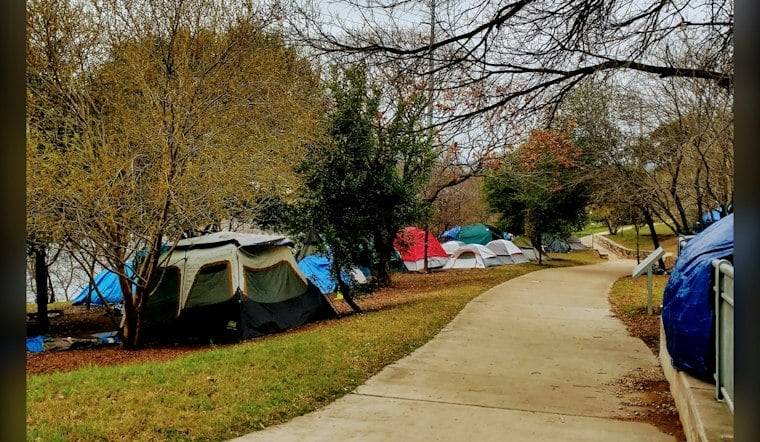
Austin’s encampment-management initiative connected 35 people to shelters and nine to supportive services during a 26-day period, while 28% of the locations handled by city crews had renewed encampment activity within 30 days. The figures came from a Sept. 2 presentation by the Homeless Strategies and Operations Department, as reported by KXAN Austin.
From May 11 through June 5, crews made 456 visits to 127 locations and removed nearly 700,000 pounds of debris, according to the department’s presentation. The city has not treated the number of site visits or the amount of debris removed as a measure of whether people ultimately obtained housing.
How the money was used
The initiative cost $719,361. Staff salaries accounted for 62% of the total, or nearly $450,000; contractors represented 32%, at slightly more than $230,000; equipment made up 4%, or just under $30,000; and disposal costs were about $10,000, according to the city figures reported by KXAN.
Department director David Gray said the spending was intended to create a more coordinated process for outreach, site closures and cleanup. He also acknowledged that most of the money was committed to staffing rather than housing, prevention or additional outreach.
Service connections did not equal housing placements
Staff offered 88 people access to services during the operation, and about half accepted. Gray said employees cannot require people to accept assistance. The department also reported that shelters had available capacity, while a May 2026 survey by the Texas Harm Reduction Alliance found that 74% of respondents said they had not been connected with services, according to KXAN.
Carrieann Smith, an advocate who questioned the program’s effectiveness, argued that a referral to a shelter is different from entering shelter and that neither result necessarily represents permanent housing. Data prepared for the department by the Ending Community Homelessness Coalition showed 1,094 city-funded emergency-shelter beds as of February 2026, with 1,134 beds projected for each of the next two years. The coalition estimated that about 5,000 people had been unsheltered in Austin since May 2024.
The same February 2026 data listed 481 households in the city’s rapid-rehousing program, with projections of 322 households in 2026 and 259 in 2027. Permanent supportive housing served 901 households, with projections of 991 in 2026 and 801 in 2027. The department said it planned to release additional data in the fall.
Notice and property disputes
The Texas Harm Reduction Alliance reported that about 60% of respondents to its May survey had lost something important during an encampment sweep, while about 70% said they received no advance notice. City staff told KXAN that crews are instructed to connect people with storage options, but that the volume of property at some sites can make sorting unsafe. The department said it provides 72-hour notices, including written notices. The alliance said it spends about $4,000 per month replacing belongings destroyed during sweeps.
VOCAL-TX has questioned whether clearing sites addresses homelessness. Smith said displacement alone does not resolve the problem, while community organizer Eli Cortez criticized the cleanup approach. Those positions, along with the survey findings, were presented in KXAN’s coverage of the September meeting.
The policy framework
Austin voters approved Proposition B in May 2021 with 57.7% support, restoring city restrictions on public camping and related conduct, according to Community Impact. Later that year, Gov. Greg Abbott signed House Bill 1925, which made public camping in prohibited areas a Class C misdemeanor punishable by a fine of up to $500, according to the National Low Income Housing Coalition.
The city designates some public areas as Keep Clear locations for continuing management because of health, safety, environmental, infrastructure or access concerns. Austin says those locations may receive monitoring, cleanup, restoration and, when appropriate, enforcement; the city’s policy also says staff work to provide notice and connect people with shelter, housing assistance and other services. Some responses may occur more quickly when officials identify an immediate safety threat, according to the City of Austin.
The broader funding request
The $719,361 initiative was part of a larger proposed homelessness-response package. In April 2025, the Homeless Strategy Office presented a plan totaling just under $101 million, including about $5 million for expanded street outreach and encampment management. The proposal also faced a $22.9 million gap to replace federal American Rescue Plan Act funding, according to the Austin Monitor.





