

























































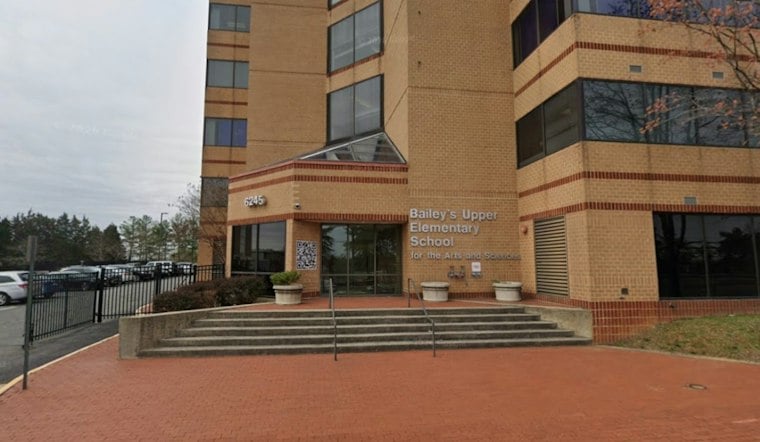
Bailey's Upper Elementary School is using a school-issued permit to make scooter riding part of its road-safety curriculum. Students must demonstrate knowledge of traffic rules and pedestrian safety on a written assessment, then complete a supervised course test before they receive a junior driver's license and permission to ride during recess, according to NBC Washington and WTOP.
The Falls Church school built the test around a traffic garden: a miniature street layout with lanes, bike lanes, crosswalks, stop and yield signs, parking spaces, a traffic circle, a railroad crossing and a parallel-parking area. Fairfax County Public Schools says the setting is intended to let students practice decisions they may face while walking or riding outside campus, including yielding, obeying signs and crossing at marked locations. The district has not published evidence showing that Bailey's permit system has changed students' off-campus travel behavior or reduced crashes.
That limitation matters because a supervised school course is not the same as a public-road safety intervention. Safe Routes to School resources can support efforts to teach children to walk or bicycle safely around traffic and other risks. Transportation Alternatives funding is available for eligible Safe Routes to School projects, and the Virginia Department of Transportation says both infrastructure and non-infrastructure Safe Routes to School projects can seek competitive Transportation Alternatives funding.
Several models, different purposes
Bailey's approach is more structured than some other traffic-garden examples because access to scooters depends on passing a test. The City of Tacoma records permanent traffic gardens installed at Stafford Elementary School and Jennie Reed Elementary School in 2024. Tacoma describes those spaces as practice areas for children walking, bicycling, using scooters or riding skateboards, but its public description does not identify a Bailey-style school license requirement.
Seattle Public Schools offers a broader district comparison. Its bicycle and pedestrian safety education is available to schools for students in grades 3 through 5, and the district set a goal of developing traffic-garden implementation plans for each elementary and K–8 site by 2025, according to Seattle Public Schools. That is a districtwide instructional and site-planning model, not evidence that a permit system improves safety outcomes.
Federal guidance similarly describes Safe Routes to School as including traffic education, enforcement near schools, student bicycle and pedestrian safety sessions and program training. The Federal Highway Administration framework helps explain why a traffic garden can fit within a wider safety effort, but it does not establish that Bailey's particular course has produced measurable changes.
A school rule, not a road license
Virginia law provides a separate legal baseline on helmet requirements for people 14 or younger riding bicycles, toy vehicles or scooters, according to the Code of Virginia. Bailey's junior driver's license permits students to ride scooters during recess.
The program's practical significance is therefore narrower—and more defensible—than a claim of proven injury prevention. WTOP reported that the project cost $80,000, took two years and was funded through grants; NBC Washington reported that Fairfax County Public Schools is considering whether similar programs could work at other campuses. Any expansion would offer an opportunity to track participation, test performance and travel behavior over time, but those measures have not yet been reported for Bailey's Upper.





