

























































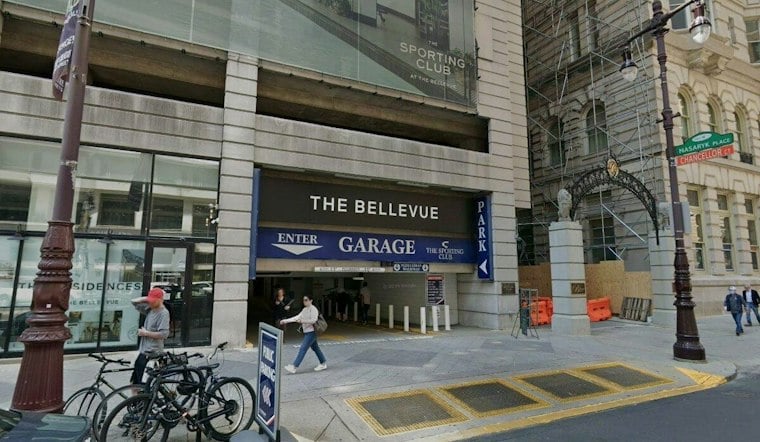
Bathhouse, the New York-based sauna and cold-plunge company, is scheduled to open Sept. 25 in the Bellevue Hotel’s former basement food court at 1418 Walnut St. The 36,000-square-foot complex will bring three pools, three saunas, massage rooms, a cafe, and contrast-therapy programming to a lower level that has been largely vacant, according to The Philadelphia Inquirer.
A new use for a repositioned Bellevue
The opening is part of a larger effort to recast the historic hotel property as a mixed hospitality, residential, retail, and fitness destination. Lubert-Adler acquired the Bellevue in November 2021 and began a $187 million overhaul that converted vacant upper-floor offices into 155 apartments while updating the Hyatt hotel and the 100,000-square-foot Sporting Club, according to the National Trust Community Investment Corporation. The project used $28.7 million in federal historic tax credits.
Bathhouse follows the debut of Mr. Edison, a two-story supper club that opened in the former Ralph Lauren space in June 2026. That project was previously reported by Hoodline. Together, the openings show how the Bellevue is filling formerly underused areas with destination-oriented food, wellness, and entertainment uses.
The basement also carries an older commercial history. The site was associated with the Bellevue Court Building and the Bellevue Court Tavern, which operated from the 1940s through the 1960s. The passage became part of Bellevue Court during construction of a later addition begun in 1911, according to Hidden City Philadelphia.
What Philadelphia customers will find
The Philadelphia Bathhouse will combine a 190-degree Russian banya, a 180-degree dry sauna designed for group events, and a 140-degree infrared sauna with hot, neutral, and cold pools. Staff-led aufguss sessions—ritualized sauna performances using scented snowballs and towels to circulate heat—are planned every 90 minutes, the Inquirer reported.
Day passes start at $29, with prices varying by demand and time of day. The facility is scheduled to operate daily from 8:30 a.m. to 11 p.m. The company has also said it plans to add a rooftop pool and sauna by May 2027, although that future work is not part of the opening-day offering.
Bathhouse’s arrival comes as Center City remains Philadelphia’s largest concentration of jobs and retail activity. The Center City District and Central Philadelphia Development Corporation reported that Greater Center City supports 309,000 jobs—42% of the city’s employment—and that retail occupancy reached 84%, a seven-year high, in their State of Center City 2026 report. Those figures describe the surrounding market, not demand specifically for Bathhouse.
How the Bitcoin-heated pools work
Bathhouse operates Bitcoin-mining computers on site and says the heat produced by the machines is captured for use in the facility. Its help center says the air-cooled ASIC computers are immersed in nonconductive dielectric fluid; heat exchangers then transfer the resulting heat into hot-water loops used to warm pools and heated seating. The company says pool temperatures can be maintained at about 104 degrees Fahrenheit. This explains the system’s design, but Bathhouse has not publicly provided Philadelphia-specific figures for energy use, recovered heat, emissions, or savings.
The Inquirer reported that Bathhouse believes heat recovery has reduced electricity costs and helped the company recoup some money from the arrangement. Those are company claims rather than an independently audited assessment. The setup also does not eliminate the electricity demand associated with cryptocurrency mining; it changes how some of the resulting heat is used.
A commercial spa, not a public bathhouse
Bathhouse is entering a market that blends hospitality, fitness, and social bathing. A useful but limited comparison is The Baths at Pocketbook Hudson, a 6,000-square-foot spa in a renovated 19th-century pocketbook factory in the Hudson Valley. Vogue described that facility as having three pools and initially serving hotel guests before opening to day visitors. The projects share an adaptive-reuse setting and a pool-centered wellness model, but Pocketbook Hudson is much smaller and is tied to a hotel; it does not establish a regional trend or predict Philadelphia demand.
Philadelphia’s facility will also operate within the state’s public-bathing rules. Pennsylvania regulations require water sampling at least weekly for swimming pools, specialty pools, spas, and hot tubs, with laboratory reports retained for at least two years, according to Pennsylvania Code, Chapter 18. The regulation sets a baseline for operation; it does not independently verify Bathhouse’s planned staffing, maintenance procedures, or opening readiness.
Bathhouse’s Philadelphia launch therefore represents two projects at once: a new paid wellness attraction and another step in the Bellevue’s conversion of underused space into revenue-producing destinations. Whether the Bitcoin heat-recovery system delivers the savings and environmental benefits the company expects—and whether the concept can sustain the projected rooftop expansion—will become clearer only after the facility has operated and disclosed performance data.





