

























































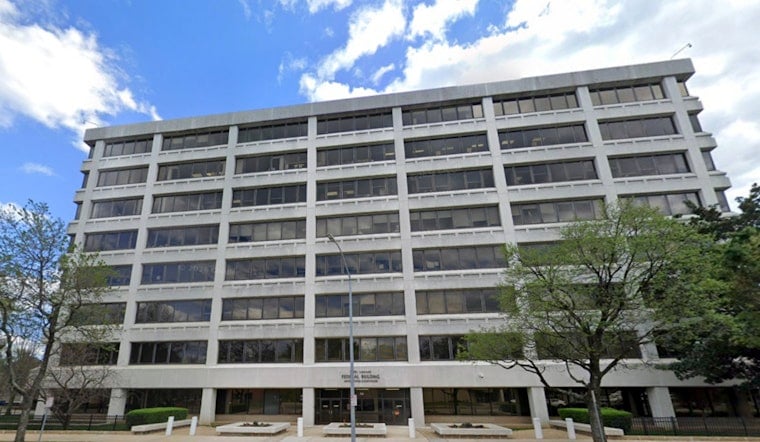
A battery leaked inside the Terry Sanford Federal Building in downtown Raleigh on Wednesday, creating a hazardous environment that forced people out of the building and brought a hazmat crew with large tanker trucks to the scene, officials said.
The evacuation unfolded at the courthouse located at 310 New Bern Ave., according to WRAL, whose Sky 5 helicopter flew over the scene as the response got underway. Officials told the outlet the battery leak created hazardous conditions inside the building, which prompted the call for specialized crews and the evacuation of people inside.
The Terry Sanford Federal Building is no ordinary office tower. Built in 1968, the nine-story complex spans 255,060 square feet and serves as the primary courthouse for the U.S. District Court for the Eastern District of North Carolina, also housing operations for the U.S. Marshals Service and the Federal Highway Administration. That means a hazmat evacuation there carries the potential to disrupt federal court proceedings and the daily business of multiple agencies under one roof.
Why a Leaking Battery Can Trigger a Full Hazmat Response
Battery leaks might sound like a minor maintenance issue, but large backup power systems in facilities like federal courthouses often rely on UPS battery banks containing corrosive sulfuric acid. Under OSHA guidelines described by the Solus Group, electrolyte leaks involving sulfuric acid are classified as emergency spills once they generate hazardous mists or pose immediate health threats — a threshold that requires specialized hazmat technicians rather than a building janitorial crew.
Federal regulations reinforce that standard. OSHA rule 29 CFR 1926.441 mandates that facilities housing industrial battery systems keep those rooms well ventilated and maintain emergency quick-drench eyewash and body-wash stations within 25 feet, along with neutralizing materials on hand to contain corrosive spills. Whether the Terry Sanford Federal Building's leak came from a building-wide UPS backup system remains unclear, and it is not yet known whether court hearings were delayed or rescheduled as a result.
Raleigh's Hazmat Team Has Had a Busy Year
The response fell to the Raleigh Fire Department, which operates North Carolina Hazardous Materials Regional Response Team 4 out of Station 27, according to the City of Raleigh. RRT-4 is a state-contracted, technician-level unit that provides specialized hazmat services across Wake County and beyond, and 2026 has kept the team on the move — it resolved an indoor chemical off-gassing call in Vance County in June and responded to a commercial explosion in Warren County in May, per NC Emergency Management.
Wednesday's leak also adds to a run of security incidents at the downtown courthouse. The building underwent a full emergency evacuation and street closure in March when an active bomb threat triggered a multi-agency response involving local police, federal agents, and the FBI. It's the kind of pattern that underscores how disruptive any hazard call at a facility housing federal courts and agencies can be, regardless of its ultimate cause.
The scenario also echoes a hazmat scare in nearby Durham, where the Durham Fire Department's hazmat team responded to an unidentified hazardous substance downtown in February and secured and disposed of the material without any injuries, as Hoodline previously reported. It remains unclear what air-monitoring thresholds federal officials required before allowing workers back into the Terry Sanford Federal Building following Wednesday's leak.





