

























































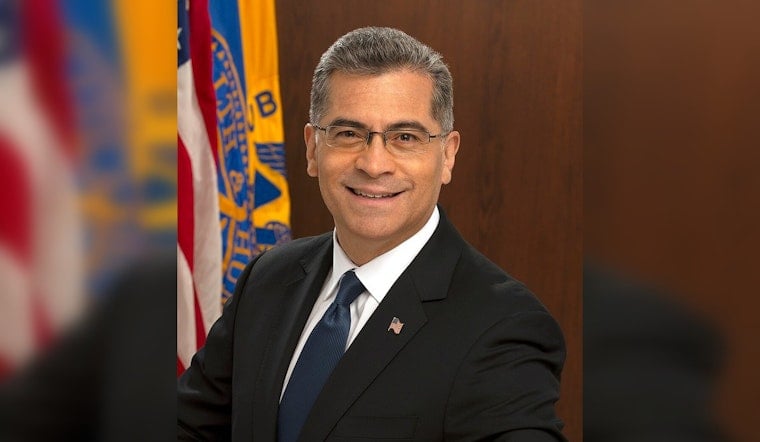
Xavier Becerra stood at a stalled Long Beach development site last week and made a pitch that sounded almost modest by California standards: rather than promise millions of new homes, he said a realistic goal might be doubling the state's housing-construction rate to around 200,000 units a year. The Democratic gubernatorial candidate spoke for less than 10 minutes, but the restraint in his numbers was deliberate, a break from the sweeping housing pledges that have defined California governors' races for a decade.
Becerra's remarks, first reported by the Sacramento Bee, framed the 39-unit affordable project in Long Beach as a test case for his approach: he said supporters might pray for the development to happen, and argued that Proposition 1, the $11.25 billion housing bond he has endorsed, could help developers like this one actually break ground. Becerra, who launched his campaign in 2025, plans to secure funding to unstick roughly 40,000 permitted but stalled shovel-ready projects statewide, according to the Bee's reporting.
The caution is intentional. Becerra told the Bee he wants to avoid inflated campaign promises on housing, and in a separate August interview with CalMatters, he traced that instinct back to 1993, when he voted for NAFTA in Congress believing labor protections would shield workers, only to watch domestic jobs disappear anyway. He said the experience taught him never to commit to specific numerical goals or policies unless he is completely certain he can deliver, and he explicitly said he would not promise 3 million housing units.
Learning From Newsom's Unmet Target
The comparison to Governor Gavin Newsom hangs over the race. Newsom fell short of his 2018 goal of building 3.5 million new homes by 2025, and according to the Better Cities Project, California cities issued only about 650,000 building permits between 2019 and late 2024 — roughly 18% of the original target. Newsom later scaled back, urging cities in 2022 to plan for 2.5 million homes by 2030.
Becerra's 200,000-unit figure is itself an acknowledgment of how far the state has fallen behind. The California Department of Housing and Community Development estimates the state needs at least 180,000 new homes built annually to meet population demand, yet average annual production over the past decade has hovered under 80,000 units, per CalMatters. The outlet notes the state's own economic forecast projects construction will stay plateaued between 100,000 and 104,000 units a year through 2028. Compounding the problem, permit volume dropped to just 49,400 units in the first half of 2025, the lowest mid-year total since 2014 outside pandemic lockdowns, according to the Southern California News Group.
Enforcing SB 79 and Targeting Exclusionary Zoning
Central to Becerra's platform is a promise to enforce Senate Bill 79, the Abundant and Affordable Homes Near Transit Act that Newsom signed in October 2025. The law, which takes effect July 1, 2026, mandates height and density allowances for multi-story housing within half a mile of major rail and transit hubs, overriding local zoning controls in urban transit counties that include Los Angeles, Alameda, San Francisco, San Mateo and Santa Clara, according to the Association of Bay Area Governments. Becerra has said he will ensure localities do not skirt their housing obligations under the law, and he plans to direct state agencies to prioritize building more homes. He has also vowed to declare a housing state of emergency on his first day in office.
Per his campaign website, Becerra plans to seek an end to exclusionary zoning around more types of transit and in high-opportunity areas, building on a housing plan his campaign posted in May 2026. On wages, Becerra has taken a split position: he supports requiring prevailing wage for infill projects over eight stories but does not support that requirement for smaller housing builds. That distinction tracks with an August 2024 UC Berkeley Terner Center study, cited by California YIMBY, which found per-unit construction costs for affordable projects requiring prevailing union wages ran about $94,000 higher than for non-prevailing wage developments.
Cost Pressures Beyond Wages
Wages aren't the only expense weighing down affordable housing budgets. A January 2026 Terner Center for Housing Innovation study found California affordable developments paid nearly $300 million annually in local municipal development impact fees between 2020 and 2023, adding close to $20,000 per unit on average to project costs. Those fees force affordable housing projects to stack multiple public financing subsidies just to pencil out, complicating delivery even when land use and zoning cooperate.
At the Long Beach event, Becerra framed the stakes in personal terms, saying California should be a place where the carpenter who builds a home can afford to buy one. He also said plainly that voters need to come through if his agenda is going to move forward.
Hilton's Deregulation Counterpitch
Becerra's Republican opponent, Steve Hilton, has staked out a starkly different approach. Hilton has argued that California's environmental laws obstruct prolific single-family-home construction and has said the state needs to build outward, not just upward. His platform, detailed in Hilton's 10-year freeze plan, stems from white papers published by Golden Together, an organization he founded in 2023 that calls for ending environmental lawsuits under CEQA, capping developer impact fees, and encouraging suburban expansion alongside urban infill. Hilton has also stressed streamlined permitting and reduced red tape as his primary fix for housing construction.
The financial backdrop of the race adds another layer to Becerra's cautious framing. Independent expenditure committees funded by corporate, oil, and real estate interests — including Chevron, McDonald's, and the California Association of Realtors — spent more than $13 million promoting Becerra's campaign during the primary, according to CalMatters. A UC Berkeley poll in August found Becerra leading Hilton by 18 percentage points among likely voters, a margin Hoodline previously reported in detail.





