

























































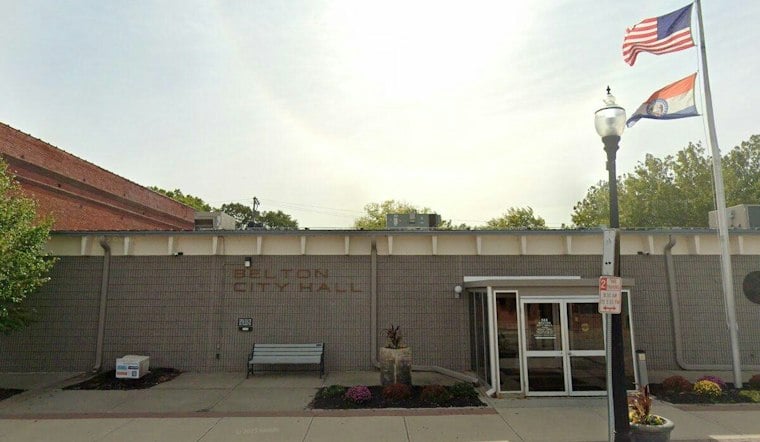
Belton's city council held a public hearing Tuesday night on a request for $250 million in industrial revenue bonds to help fund a sprawling new entertainment and housing district at the northwest corner of North Avenue and Cedar Street, a project city leaders are calling one of the city's largest to date. The bonds, sought under Missouri's Chapter 100 program, would back a development plan expected to be completed in four phases by 2033, built around go-karts, a bowling alley, a new movie theater and hundreds of housing units.
The hearing, held in council chambers at 520 Main Street starting at 6 p.m., was open to residents who wanted to attend the Uptown Development District, a project with investment estimates ranging from nearly $150 million to $250 million, first announced in November 2025, according to KSHB 41 Kansas City. But residents could not provide input without signing up in advance, the station reported. Tyler Burks, who represents master developer Petra, told the council the company has struck an agreement with B&B Theatres to anchor the project, adding go-karts, a bowling alley and a new theater to the mix. Burks, who grew up in Belton and graduated from Belton High School in 2010, is managing director of development for Petra, a regional real estate firm headquartered in Wichita, Kansas, according to the Martin City Telegraph.
A 40-Acre Site With a Former Name
The 40-acre project site, previously branded as “District 163,” sits at the corner once envisioned under that earlier name, per the Martin City Telegraph's reporting. B&B Theatres, the project's primary anchor tenant, is a family-owned chain founded in 1924 in Salisbury, Missouri, and now headquartered in Liberty, Missouri, ranking as the sixth-largest movie theater chain in North America, according to background compiled on the company.
Per KSHB, the district is planned in four phases. Phase one calls for a 100,000-square-foot entertainment district with mixed retail uses, while phase two would add 30,000 square feet of retail and dining pad sites. Phase three envisions roughly 312 residential units in a multifamily development, and phase four would bring 288 more housing units alongside 15,000 square feet of retail space. KSHB's phase figures total 600 housing units, while the Martin City Telegraph reported more than 660 new housing units. Altogether, the plans include five 6,000-square-foot sit-down restaurants, 7,500 square feet of retail and a 110,000-square-foot entertainment complex, the station reported. While full buildout of the multi-phase district is projected for 2033, developers anticipate the B&B Theatres complex and more than 300 housing units will be operational by 2028, according to the Martin City Telegraph.
How the Tax Breaks Would Work
Under Chapter 100 of the Revised Statutes of Missouri, municipalities can issue revenue bonds with repayment provisions that do not make them general obligations of the city, according to the Missouri Department of Economic Development. According to public documents cited by KSHB, the bonds would not require the city to spend its own funds, would be purchased by Petra or its affiliates, would be payable from project revenue, and would not constitute a debt or liability to the city of Belton.
Beyond the Chapter 100 bonds, Petra has proposed an incentive package equal to 24 percent of total project costs, made up of a 27-year 1 percent Community Improvement District sales tax, a 40-year 1 percent Transportation Development District sales tax, and a 15-year 1 percent Sales Tax Reimbursement Agreement, according to the North Cass Herald. The station's report also notes that Petra is asking for a second funding agreement providing up to $7 million from sales taxes generated by the new businesses.
Projected Revenue Versus Abated Taxes
Public records cited by the station estimate the district could generate upwards of $67 million in taxes. Petra would pay an estimated $11.5 million in property taxes over 20 years under the proposal, while the tax abatement would save the company about $56 million over that same period. The Belton school district stands to see an estimated $35 million in abated taxes over the 20-year span, per the same records.
The Uptown district isn't the only major project on Belton's plate. The city is also considering development of a professional baseball stadium, though it has not yet released a feasibility study for that project, KSHB reported.
Litigation Looms Over Housing Policy
Belton is separately engaged in litigation concerning an affordable housing development, a case the station connected to the broader debate over how the city balances new market-rate housing against past rejections of subsidized projects. The federal Fair Housing Act lawsuit was filed December 2, 2025, in the U.S. District Court for the Western District of Missouri by Belton Development LP, Commons of Belton DVLPR LLC, Jabal Companies LLC and Calvary University after the city council rejected a 252-unit affordable housing proposal, according to Relman Colfax PLLC, the law firm representing the plaintiffs. The lawsuit claims the city sided with discriminatory comments made by residents opposing the project and that Belton violated the Fair Housing Act, per KSHB's reporting.
That rejected development, known as the Commons of Belton, was planned for an eight-acre site near Westover Road and Bong Avenue across from Calvary University, on land city planning staff had previously identified as underutilized, according to the Mercatus Center. The contrast between that rejection and the tax-supported push for hundreds of new housing units in the Uptown district has become part of the backdrop for the city's current development debates.
The $250 million commitment underscores the scale of the Uptown Development District, while city officials have framed it as an effort to keep sales tax dollars circulating within Cass County rather than losing shoppers to neighboring Jackson and Johnson counties. The size of the incentive package and its impact on school district revenue remain points of public scrutiny as the council considers the proposed incentives.





