

























































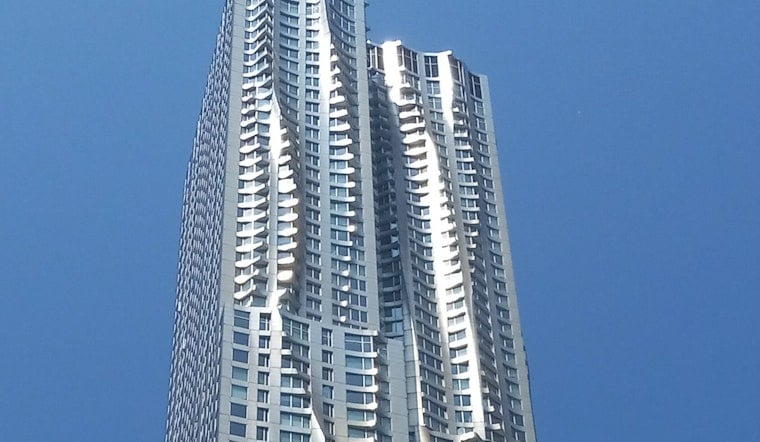
Tenants at Manhattan's 8 Spruce Street have filed a class action lawsuit accusing landlord Blackstone of overcharging renters in the 898-unit rent-stabilized tower by more than $30 million. The suit claims Blackstone calculated renewal rent increases using the building's higher listed rent rather than the lower net rent tenants actually paid, and that in some cases rents jumped by more than 50% year to year.
According to amNewYork, the lawsuit was filed by the nonprofit watchdog group Housing Rights Initiative on behalf of current and former tenants who lived at 8 Spruce Street since September 2020. The suit names Blackstone along with shell management companies it allegedly used to run the building, including BREIT Operating Partnership, 8 Spruce, and Beam Living. Tenants say Blackstone, described in the filing as a trillion-dollar asset management company, offered lower net rents with several months free on some of its more expensive units, then pulled those concessions at lease renewal — a practice the lawsuit alleges is illegal under city law.
Blackstone did not respond to a request for comment from amNewYork.
How the Alleged Scheme Worked
The lawsuit points to specific listings as examples of the practice, including one apartment advertised at $2,960 a month with the first four months free. Tenants say Blackstone then used the higher, undiscounted rent figure — rather than the lower net rent they actually paid — to calculate legal renewal increases, letting the landlord blow past the caps set for rent-stabilized units.
Those caps are not small print. For rent-stabilized lease renewals running between October 2024 and September 2025, the New York City Rent Guidelines Board capped allowable increases at 2.75% for one-year leases and 5.25% for two-year leases, according to the New York City Rent Guidelines Board. Tenants in the suit say they instead accepted year-to-year increases exceeding 50% on their stabilized units — a gap the lawsuit attributes directly to Blackstone's alleged rent-calculation method. According to the NYC Rent Guidelines Board, its mandate covers approximately one million dwelling units subject to rent stabilization citywide.
A Tax Break Tied to Stabilization Promises
Blackstone purchased 8 Spruce Street for $930 million in 2022, and the property has since received more than $115 million in tax credits, per the lawsuit's figures reported by amNewYork. That benefit flows through the city's 421-a program, which requires landlords who take part to keep building apartments rent-stabilized in exchange for the tax break. Housing Rights Initiative says 8 Spruce was committed to having all of its apartments rent-stabilized as a condition of that arrangement. A NYC.gov final report says the city brought 72,000 apartments into compliance with 421-a requirements, including rent stabilization.
The tower's tax abatement is on a stepped schedule: the exemption dropped from 80% to 60% in 2025 and is set to fall to 40% in 2027 before expiring entirely in 2031, according to CoStar. The schedule runs through the abatement's 2031 expiration. Citywide, the 421-a program costs New York roughly $1.7 billion a year in forgone property tax revenue, making it the city's single most expensive residential tax incentive, per Hoodline's earlier reporting on a similar case.
Public Financing Adds to the Scrutiny
The dispute lands against the backdrop of a separate, publicly backed refinancing deal. In December 2024, New York City's Housing Development Corporation issued $550 million in municipal bonds — including $204 million in tax-exempt Liberty Bonds originally created to help rebuild Lower Manhattan after 9/11 — to help Blackstone refinance 8 Spruce Street, according to The Real Deal. That means the same property now facing $30 million in rent overcharge claims also received public financing tools tied to the city's post-9/11 recovery efforts.
Designed by architect Frank Gehry, the 76-story, 870-foot tower opened in February 2011 as the tallest residential skyscraper in the Western Hemisphere at the time. Beyond apartments, it houses a public pre-K-8 school and hospital space, according to background compiled on Wikipedia.
What Tenants Are Asking the Court to Do
The lawsuit seeks a court order barring Blackstone from raising rents in ways that conflict with rent-stabilization laws, along with a correction of all leases to bring them into compliance. Tenants are also asking for an independent entity to audit the rent-stabilized units at 8 Spruce Street and are seeking tens of millions of dollars in rent refunds, reductions, and additional damages.
Housing Rights Initiative executive director Aaron Carr said landlords who cheat on affordable housing tax benefits harm both taxpayers and tenants. The group said Blackstone's rent practices harmed tenants and undermined the integrity of the city's 421-a program, framing the case as part of a broader pattern of landlords using concessions to sidestep stabilization caps.
That pattern has shown up elsewhere in New York courts. In Chernett v. Spruce 1209, LLC, the state's Appellate Division ruled that landlords receiving 421-a benefits cannot register artificially high legal rents while quietly charging tenants lower net rents, treating those discounts as protected preferential rents rather than temporary concessions. The 2019 Housing Stability and Tenant Protection Act reinforced that rule by making preferential rents permanent for the life of a tenancy, and a May 2026 decision in Choi v. Linc LIC L.L.C. also addressed rent concessions.
The 8 Spruce Street case also isn't Housing Rights Initiative's only active fight with a major corporate landlord this year. In August, tenants at Manhattan's 761-unit American Copper Buildings filed a $20 million suit against landlord Black Spruce Management alleging the same core scheme — using temporary rent concessions to dodge 421-a stabilization limits. Housing Rights Initiative has coordinated dozens of similar class actions against major New York landlords.



